Showing posts with label amaterasu. Show all posts

Tuesday, May 1, 2018

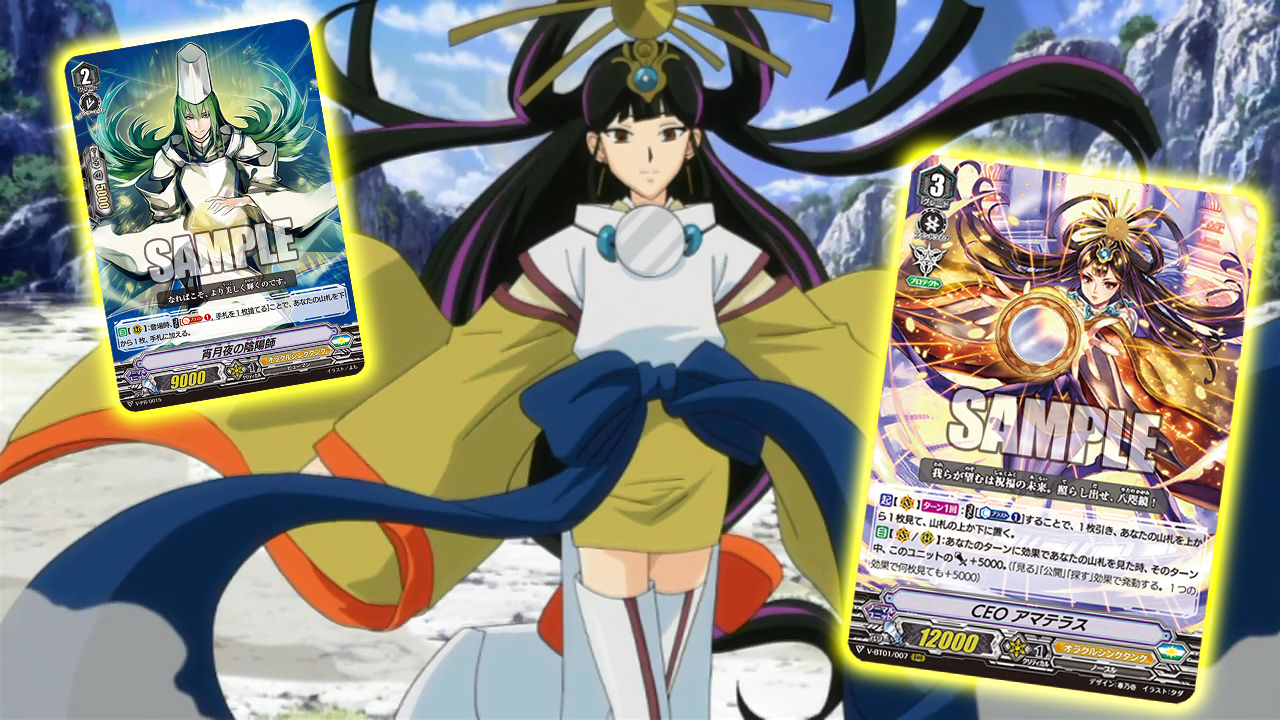
Today's Card Analysis: CEO Amaterasu


The Japanese card of the day for May 2nd, 2018, is our first Oracle Think Tank grade 3 of the Standard format and one of Tokura Misaki's key cards from the anime series, CEO Amaterasu.
ACT [Vanguard Circle]: Once per turn: [Cost: Counterblast 1] Draw 1 card, look at 1 card from the top of your deck, and put it on the top or bottom of your deck.
AUTO [Vanguard/Rearguard Circle]: During your turn, when you look at your deck by one of your effects, this unit gets Power +5000 until end of turn. ("Look at," "Reveal," and "Search" effects will all activate this effect. No matter how many cards you look at with 1 effect, it's still +5000.)
The new Amaterasu is easily one of the most powerful grade 3s revealed, on par with Dragonic Overlord. Just as the grade 3s we've seen up to this week came with Force, and Asura Kaiser yesterday came with Accel, Amaterasu comes with the third and final Imaginary Gift: Protect.

Protect adds a Protect Marker to your hand every time you ride a unit with the Protect ability. This Marker acts as an additional perfect defense card that can stop an opponent's attack from hitting by discarding when you guard with it, and the Marker carries the unique property of having no grade, meaning it cannot be blocked by guard restriction effects. Unlike the other Gifts that interact primarily with the rearguard circles, the Protect Marker cannot even exist outside of the hand or guardian circle, so if moved to another zone it simply returns to your Gift area.

On your first ride the Protect Marker is a net +1 in card advantage, as it represents an additional card gained over what you're expected to spend to reach grade 3. Protect decks have a leg up over Force and Accel because every time they reride for their Gift thereafter, the cost of riding is paid back to them via the additional card they gain. The other types are instead forced to repeatedly commit grade 3s with no immediate return in cards, reducing their overall hand size compared to Protect decks. If the Marker's Sentinel effect isn't helpful at the time (something Draw Trigger perfects make all too real) it can also be used to pay discard costs, giving the Protect Marker greater overall versatility than Accel and Force. One example we already have is Onmyoji of the Moonlit Night, whose skill involves discarding 1 and soulblasting 1 to put the bottom card of your deck into your hand.

This is where Amaterasu's Activate skill comes into play. Not only does she give you a consistent +1 in card advantage every turn, checking the top card of the deck lets you know ahead of time if you're going to get a trigger unit, and if it's instead a card you want to draw you can put it on the bottom and use Onmyoji to fetch it. Her ACT also triggers her autoskill, granting 5000 power for the turn, which is where most of the confusion over today's card has come from.

First, look at this Q&A from the Card of the Day page:
Q: "When looking at the top card of the deck multiple times with the "You may look at the top card of the day, and place it on top" skill of G-BT05/004 "One Who Views the Planet, Globe Magus," will the "When you look at the deck, this unit gets Power +5000 until end of turn." of my rearguard V-BT01/007 "CEO Amaterasu" repeat?"
A: "No, it will not repeat. No matter how many cards you look at with 1 effect, the skill of "CEO Amaterasu" gives +5000 power, so even if you look multiple times the skill of "One Who Views the Planet, Globe Magus," the power increase will only be 5000."
What this means is that when you have a continuous skill that looks at the deck, Amaterasu's vanguard/rearguard skill only checks for if you have used it to look at a card or not, and does not care how many times you've used it or how many cards you've looked at. Things are a little different for automatic and activated skills--with the current wording of the card, every time an effect looks at the deck she gains power. Both the number of times and the quality of actions performed are irrelevant--if you have a card that both reveals the top card(s) of the deck and then searches a card from among them, it's still only +5000 because it's only one effect looking at the deck.

This essentially cuts Amaterasu out of any theoretical infinite loops, but still gives room for her power to climb into incredibly high numbers on both vanguard and rearguard circle. Considering that in the manga--the basis for the upcoming "Origin" anime--Misaki also used Circle Magus and Battle Sister Cocoa, both cards that checked the top card previously, reaching +15k is likely to become a regular occurrence for Oracle Think Tank. Perhaps after all this time, Amaterasu will finally get back at Vortex Dragon.

The last point to consider with regard to Amaterasu in the Standard format is her base power. Like Asura Kaiser before her, Amaterasu is as base 12000 grade 3 rather than the 13k we've come to expect. Unlike Asura she has a somewhat easier time overcoming her lower base thanks to her innate power-gain, which gives her the potential to swing on par with the Force decks of the game.

With this, we are now officially in Golden Week. May 3rd through the 5th are national holidays in Japan; usually no new Card of the Day profiles go up during Golden Week. May 3rd is Constitution Day, commemorating the adoption of Japan's post-World War II constitution, May 4th is Greenery Day, observing environmental awareness (so go hug a Neo Nectar) and May 5th is Children's Day.

The previous Japanese card of the day was Asura Kaiser.

V-Booster Set 01: UNITE! TEAM Q4 will launch in Japan May 25th, 2018, and in English June 22nd, 2018. It will be accompanied by sleeves based on Dragonic Overlord and Blaster Blade. V-Trial Deck 01: Sendou Aichi and V-TD02: Kai Toshiki will launch in Japanese May 11th, 2018, and in English June 8th, 2018. They will be accompanied by a new sleeve based on the "Imaginary Gift" design.

The first Extra Booster set of Standard, V-EB01: The Destructive Roar will launch in Japan June 29th, 2018, and August 3rd for the English-speaking world. The accompanying new anime series, codenamed "Origin," will begin airing May 5th, 2018, on TV Tokyo and affiliated stations. It will be simulcast with English subtitles on YouTube and Crunchyroll.

Saturday, January 5, 2013

Subgroups and Subgroup Support

Subgroups as a mechanic have been around since the first trial decks, and were codified as early as BT03. However, they did not take their modern shape until BT05. In general, subgroups rely on the vanguard having a specific block of text in its name, and target particular units in the subgroup for skills. In this way, subgroups can transcend clan limitations to form viable mixed decks. Tsukuyomi is an early example of the mechanic, using "six or more" text for soul-based units, just as CoCo would succeed her with "do not have any cards in your soul" in 2012. It is generally accepted that the first modern subgroup is the Blaster series as it was completed in BT05, although this was contemporary to the development of other series. While TD01, BT01 and BT04 all had elements that contributed toward a Blaster deck, they lacked the now-definitive rearguards that gain power from having a subgroup-specified vanguard. Without these rearguards, a play style will be just that; a highly developed strategy, but not a true subgroup as became prominent in post-crossride formats.

The difference between a subgroup card and a subgroup support card is that support cards are not strictly necessary for the deck, but instead exist as outliers that make it stronger. These units specify a general characteristic like "Blaster" being in the name, or "six or more soul" while the actual subgroup cards will specify unit names like "Blaster Blade" or "Goddess of the Full Moon, Tsukuyomi" instead of listing a generic element of the card. There is some room for interpretation here, since some cards that would normally be considered subgroup cards are grandfathered into subgroup support because they predate modern wordings, and vice versa. Below is a list of examples of subgroup and subgroup support units, using the Blaster subgroup as the base for showing what this mechanic looks like.
Examples of Subgroup Support Cards
Wingal Brave
Knight of Friendship, Kay
Apocalypse Bat
Knight of Loyalty, Bedivere
Knight of the Void, Masquerade
Starcall Trumpeter
Examples of Subgroup Cards
Barcgal
Fullbau
Blaster Javelin
Blaster Blade
Blaster Dark
Demon World Castle, DonnerSchlag
Blaster Keroro
Blaster Keroro Dark
Solitary Knight, Gancelot
Phantom Blaster Dragon
Majesty Lord Blaster
Phantom Blaster Overlord
Blaster Blade Burst
Sometimes, subgroups overlap. For example, Phantom Blaster Overlord is able to receive support from both Blaster cards like Wingal Brave and Knight of the Void Masquerade, and from Overlord cards like Flame of Promise Aermo and Burning Horn Dragon.

With all this support, this question surrounding subgroups is, "How do we run subgroup support cards?" Japan has had the better part of two years to develop, playtest with and codify subgroup decks, and using the example above, the model below has become the standardized framework.
Grade 0
x1 Wingal Brave
Grade 1
x4 Knight of Friendship, Kay
Grade 2
x1 Knight of Loyalty, Bedivere
Grade 3
x1 Solitary Knight, Gancelot
While it's important to continue innovating and finding new ways to integrate these cards, this is the model currently in vogue. The first thing to notice regarding the model is that it can be easily adapted to other subgroups, as seen when applied to a BT09-based Amaterasu deck;
Grade 0
x1 Supple Bamboo Princess, Kaguya
Grade 1
x4 Battle Maiden, Sayorihime
Grade 2
x1 Battle Deity, Susanoo
Of course, there are key differences. Kaguya is in no way a perfect equivalent to Wingal Brave, nor is there a Gancelot for Amaterasu. Not every subgroup will play like every other subgroup, nor does every subgroup have access to both a Kay and Bedivere, so the canon of support cards requires adjusting from clan to clan. However, this is a good starting point for those just trying out subgroups for the first time, and as a stable, time-proven framework it can be a springboard for stabilizing one's own take on a particular deck.

The crossing of clan boundaries means that occasionally, some units from one clan can fill the gaps in another. For example, the framework can be adjusted to a Shadow Paladin-based Blaster deck;
Grade 0
x1 Fullbau
Grade 1
x4 Knight of Friendship, Kay
Grade 2
x1 Knight of the Void, Masquerade
In this example, Kay fills in for the Shadow Paladin's lack of an equivalent unit. Because Kay only specifies a vanguard with "Blaster" in its name, not a Royal Paladin with "Blaster" in its name, Kay can be safely integrated by himself without making a strong impact on the deck's consistency, synergy or the rate at which it activates triggers. Likewise, Royal Paladin Blaster decks can make the somewhat riskier move of integrating Apocalypse Bat into their build, although this particular decision has not done well in the pro scene and isn't considered part of the mainstream framework. Integrating units of overlapping subgroup is then one way to improve the synergy of a deck that uses multiple clans.
List of Subgroups, Chronologically
Blaster (Royal Paladin - Shadow Paladin)
6-Soul/Goddess of the Full Moon, Tsukuyomi (Oracle Think Tank)
Overlord (Shadow Paladin - Kagerou)
Machining (Megacolony)
Ezel (Gold Paladin)
Beast Deity (Nova Grappler)
Dudley (Spike Brothers)
Soulless/Scarlet Witch, CoCo (Oracle Think Tank)
Lox (Great Nature)
Amaterasu (Oracle Think Tank)
Maelstrom (Aqua Force)
Dimensional Robo/Daiyusha (Dimension Police)
Battle Sister (Oracle Think Tank)
Vermillion (Narukami - Dark Irregulars)
Liberator (Gold Paladin)
Eradicator (Narukami)