Showing posts with label dauntless drive dragon. Show all posts

Thursday, August 7, 2014

Study Guide: Kagerou in 2014

The idea of going into a 96-person best-of-three pro tournament and coming out of it virtually unscathed, undefeated in sets, sixteen wins to one loss was once unthinkable. Many cardfighters struggle just to make it to 16-8 under the same circumstances. It is exceedingly difficult to not give in to some kind of exploitable weakness and have a game taken each round, even assuming that one tops without losing any sets. But this was the story of faruke, one of the first cardfighters to make a strong showing with the grade 4 Dragonic Nouvelle Vague just after Kagerou was hit with Japan's January 2014 restricted list. It was this display which testified to Nouvelle's status as the best deck in format for Japanese professional play, and internationally we are still seeing the influence of this play out in the English-language game. We will continue to see it for some time to come, and both for Kagerou cardfighters seeking to either main Nouvelle Vague or an alternative Kagerou build, and for other fighters intending to compete with other clans it is necessary to fully understand the strengths and weaknesses of Dragonic Nouvelle Vague. Having a Nouvelle matchup is how you compete in 2014, and once you have a way to fight it the rest of your matchups will write themselves.
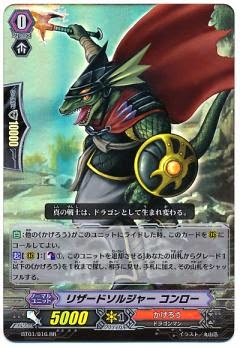
Before proceeding, there are several tools that you should be aware of that make virtually any Kagerou deck better. Some of these go as far back as the very first trial deck; one of the primary reasons that Kagerou has endured for so many years as one of the most competitive clans is because of the massive amount of strong, amorphous support they've received that can be reasonably mixed into almost any deck. Lizard Soldier Conroe is considered the optimal first vanguard for the clan in most situations because being able to pay counterblast 1 and retire him to search for any grade 1 allows you to effectively tech a wide variety of grade 1 units both for their utility and aggression, or simply guarantee yourself a perfect defense card at any time. However, as of August 20th Conroe will be restricted from being placed as the first vanguard.

This necessitates the use of an alternative first vanguard, and most fighters default to Red Pulse Dracokid. Red Pulse is a grade 3 searcher, counterblast 1 to go into the soul and look at the top 5 cards for a grade 3 or greater Kagerou, and it's his ability to target both grade 3s and 4s that make him useful to nearly any deck. While grade 3 searchers have been criticized for having a success rate in the ballpark of 30%, it's important that their skills shuffle the deck afterwards. If your grade 3 or 4 wasn't in the top 5 cards of the deck then it's foreseeable that you would not be able to ride to that grade on the next turn regardless, so by shuffling the deck Red Pulse tries for a game state where you will draw either of those grades.

The primary grade 3 around which most strategies for this clan hinge is the break ride Dauntless Drive Dragon. When ridden over with another Kagerou, Dauntless gives that unit the standard +10000 power boost and a skill that lets you restand your vanguard after it attacks as long as it hasn't already stood before, by discarding 3 cards. Counting both the additional grade 3 you have to ride and that this skill takes away three cards but only gives two back with the second twin drive, overall Dauntless is a -2 and so unlike many break rides will gradually kill you as you ride successively more copies of it, but the intention of the card's design is that the restanding skill be so devastating to the opponent that the -2 is reasonable. You should take more cards away with multiple attacks than you are losing. So you want to be able to break ride over Dauntless just once or twice, then immediately form an effective endgame turtling strategy to secure your victory.

Berserk Dragon
The key supporting units that can improve your deck are Berserk Dragon and Bellicosity Dragon. Either of these cards could make or break the effectiveness of another clan alone, and together they're a dangerous combination. Berserk's cost is counterblast 2 to retire an opponent's grade 2 or lower unit, while Bellicosity can unflip a card when his attack hits the vanguard, making him an ideal grade 2 ride since he can effectively compensate for Berserk or Conroe.

Bellicosity Dragon
Controlling the backrow is usually considered much better than controlling the front because retiring backrow units requires the opponent to dedicate exponentially more shield to the field over time where frontrow units can intercept, but situationally you will find it helpful to curb the opponent's aggression by doing things like retiring a 10000-power grade 2 with Berserk's skill and then using him to attack a 9000-power unit in the other lane. Bellicosity keeps the damage zone open and usable, which is more important for Nouvelle than other decks because it is not a deck where you are constantly at limit break-level damage and so being able to budget within three counterblast is a game all its own.

A good Kagerou deck will tend to balance between four and six draw triggers with criticals to compensate for a lack of direct searching in a post-Conroe format, and Gattling Claw Dragon is easily their most important draw trigger. Gattling's skill is to counterblast 1 and move into the soul to retire an opponent's grade 0 rearguard, and this is an example of one of the myriad reasons Kagerou has stayed such a consistently good clan over the years. It does more for taking the same actions than other decks of comparable support. Drive checking triggers can be considered one of the many standard parts of a deck existing in play, and in that regard Kagerou does more just by existing than its contemporaries. Gattling increases your card advantage by 1 when you drive check him, then by using his skill next turn you retire the opponent's first vanguard and have a net change of +/-0 compared to their -1.

The last important supporting element in generic Kagerou is a card that was intended to be specific to one subclan but because of its conditions can be used in any Kagerou deck. Seal Dragon Kersey is a grade 1 that allows you to discard a card when placed on a rearguard circle if the opponent has a grade 2 on their field. Kersey is considered superior to the clan's other card changer, Dragon Monk Gojo, because Gojo requires himself to be rested to use his skill while you will still get Kersey's boost after card changing. This lets you dispose of excess Gattling Claws or other drive checked cards, concealing your hand from your opponent and trading out less useful units for others of either the same or greater utility.

Moving into the cards introduced by VGE-EB09: Divine Dragon Progression, consider Nouvelle himself. Dragonic Nouvelle Vague is the standard by which not just all Kagerou decks in 2014 must live up to, but is the standard by which all professional decks must compete. If you cannot plan for and play against the Nouvelle matchup, you are not ready to be playing in a pro setting this year. Unlike every other boss card in the format, DNV's game is defined not by its limit break but by its innate skills. The unit has been said to remove chance from the game without reintroducing a proportionate amount of skill, and any one of its unique abilities could have easily been a boss card in its own right. When Nouvelle attacks the vanguard it cannot be guarded using grade 0 units from the hand, removing the primary means of defending oneself from the game, and all of the defending player's trigger effects are cancelled during the Nouvelle cardfighter's turn. This means that the benefits of defensive triggers cannot be received, including draw effects, and most importantly if a sixth damage is taken during the opponent's turn there is no way to heal out of it. DNV controlling the ability to defend oneself is easily the most dangerous aspect of it, while everything else is complementary fluff.
Nouvelle in the Cardfight!! Vanguard manga
Dragon Knight Ashgar
As a grade 4 unit Nouvelle Vague boasts a 13000 power base, giving defensive power equal to that of a crossride without demanding specific units to be in the soul. Blocking grade 0 units means that even an unboosted Nouvelle requires two cards to be put down for a two triggers to pass defense, but his grade 1 especial booster Dragon Knight Ashgar, makes this a 23000 power total and can be searched as early as turn 2 by Conroe. With any grade 0s in the hand being dead, guard options against such a line are limited to perfect defense, Quintet Wall, or dropping four 5000-shield grade 1~2 units for two to pass. In the rearguard DNV drops down to 12000 power, but Ashgar's boost is applicable to both vanguard and rearguard Nouvelles, making DNV arguably the best overall unit in the deck regardless of where it is placed.

Depending on the tempo of the fight however, a rearguard Nouvelle may never be seen. This is because Dragonic Nouvelle Vague's limit break is a persona blast; for counterblast 3, soulblast 3 and by discarding a copy of Nouvelle, all of the opponent's rearguards can be retired. Originally intended as an incentive for Nouvelle cardfighters to run four copies of the grade 4 instead of just two as had been seen in grade 4 playtesting with Epitome of Knowledge Silvest, the persona blast is often regarded as an incentive gone completely out of control. Achieving a total field wipe can make it impossible for the opponent to fight back at all, crippling setup-heavy decks like Aqua Force and Beast Deity builds, and coming back from extremely poor situations with a game-deciding limit break. Rather than considering this skill from an advantage perspective, it may be helpful to look at it from the angle of how many turns it takes to set up a field. It effectively puts the Nouvelle Vague cardfighter ahead one turn for each unit retired. The persona blast is the reason that a gradelocked Nouvelle fighter cannot be said to be totally out of a game, because the moment the skill goes off it puts Nouvelle five turns ahead by destroying that many turns' worth of drawing.

Nouvelle's major drawback of not actually being a grade 3 unit that can be ridden from grade 2 can also be partially mitigated with the grade 1 Nouvelleroman Dragon, who can send a Nouvelle Vague into the deck when ridden or called to search for any grade 3 Kagerou. Roman is how Nouvelle Vague has been treated as if it were a grade 3 in deckbuilding, and the biggest wall between DNV fighters and gradelock. Given that each of Nouvelle's attacks blocks grade 0 units, there's inherent synergy between Nouvelleroman, the grade 4 himself and Kagerou's restanding break ride Dauntless Drive. The more attacks Nouvelle gets in per turn, the more attacks the opponent has to block without using grade 0s, pushing them steadily behind in card advantage and working to that key moment when there are nothing but 0s in their hand.

Nouvelle's grade 2 lineup is usually rounded out by Demonic Dragon Berserker Kumbhanda and Nouvellecritic Dragon. Kumbhanda is a normal base 8000 grade 2 that becomes an 11000-power attacker if the vanguard has a limit break icon, and is standardized in most Kagerou decks that are not Seal Dragon or purely Dauntless based. Nouvellecritic is more interesting, acting like a Nouvelle-specific Berserk Dragon. When called or ridden Critic can counterblast 1 and reveal a Dragonic Nouvelle Vague in hand to retire any of the opponent's rearguards, eliminating key units while punishing them for trying to put together a strategy. By conserving more counterblast than Berserk, Nouvellecritic is overall healthier for the progression of Vague's game and keeping the damage zone open, and puts the field control abilities of other decks to shame by giving the deck two different options for destruction.

Overall Nouvelle Vague is a powerful format-defining deck that combines overwhelming control over the pace of the game with excellent resource management and hyperaggressive endgame pushes with a restanding vanguard that manipulates the opponent's defense, edging on being the best deck in the format. And in its favor, aside from Dauntless Drive most of the Nouvelle deck is compressed into VGE-EB09: Divine Dragon Progression, which greatly expedites assembly. It is far from the only deck worth consideration and faces severe competition from within its own clan, and as the "final boss" of Vanguard defeating it can be its own reward. It does not totally eliminate any particular decks from play as Chaos Breaker Dragon once did, but you cannot build in 2014 without accounting for the Nouvelle matchup. To do so would be like trying to ignore the existence of the sun.

Accounting for the clan as a whole Kagerou at present has three options for perfect defense cards split between BT01's Wyvern Guard Barri, BT11's Seal Dragon Rinocross and EB09's Dragon Dancer Maria. Maria is easily the cheapest option among these because of her recent release in an extra booster set, but Rinocross is desirable for Seal Dragon cardfighters because of their need for Seal Dragon-specific counterblast.

Divine Dragon Progression has also introduced several alternative grade 3 options. Of particular note is Blast Bulk Dragon, formerly known to his English-speaking fan following as Barky. Like Nouvelle, Barky is considered dangerous even before limit break, because his autoskill gives him +5000 power whenever his critical is two or greater, turning every critical trigger check into two triggers. This makes guarding Barky extremely tricky, because in normal calculations he behaves as if he always has an additional +5000 power over whatever his current swing is. Note that the +5000 power lasts until the end of the turn but cannot be stacked, so if you attack with Barky after break riding over Dauntless Drive and his critical increases then his next attack after restanding will have 26000 power rather than 21000. Barky's limit break is to counterblast 1 and discard a card for +5000 power and +1 critical until the end of the battle, making him a constant 21000 power 2 critical lane.

The other new grade 3 introduced by the set is Cruel Dragon, who was originally designed as Nouvelle support and so can either function in DNV or as his own build. Prior to limit break, Cruel's superior ride skill allows it to be ridden by resting your grade 2 vanguard when an opponent's card is put into the drop zone during the main phase, after which Cruel will ride in the standing position but with -3000 power for the rest of the turn. So Cruel will drop down to an 8000 power base to attack with effectively the same power as a grade 2, but with the benefit of twin drive to give an extra card over what is normal for that point in the game.

Cruel's limit break is to counterblast 1 and soulblast 1 when it attacks a vanguard to retire an opponent's grade 2 or lower unit, incurring a -1 against the opponent while controlling the field with a cheaper Berserk Dragon effect. The soulblast requirement normally limits Cruel to twice per game, but with Conroe out and Red Pulse in this can increase to three times per game, and it can also work in tandem with Gattling Claw's main phase effect or that of Seal Dragon Artpique. The skill is not as dominatingly aggressive as DNV, but note that if you forego the superior ride it can also combo with Dauntless' restanding skill to retire two cards in a turn and effectively force the opponent to lose as many cards as you do for break riding.
Cruel Dragon in the Cardfight!! Vanguard manga.
Cruel synergizes well with Nouvelle Vague because you can combo his skill with Nouvellecritic's and ride your grade 4 on the next turn while negating the extra -2 taken from riding one more unit than normal with his early twin drive. This is how Nouvelle was originally designed to be run prior to Dauntless Drive's design, and it allows you to secure your grade 4 ride a turn earlier. For this reason many diehard Japanese cardfighters have sworn by their Cruel Dragon techs even in builds that do use Dauntless Drive, because Nouvelleroman makes a single copy of Cruel so easily searched that it lets the deck adjust as necessary for the pace of each fight.

A direct competitor to DNV exists in VGE-BT14: Brilliant Strike's Dauntless Dominate Dragon "Яeverse," which is more field control-centric than Nouvelle with less opportunity to be gradelocked at 2 but in exchange a less stable 13000 base. Being one of the units that was Яeversed by the invading forces of Link Joker, Dauntless Dominate's strategy is based around temporarily sacrificing one's own rearguards by locking them in order to gain overwhelming power. Like most crossbreak rides, Dauntless "Яeverse" has strong breakride synergy. Once per turn during the main phase, his limit break 4 locks one of your own rearguards to receive an autoskill, so that when he drive checks a grade 1 or greater Kagerou during the battle phase one of the opponent's grade 1 or lesser rearguards can be retired, and Dauntless Dominate receives +3000 power. Acting like the new and improved Dragon Monk Goku, Dauntless "Яeverse" compensates for poor trigger checks by turning them into good ones, getting "half a trigger" in power whenever he checks a nontrigger units and giving the opponent a -1 in card advantage.

With Dauntless Drive's breakride skill you can simply sacrifice Dauntless' booster for the lock cost, and being able to restand for that turn means getting twice the chances to retire the opponent's rearguards. After potentially taking out 2~3 units and powering up your own with trigger checks, you can then go into a defensive game with his 13000 base when the opponent's field is already crippled and not well prepared to make lanes that can even hit the vanguard, much less create 18000 power lanes. This is one of the best ways to contend against both Nouvelle and Chaos Breaker in the current format, as assaulting the opponent's field is one of the few ways to reliably deal with either deck. Dauntless "Яeverse" is thus one of the strongest contenders within the clan for the Kagerou throne, and his bevy of support from BT14 assists that.

In particular DDЯ does not make use of the soul, which opens the door towards a playset of Calamity Tower Wyvern. Introduced in the same set, Calamity Tower is a Luck Bird clone that can soulblast 2 when called to draw a card, building advantage and making him into a safe lock target.

DDЯ also has room for an alternative first vanguard to Red Pulse, Dragon Knight Sadegh. Sadegh's skill places him into the soul when an opponent's unit is retired, and in exchange forces the opponent to retire another of their rearguards, which when combo'd with DDЯ's limit break and Calamity Tower over two turns can make a net change of +/-0 on your end to the opponent's -3 cards. Berserk Dragon can also capitalize on Sadegh, but as counterblast is important in this build and DDЯ has his own grade 2 subclan attacker in Dominate Drive Dragon, space may be too tight for this particular combo.

The Seal Dragons are the corner of Kagerou that is in the most need of renovation. Made up of prisoners from Kagerou's Magma Prison temporarily put on parole in exchange for fighting the Link Joker invaders, the subclan has the bare minimum of grade 1 and 2 subclan attackers and unique skills at every grade, but lacks a strong core grade 3 lineup and suffers from needing Seal Dragon-specific counterblast in a deck that is mostly not Seal Dragons. Their first vanguard is Seal Dragon, Terrycloth. Once a revolutionary that rebelled against the empire, Terrycloth in his sealed form has had his body and magic rewound three thousand years. While that seal is in theory indefinite and meant to assist a life sentence, Terrycloth still has access to some of his magical power. His especial counterblast places him into the soul, then retires an opponent's rearguard; the opponent can then look at up to four cards from the top of their deck and superior call 1. Note that even if the opponent chooses to look at up to zero, they still have to shuffle their deck, so this ruins the deck stacking strategies of Tsukuyomi and Mandalalord.

Also note that Terrycloth is the key to a specific Seal Dragon combo. The majority of Seal Dragons specialize in retiring units for cheaper costs than standard Kagerou cards would pay to retire any unit, attempting to pay less and then gamble that the opponent does not get a grade 2 off the top of their deck. These cards can retire any unit, allowing you to force the opponent to replace a grade 0 or 1 in a boosting position with a grade 2, which locks up their field. Furthermore, the Vanishing Field skill of this deck's key card prevents the opponent from intercepting, which completes the lock by forcing them to guarantee you a cheap retire by removing the grade 2 that your skill called. The point to be wary about with Seal Dragon retire skills is that they will also activate "when this unit is called" autoskills; so you could for example, end up superior calling a Blaster Blade that then retires one of your units, or a Nemain that reinforces the opponent's hand, or even end up helping the opponent to superior ride on your turn by calling a Lop Ear Shooter that they then combo with Pellinore. There's a lot of risk involved with sealed magic, and part of the reason that the magic of these cards is forbidden in the first place is because it operates in a completely different way from every other skill type in the game.

Corduroy is the star of this build's grade 2s. An insane dragon, Corduroy was dissatisfied with run-of-the-mill dragon magic and turned to investigating the cursed black arts to feed his unending greed. When called or ridden he can counterblast 1 Seal Dragon to retire one of the opponent's rearguards, and from there the skill operates exactly the same as Terrycloth. This is important because while Terrycloth interacts as turning your advantage from +1 to 0 to either give the opponent a -1 or -0 with weaker field setup, Corduroy is always a -1 or -0 to the opponent without giving an inherent loss to your own advantage.

The vanguard that once served as the basis of the deck is Seal Dragon, Blockade. While he only has a 10000 power base in a clan of 11000-power units, Blockade's Vanishing Field stops the opponent from intercepting during your own turn. Blockade himself has two forms. In his sealed form the Vanishing Field can only be momentarily expressed, but VGE-BT11: Seal Dragons Unleashed opened up the ability to unseal the original Sealed Dragon. In his crossridden form as Hellfire Seal Dragon Blockade Inferno, his cursed magic runs wild and the Vanishing Field with that. Inferno's limit break is to counterblast 2 Seal Dragons, then retire all of the opponent's grade 2 rearguards and get +10000 power until the end of turn. The setup that has been established thus far is to use Terrycloth and Corduroy to retire the opponent's grade 1 and grade 0 units, replacing them with grade 2s that help lock down the field, then keep them trapped there with Blockade. After crossriding Blockade Inferno, you then take advantage of this through his especial counterblast to destroy those units that you locked into the opponent's field, giving them up to a -3 in a good game and potential field wipe on the extreme end.

VG-BT14: Brilliant Strike brings with it both a new grade 2 for the Seal Dragons and their Lock Break campaign promo, Seal Dragon Georgette. Prior to limit break Georgette has a main phase counterblast 1 to unlock one of the rearguards, carving out a specific and somewhat redundant niche for Seal Dragons as the anti-Link Joker branch of Kagerou. While DNV already overwhelms Chaos Breaker handily, both CBD and the upcoming Glendios have terrible matchups with Georgette because he effectively makes any reductions in CBD and Glendios' advantage permanent by making all of the cards they discarded and put into the soul to lock, relock and omega lock units wasted and shuts down both limit breaks for cheap. Meanwhile Georgette's limit break automatically gives him +5000 power for each of the opponent's grade 2 rearguards when he attacks the vanguard, and an additional critical if they have two or more in play. This puts Georgette on par with Barky for being a strong power and critical boss card, and further cements his status as an anti-Link Joker unit by making him into a devastating independent swing.

The grade 2 Flame Star Seal Dragon Knight is considerably less impressive, counterblasting 1 when called to prevent the opponent's units from intercepting. It is important that Seal Dragon Knight does not require Seal Dragon counterblast to use his skill, and with the original Blockade potentially out of the deck in favor of Georgette blocking the opponent's intercepts is a useful way to keep grade 2s around to activate the deck's other skills.

In December VGE-FC02: Fighter's Collection 2014 is to introduce their next major boss card, Hellfire Seal Dragon Weathercloth. Weathercloth's breakride skill is to give the vanguard +10000 power and to retire two of the opponent's rearguards when ridden, with no counterblast cost. The opponent then looks at the top 4 cards of their deck for up to two grade 2 units and calls them, and because this is only two checks from four cards rather than two checks from eight, they are much less likely to be able to hit two replacements than they would with Corduroy or Terrycloth.

Weathercloth and Georgette are the kind of boss cards that Seal Dragons need. In conjunction with Blockade Inferno's limit break he creates a 31000 power center lane and has the potential to completely wipe their field, for effectively 2 counterblast and a -1. With Georgette, Weathercloth makes up for the lack of direct retiring attached to Georgette himself and strongly supports his own innate skill, making a center lane in the range of ~36000 power 2 critical before boosting and ~43000 afterwards. The main problem with the Blockade Inferno build at this time is whether or not his skill is enough to finish the opponent off and reign the game in. Arguably other late-game power pumps like Gancelot Zenith and Dragruler Phantom do even less than this the further the game goes on, so many fighters would say that this is enough to put Seal Dragons in contention for DNV's throne, but Georgette provides them an extra boost that helps define them in a different direction and in that way compete.

On September 19th we're due for the release of VGE-BT15: Infinite Rebirth and the rise of Kagerou's second Яeverse card, Dragonic Overlord "The Яe-birth." While the cornerstone of the deck is a restanding strategy, unlike Dauntless the goal of "The Яe-birth" is to fight totally alone by sacrificing the entire field to stand as many times as possible and rack up multiple trigger checks. "The Яe-birth's"limit break 4 is to counterblast 1 and lock Kagerou rearguards until you have five locked cards in play; this gives DOTЯ +10000 power and the ability to restand by discarding two cards after it attacks the vanguard. In combination with a break ride this guarantees DOTЯ a 31000 power base to work off of and six drive checks, and is equivalent to giving the entire field twin drive.

Dragonic Overlord "The Яe-birth" is one of the only cards in the game to be both a crossride and a crossbreak ride, as there are two cards that qualify his continuous +2000 power. The first is the original Dragonic Overlord introduced in VG-TD02: Raging Dragon of the Empire and VG-BT01: Descent of the King of Knights, but the second is a new break ride with the same name introduced by BT15.

Like many alternate break rides given to other clans, the break ride incarnation of Dragonic Overlord comes with a counterblast 1 cost attached, but the timing for it is unorthodox. When ridden, Overlord gives the vanguard +10000 power and an autoskill which allows it to counterblast 1 and discard a card after attacking a rearguard to restand. So while DOTЯ's restand is an exchange of +0/-0 whose effect on the game is wholly dependent on how heavily it damages the opponent's defense, break ride Overlord's is a +1 that negates the -1 of riding over him, but also incurs a -1 against the opponent to work the individual battle in your favor. There was once some debate among "The Яe-birth" cardfighters regarding whether it would be better to run DOTЯ with Dragonic Overlord or to forgo the crossride entirely and use Dauntless Drive to get in three attacks against the vanguard, but the final print of "The Яe-birth" prevents its skill from being used if the cost was not paid after it attacks.

The break ride reimagining of the original Overlord has other consequences. While it doesn't synergize well with Seal Dragons, who are likely to not have an opposing frontrow to attack, one of the noted features of the new Overlord is that it makes the old standby Dragonic Overlord the End into a crossbreak ride. DOTE's persona blast is a familiar element to the game, restanding it whenever its attack hits, and this has been historically devastating when used in combination with Dauntless Drive Dragon because it puts the opponent in a world of bad decisions, but the new Overlord is a strong improvement by returning his defense to him and enabling his skill to be more powerful than ever.

While neither DO nor DOTE have stipulations demanding that they must not have stood previously, their skill interaction is made more complicated by sensitive timing. Overlord's break ride skill only activates when the broke ridden unit attacks a rearguard for the first time; if the cost is not paid and the vanguard restands by another skill, then like with Galaxy Blaukluger because of the clause "(Even if you do not pay the cost, this ability cannot be used for the rest of that turn.)" Dragonic Overlord's skill will not be usable. So while the End and Dragonic Overlord's skills may both be used in the same turn, they must proceed in the order of Dragonic Overlord followed by the End even if their first attack is not defended. What this means is that the best option for the opponent is also the scenario in which they lose the most cards, no-guarding the rearguard attack and then dropping a perfect defense or greater when the End's next attack comes down. If the opponent chooses not to guard the End's second attack then they are conceding to staring down a third vanguard attack in addition to the still-standing rearguard lanes and giving DOTE a +1 where "The Яe-birth" merely breaks even. Dragonic Overlord as a break ride thus solves the problem faced by Dauntless Drive Dragon, that the exchange was 'solved' by being at two to three damage. Versus a crossbreaken the End, it's better to be at higher damage and a later stage of the game that justifies dropping a perfect defense than at lower damage where one is enabling the additional drive checks. At low damage it becomes a paradoxically necessary play for the End's opponent to let their rearguard go and allow the End to hit so that they only guard the last attack that DOTE makes on that turn, giving the End an overall +1 and the opponent a -3. The alternative is losing out on limit break during a crucial endgame stage of the fight, giving the Overlord fighter more time to recover and going into their next turn still at lower damage and still vulnerable to the End's persona blast. DOTE's midgame vanishes more quickly the sooner its attack hits.

The chief problem for all Overlord decks is that their strategies peter out after their break ride turns. This is more of a problem for the End than it is for "The Яe-birth" because the End becomes a vanilla crossride once his counterblast is spent. "The Яe-birth" can still repeat his limit break each turn to make two 23000 power attacks, preserving quality over time and scoring multiple drive checks, but faces problems with gradually approaching a deck-out the longer that the game drags on, and that his limit break may not always be superior to simply attacking with three lanes instead of one twice. "The Яe-birth" also has a notably poor matchup against Star-vader “Ω” Glendios because its requirement to lock all of the rearguards can walk right into Glendios' alternate win condition of having all of the rearguards locked, but only if Glendios reaches its main phase with five damage. Because DOTЯ does not make use of its rearguards very much, a Glendios cardfighter at four damage is liable to be trapped that way for the rest of the game, as the DOTЯ fighter will not be putting them to five with their rearguards. The matchup is thus not as bad as it may appear initially, although it is important to note that if all of the rearguards remain locked through Glendios' omega lock skill, DOTЯ may not use his limit break because at least one rearguard needs to be unlocked before the cost is paid in order to initiate it.

BT15 introduces two cards that support Overlord units directly. Eternal Bringer Griffin is an updated Doom Bringer Griffin, reimagined as a grade 1 that can discard any Kagerou grade 3 to search the deck for a card named Dragonic Overlord and add it to hand, helping to secure your vital break ride turn.

This also connects to the skill of Dragonic Burnout, another modified Berserk Dragon. Burnout's skill is to soulblast 1 when called and return any Overlord from the drop zone to the bottom of the deck to retire an opponent's rearguard. Like Nouvellecritic, there are no restrictions on Burnout's possible targets. This helps support a stronger endgame for the End after its break ride turn is over, capitalizing on his crossride defense by destroying the opponent's 18000 power lines and protecting the vanguard while the opponent struggles to recover from being crippled by the break ride turn.

The overall goal of "The Яe-birth" is to use the entire field as a tool to support the lone vanguard, making great use of Calamity Tower Wyvern, Dragonic Burnout, Gattling Claw and Berserk Dragon and then locking all of them to initiate a strong crossbЯeak ride turn that exhausts the opponent's defenses with its restanding strategy. While it has never been as dominant as Nouvelle, the various Overlord decks are strong contenders and have even seen mixed play with Nouvelle in Japan's post-Legion format as an effective means of piggybacking the old deck.

While Kagerou has always been one of the most well-supported clans, 2014 has a much stronger showing of support over previous years, and the rise of the Legion format in 2015 will mark a temporary dry spell for them until the arrival of the Perdition Dragons in BT17. With at least five distinct decks available that each occupy their own place in professional play, the clan is one of the best choices for cardfighters in 2014, both casual and competitive.

Wednesday, April 9, 2014

Spotlight: Almeida Stewart

Fighter's Spotlight is an ongoing project concerned with tracking real-world professional cardfighters across the globe.
Almeida Stewart (far left) with Albert Lee, Adwin Leong and Kevin Lang. Original photo by Cardfight!! Vanguard USA.
Almeida Stewart
Titles Won: Belgium Regional Champion, European National Champion, World Champion (2013)
Current Status: World Champion (2013)
Deck Type: Kagerou (Dragonic Overlord), Gold Paladin (Great Silver Wolf), Aqua Force (Genovius)
Almeida Stewart is the second Cardfight!! Vanguard world champion, having formally succeeded his predecessor Brandon Smith on January 12, 2014. Although originally celebrated at his ascension, subsequent cheating scandals disgraced his reputation as a professional cardfighter within the community.

An eclectic player who had experience with many different clans, Stewart first made an appearance at the 2013 Belgium regional qualifier, taking first place with a Dragonic Overlord the End deck that would go on to be one of the mainstays of his emerging career. Stewart's qualifier had a turnout of 81 persons, which was relatively high for a European tournament but small compared to the size of regionals abroad. For the national finals he chose to play a Gold Paladin deck, coming out as the European national champion with using a Gancelot-Garmore Gold Paladin deck, and in the WCS2013 finals Stewart put Luxembourg on the map for professional play by becoming world champion with a modified Overlord build. As this was at a time when Kagerou had largely fallen out of favor in the international pro scene and was almost wholly replaced by Eradicator Dragonic Descendant, Stewart's decision to play a more deliberate DOTE than what had dominated in previous world championship qualifiers proved highly effective versus the rest of the world's top 8, then comprised entirely of Eradicator cardfighters save for one other player. Stewart made it to the top 2 with this other fighter, Albert Lee, who had been playing a Nova Grappler Beast Deity deck. Although the recordings of their games have not been made available to the public, Stewart achieved considerable fame for winning the world championship with an otherwise abandoned deck.

Stewart also did well in underground play, placing first in the March 9th BeNeLux tournament, at the time one of the larger unofficial tournaments of the Belgium-Netherlands-Luxembourg circuit.

In 2014 it came to light that Stewart was a repeat-offense cheater both in local tournaments and in professional play; individuals close to him came forward to Cardfight Pro with testimony against Stewart during the Paris regional qualifiers, and his fingerprints were later connected by the Luxembourg police with a robbery at card shop La Caverne du Gobelin on top of the existing accusations. Allegedly one of Stewart's personal mottos at the time  was "If you cheat, cheat good," and he favored draw triggers on in his decks so that he could touch them more frequently to stack the cards. Video footage from the Paris qualifier supposedly proved him stacking his deck on stream, but this footage was turned out by the organizers to Bushiroad without being disclosed to the general public, and Bushiroad later denied its existence. After his team was connected to the robbery at La Caverne, Stewart formally apologized, returned the stolen merchandise, and was banned for life from the card shop. Bushiroad has never instigated a further investigation of Stewart, nor issued any sanction against him for his behavior.

Decks and Play Style
Stewart's playstyle was marked by a heavy overall focus on draw power, consistency and acceleration, as auxiliary support for his deck's core strategy. He once commented that he played four draw triggers in his Aqua Force deck "because Aqua Force only has four." He tended to favor trigger lineups that ran six draw and six critical triggers, and card changing units to exchange the draw triggers after he'd checked them.

The Overlord decklist that Stewart won Belgium with is generally in line with the majority of DOTE decks being played in that era; by crossriding Dragonic Overlord the End over Dragonic Overlord, Stewart set up a base 13000 defense that allows standard 16000-power lines to be blocked with a single 5000 shield, while also creating a 21~23000 power vanguard line with either Embodiment of Armor Bahr or Flame of Promise Aermo. If the End's attack hit, his persona blast skill allowed him to stand for a +1 in card advantage and two extra drive checks, which in combination caould snowball into a high-power, high-critical vanguard line. The real value of the End during this era was its status as a "pressure unit" that forced the opponent to drop more defense than normal, as DOTE could absolutely not be allowed to hit in the minds of Stewart's opponents. The intention of the deck is thus not necessarily to use DOTE's persona blast, but to drop more cards than normal from the opponent's hand to prevent the on-hit skill where otherwise they would simply no-guard the powerful center lane. The first vanguard Conroe allowed both Bahr and Aermo to be searched effectively, while Gattling Claw Dragon controlled the opponents' first vanguard and built additional soul for Flame of Promise's soulblast. As Kagerou's damage unflipper, Bellicosity Dragon kept the damage zone open after using Conroe or Berserk Dragon's field control skill, to keep threatening the opponent with DOTE's persona blast. At endgame when it was certain that there was no more room for the vanguard to hit, it was then possible to use a rearguard Dragonic Overlord's counterblast 3 as a finishing move, with a rearguard in the range of 23000 power either crippling the opponent's frontrow while also dealing damage to their vanguard or draining their hand sufficiently that the game would end that turn.

The biggest difference between standard decks and Stewart's is the trigger lineup. Stewart chose to run additional draw triggers rather than critical triggers so that he would continually build card advantage while the opponent lost it from defending DOTE, and he would then use Gojo or Flame of Hope to card change out the draw triggers for more useful units. The use of Tejas to attack the opponent's backrow units is also unusual for an international deck where Nehalem as a base 10000 unit is more common, although it will appear familiar to Japanese cardfighters due to overall differences in unit usage. Running just four critical triggers did run the risk of running out of criticals entirely and losing out on one of the points that the End so threatening during this period, but that also requires the opponent to notice that there are only four critical triggers. This was also a period when some cardfighters were choosing to counter the End by not playing the mindgames he created at all and allowing his skill to go off early, guarding Bellicosity but letting the vanguard hit, putting them at higher damage to use for fighting back with limit breaks and leaving the DOTE fighter with a majority of their counterblast used up. Nevertheless, Stewart's strategy was brutally effective in Belgium and brought him to first place.

Winter 2013 Regional Tournament, Belgium
Card Pool: TD01-EB06, PR 0001-0071
Grade 0
x1 Lizard Soldier, Conroe (FV)
x2 Dragonic Dancer, Monica DT
x4 Dragon Monk, Genjo HT
x4 Gattling Claw Dragon DT
x4 Blue Ray Dracokid CT
x2 Red Gem Carbuncle DT
Grade 1
x2 Flame of Hope, Aermo
x4 Wyvern Guard, Barri
x3 Embodiment of Armor, Bahr
x2 Dragon Monk, Gojo
x2 Flame of Promise, Aermo
Grade 2
x2 Berserk Dragon
x2 Dragon Knight, Nehalem
x2 Wyvern Strike, Tejas
x4 Burning Horn Dragon
x2 Bellicosity Dragon
Grade 3
x4 Dragonic Overlord
x4 Dragonic Overlord the End

For the European national championship Stewart chose to bring his Gold Paladin deck rather than make a repeat appearance with Kagerou, using the established Silver Wolf Garmore with the Liberator Gancelot break ride that had just come out in a recent trial deck. At the time the international release of VGE-BT10: Triumphant Return of the King of Knights was delayed, having had its release date been deliberately staggered in time for the Christmas season, and instead BT11: Seal Dragons Unleashed debuted ahead of schedule. So while Stewart could have modified his Overlord deck using the Dauntless Drive Dragon break ride from that set, as many around the time of the European, Asian and North American nationals had been doing, he instead broke the trend to play Garmore.

Stewart's Garmore build uses five draw and seven critical triggers, an uncommon count at the time that helps to secure his break ride setup with higher on average acceleration. The deck's key feature is how it utilizes skill timing; Liberator Gancelot's break ride skill can give up to three Gold Paladin rearguards +5000 power, equivalent to riding a Soul Saver Dragon in Royal Paladin decks, but encounters the problem of having three rearguards on the field to power up. Since Garmore and Gancelot share the same timing of when Garmore is placed on the vanguard circle, Garmore's on-ride counterblast 2 can fetch a rearguard for Gancelot to power up, negating one of the major weaknesses of the deck while also breaking even in card advantage from dropping a second grade 3 to make the break ride take place. Garmore's ideal target is the grade 1 Dindrane, a base 6000 unit that when called from the deck can soulblast 1 to draw a card, playing into Stewart's advantage-based play style by effectively trading the extra grade 3 he puts down for a usable booster and then giving him another card in hand. Blaster Blade Spirit is also an important tech for the build, since Garmore can fetch Spirit and then use his on-call counterblast 1 to retire an opponent's rearguard, pushing the opponent down in advantage and making it more difficult for them to guard all three lanes which attack in the ballpark of 21000, 31000 and 26000 power. The build is also able to utilize Tripp to keep the damage zone open in the same way that Bellicosity was played in his previous deck, use Nimue and Viviane as early pressure units to convince the opponent to guard their counterblast 1 on-hit skills, and build base 21000 rearguard lanes using Charjgal with additional Garmore copies.

Due to the original Overlord fading out of use, at this point crossride defense was becoming a negligible element of the format, and this helped the use of lower power rearguards like Dindrane and Viviane where previously base 12000 attackers had been the staple cards of any competitive deck. Although the public was uncertain of which deck Stewart would bring to the championship, by the time of the international finals he was deciding between either a modified Overlord or a Scarlet Witch CoCo-Battle Sister Cookie deck, and had traded away this Gold Paladin deck.

Winter 2013 National Tournament, Europe
Card Pool: TD01-EB06, BT11, PR 0001-0078
Grade 0
x1 Spring Breeze Messenger (FV)
x2 Silent Punisher CT
x1 Weapons Dealer, Gwydion DT
x4 Elixir Sommelier HT
x4 Armed Liberator, Gwydion DT
x4 Flame of Victory CT
x1 Dantegal CT
Grade 1
x2 Charjgal
x4 Halo Shield, Mark
x1 Player of the Holy Axe, Nimue
x4 Knight of Elegant Skills, Gareth
x3 Listener of Truth, Dindrane
Grade 2
x2 Sacred Guardian Beast, Nemean Lion
x3 Player of the Holy Bow, Viviane
x3 Mage of Calamity, Tripp
x2 Lop Ear Shooter
x1 Blaster Blade Spirit
Grade 3
x4 Great Silver Wolf, Garmore
x4 Solitary Liberator, Gancelot

For the championship finals Stewart built his own variation on Overlord, incorporating the Dauntless Drive Dragon break ride that by then had become well established in pro play. Several supporting cards expedite his previous strategy's consistency; while this deck runs six draw instead of eight, the new draw trigger Artpique helps him power up his rearguards to break 21000 power and strengthen his vanguard line where necessary. Seal Dragon Kersey generally replaced Gojo's role, since it could card change one of his draw triggers out just by being called as long as the opponent has a grade 2 in play.

The game-deciding play for the deck is to break ride Dragonic Overlord the End over Dauntless Drive Dragon, forcing the opponent into a situation where there are no good decisions. Dauntless' break ride skill activates after the vanguard has attacked, allowing it to discard 3 cards to stand if it has not already stood that turn; the opponent is thus forced to choose between giving Stewart two vanguard attacks with a +1 from DOTE's persona blast or a -1 from Dauntless' skill, but if the first attack is defended then they also run the risk of the second attack connecting and triggering the End's persona blast. Earlier plays are made possible by break riding Dauntless over Dauntless, and the losses in card advantage are generally made up for by the draw-heavy focus of Stewart's build. The only safe counter is to no-guard the first attack and allow the persona blast to activate so that no more skills will activate that turn, but from a more pessimistic perspective this means that the safest play is to allow the End's skill to activate and improve Stewart's position.

Winter 2013 International Tournament, Japan
Card Pool: TD01-BT10, PR 0001-0078
Grade 0
x1 Lizard Soldier, Conroe (FV)
x4 Dragon Monk, Genjo HT
x4 Seal Dragon, Artpique DT
x2 Gattling Claw Dragon DT
x4 Embodiment of Spear, Tahr CT
x1 Blue Ray Dracokid CT
x1 Seal Dragon, Biella CT
Grade 1
x4 Wyvern Guard, Barri
x1 Flame of Hope, Aermo
x4 Embodiment of Armor, Bahr
x2 Dragon Monk, Gojo
x4 Seal Dragon, Kersey
Grade 2
x2 Berserk Dragon
x4 Dragon Knight, Nehalem
x3 Burning Horn Dragon
x1 Bellicosity Dragon
Grade 3
x4 Dragonic Overlord the End
x4 Dauntless Drive Dragon

Stewart surprised the professional community in early March by taking first in a BeNeLux tournament using an Aqua Force deck unrelated to his established builds. By using Penguin Soldier in his deck he achieved a similar level of acceleration and consistency to his other decks with its on-call draw skill, and because of his deck's focus on break riding over Transcore Dragon he generally has the 4 soul necessary to use two Penguin Soldiers per game. The core of this deck uses the Ripple evolution cards for ride security to search out Pavroth or Genovius, with the grade 1 and 2 Brave Shooter support for base 10000 and 12000 attackers that allow early aggression. This also works well with Pavroth's ability to stand and power up a rearguard in the midgame, turning Twin Strike Brave Shooter into a base 15000 attacker on the second strike.

Similar to contemporary break ride-based decks, Stewart's main strategy is to break ride his main grade 3 Genovius over the supporting Transcore Dragon; attacking with both rearguard lanes first brings the opponent to 5 damage, Transcore's skill forces the opponent to discard a card just to be able to guard Genovius in the first place to ensure a -3 even if they have a perfect defense card, and Genovius' persona blast stands both rearguard columns to ensure two more attacks waiting to receive any following trigger checks. The maneuver becomes even more dangerous if the opponent is already at 5 damage, where any one of the five attacks can win the game. For endgame purposes Stewart runs a tech copy of Blue Storm Supreme Dragon Glory Maelstrom, using Glory Maelstrom's ultimate break to prevent the opponent from guarding with perfect defense cards while increasing his own power. The decision synergizes well with his focus on draw power and grade security, where it's easier to acquire tech cards towards the end of a fight, but the build's synergy is hurt somewhat by the lack of card changing to drop Sea Otters for other units.

March 9th BeNeLux Tournament, Belgium
Card Pool: TD01-BT12, PR 0001-0078
Grade 0
x1 Starting Ripple, Alecs (FV)
x2 Ice Floe Angel HT
x2 Medical Officer of the Rainbow Elixir HT
x4 Pyroxene Communications Sea Otter DT
x4 Jet-Ski Rider CT
x4 Supersonic Sailor CT
Grade 1
x4 Silent Ripple, Sotirio
x4 Mercenary Brave Shooter
x4 Emerald Shield, Paschal
x3 Light Signals Penguin Soldier
Grade 2
x4 Rising Ripple, Pavroth
x4 Twin Strike Brave Shooter
x2 Tear Knight, Lucas
Grade 3
x4 Thundering Ripple, Genovius
x3 Blue Flight Dragon, Transcore Dragon
x1 Blue Storm Supreme Dragon, Glory Maelstrom

Thursday, January 16, 2014

News: Conroe to be Restricted for February, Tsukuyomi & Majesty to Return, Almeida Stewart's World Championship Decklist Made Public

The Japanese restricted list was revised Tuesday, with a somewhat surprising addition made in Lizard Soldier Conroe; widely respected as Kagerou's most optimal first vanguard since his release three years ago in BT01: Descent of the King of Knights, Conroe is now the first card since Barcgal to be banned from being set as the first vanguard. Like Barcgal, Conroe can still be included within the deck, but is now of limited use because he cannot be played to open the game. Unlike with Barcgal, many cardfighters saw this restriction coming.

Conroe had previously spent a tournament season on the list but in a different capacity, limited to two copies in combination with Dragonic Overlord the End. Done to put down the DOTE deck after an extended term of prolonged dominance, the world was surprised when both cards were taken off the list despite the release of Dauntless Drive Dragon as DOTE's new supporting grade 3. Initial Dauntless mania cooled with the continued dominance of the Eradicators in the format, but this new decision has come about with likely inspiration from the results of the Fighter's Climax 2013 national tournament. Divided between the open class and junior divisions, six pros made waves with powerful Nouvelle Vague decks whose overwhelming success would not have been possible without Conroe to fix their grade ratios. The common feature of all Nouvelle decks used in competitive play thus far is running 4 grade 3s and 4 grade 4s--functionally equivalent to running 8 grade 3s, and only playable in this way because Conroe's search skill can be used to target the grade 1 Nouvelle Roman Dragon, whose on-call skill sends Nouvelle into the deck to search for a grade 3. In this way, all copies of Nouvelle automatically become grade 3s purely on the basis that Conroe can instantly fetch Roman for a single counterblast, and this is almost a guaranteed move with the rise of Link Joker and subsequent diminished presence of retire skill first vanguards like Linchu and Terrycloth.

This searchability also allows Dauntless Drive Dragon and Cruel Dragon to be run in unnaturally low numbers in the Nouvelle deck and still be consistently fetched, most commonly at 2-2 as done by Sen Hayato, Matsushita Daisuke and junior cardfighter Matsushita Shunji. The ability to use Nouvelle with effectively normal grade ratios is probably not an intended part of the card's design. By cutting Conroe out from organized play, Bushiroad is taking a cautionary measure that diminishes Nouvelle's effectiveness without completely destroying the deck entirely, making Nouvelle Roman a chance-based draw and forcing Kagerou cardfighters to modify their grade ratios in order to use the same kinds of grade 3s. Reinforcing the Barcgal comparison in 2011, this has taken an exceptionally consistent deck and bumped it back down to level with its contemporaries. Restricting Conroe has also resolved an issue that has plagued Kagerou from the beginning; his search skill has discouraged diverse deckbuilding by prematurely making other first vanguards for Kagerou obsolete, even in Seal Dragon builds.

A similarly surprising change is the return of Goddess of the Full Moon Tsukuyomi and Majesty Lord Blaster, whose deckbuilds had dominated alongside DOTE in 2012. For Tsukuyomi, the nail in her coffin was the ability to run the Goddess at four copies as her build's only grade 3, and Japanese cardfighters cultivating a play style of deliberately accepting gradelock in order to avoid riding non-Tsukuyomi cards, so that Goddess of the Crescent Moon's soulcharge 2 would be guaranteed, and the freed up deck space could be used for maximum copies of Oracle Guardian Red-Eye without sacrificing space given to Silent Tom or Mocha. In this way Tsukuyomi could consistently reach grade 3, reach 6 soul with support units like Red-Eye and Kaguya, make multiple gains in card advantage through free superior rides along with Tsukuyomi's draw skill and Luck Birds to make use of the extra soul, and stack the deck up to 20~25 cards through gradelock instead of being hardcapped at a maximum of 15. Meanwhile Majesty Lord Blaster was able to set up a consistent 12000 base defense on turn 3 along with a permanent extra critical and three rows of 21000+ lines with Toypugal, Bedivere and Palamedes. While Majesty may not have aged well compared to Tsukuyomi, even while restricted he was periodically seen popping up throughout 2013 in VGCS tournaments and in Fighter's Climax, so both decks are likely to find their place in the February-on format. Eradicator Dragonic Descendant has remained restricted to 2 copies, making him the only card to still be restricted in this way. Ultimately the restricted list has diminished with time rather than grown larger as in other TCGs.

Finally, the decklists from the 2013 World Championship have been released, including reigning world champion Almeida Stewart's Dauntless DOTE deck. As an update over the previous story, there were actually ten participants in the championship rather than nine. Presumably to prevent anyone from having a bye, Bushiroad injected a Japanese cardfighter with an English-language Eradicator deck into the tournament; the identity of this mystery fighter is presently unclear, but a best guess is a representative from the Fighter's Climax national tournament that was taking place on the same day.

1/25/2014 Update: A source within Bushiroad international has explained the fighter's identity. The tenth cardfighter is Nakajima Yuu, the Japanese champion for English edition Cardfight!! Vanguard. Nakajima's presence in the world championship finals was previously overlooked due to a rule in the 2013 World Championships that differed from WCS2012, which allowed for the Japanese champion to participate directly in the finals without having to make first place in the Asia-Oceania continental qualifier. In the previous year the Japanese champion still had to place within the top 3 at the AO tournament to be in the finals, but because the Japanese route to the finals for 2013 was separate from the rest of Asia's, Nakajima was not noticed. We apologize for the gap in our coverage.

2012 world champion Brandon Smith issued a public congratulations to Stewart and the other competitors via the official Cardfight!! Vanguard USA Facebook page, expressing anticipation to one day play against the new champion and see the competitors return for 2014. Breakdowns of the top 4 decklists from WCS2013 can be viewed below, with general descriptions of their strategies and play styles.

Almeida Stewart: Black BBC
Grade 0
x1 Lizard Soldier, Conroe (FV)
x4 Dragon Monk, Genjo HT
x4 Seal Dragon, Artpique DT
x2 Gattling Claw Dragon DT
x4 Embodiment of Spear, Tahr CT
x1 Blue Ray Dracokid CT
x1 Seal Dragon, Biella CT
Grade 1
x4 Wyvern Guard, Barri
x1 Flame of Hope, Aermo
x4 Embodiment of Armor, Bahr
x2 Dragon Monk, Gojo
x4 Seal Dragon, Kersey
Grade 2
x2 Berserk Dragon
x4 Dragon Knight, Nehalem
x3 Burning Horn Dragon
x1 Bellicosity Dragon
Grade 3
x4 Dragonic Overlord the End
x4 Dauntless Drive Dragon
Stewart's decklist is a modification of his favored 8-draw build for DOTE, using 6 draw triggers and multiple types of critical triggers to give the appearance of running more criticals than in reality. There are some notable similarities to Albert Lee's old Dauntless DOTE build in using 2 Gojo and 4 Kersey to cycle those draw triggers after they've been checked, but Stewart made the wiser choice in playing Conroe to be able to tech Aermo as a vanguard booster and go through his cards more consistently. The deck is notably light on Berserk Dragon, as most Kagerou cardfighters play him at 4 not for the sake of using that much counterblast but instead to consistently draw the card. The builds' main goal is to break ride over Dauntless with The End, leaving the opponent in a world of poor decisions if they're at more than 3 damage. The most optimal way to deal with the play is to no-guard it, but if this isn't an option then Dauntless' break ride skill will stand The End, allowing it to swing again and bring the situation back at the opponent. No-guarding makes an opening for Stewart to use the persona blast to stand and attack again, which differs from Dauntless' stand skill in increasing advantage rather than decreasing, but the main point is that Dauntless DOTE will always make two 21000+ power swings with the ability to go for up to three attacks total if the opponent's hand is low, but the persona blast in this scenario only recoups the -1 of break riding rather than actually giving a +1 as it did in previous months and the danger of the Dauntless build comes entirely from its four drive checks.

The biggest hole in the deck is that once that initial DOTE break ride turn is over, there's nothing left afterward. Generally all of the counterblast is used up by then, additional attacks aren't going to hit for the persona blast even when there is open damage, and more break rides aren't going to come after DOTE hits the field. Thus, the deck has to win many turns before it actually drives the opponent to 6 damage, by taking out a large part of the opponent's hand. This can be answered by doing successive Dauntless into Dauntless break rides, but because of DOTE's need to save up multiple grade 3s for both the break ride and persona blast, and the deck not actually grabbing up a huge amount of advantage despite cycling through a lot of cards per game, this isn't always practical. Stewart's deck is effective, but its primary trait is getting inside the opponent's head during break ride turns.

Albert Lee: Gundam
Grade 0
x1 Beast Deity, Riot Horn (FV)
x4 Ring Girl, Clara HT
x2 Three Minutes DT
x4 The Gong DT
x4 Red Lightning CT
x2 Shining Lady CT
Grade 1
x4 Twin Blader
x4 Clay-doll Mechanic
x1 Toolkit Boy
x4 Beast Deity, Scarlet Bird
Grade 2
x3 Magician Girl, Kirara
x4 Beast Deity, Golden Anglet
x4 Beast Deity, Hatred Chaos
Grade 3
x4 Beast Deity, Azure Dragon
x4 Ultra Beast Deity, Illuminal Dragon
x1 Beast Deity, Ethics Buster
Lee made some interesting choices when compared to the other noted Beast Deity cardfighter of the time, Sebastian LeBon; both fighters recognized the value of 6 draw with 6 critical in the Illuminal deck, due in part to Nova Grappler's minimal ways to grab up card advantage and lack of deck searching. When presented with more options than LeBon though, Lee still valued Azure Dragon more than Ethics Buster, setting up consistent crossride defense--normally ineffective in BT10-on, but with a very positive Descendant matchup due to the general reliance on Rising Phoenix in that build, tendency to run low on boosting units and the weakness of Descendant's unboosted 11000 swing vs a single 10000 shield on 13000 defense. However, Lee eschewed Black Tortoise in favor of Kirara but still considered Scarlet Bird playable as a pressure attacker and 18000 line with Hatred Chaos, where most others run Blank Marsh.

Toolkit Boy is an unusual tech, considering many cardfighters don't even know what the card does. Although at 1 it's far from guaranteed, Toolkit can unflip a damage when he boosts the vanguard and the attack hits the opponent's, which gives him a lot of synergy with Kirara's counterblast 2 and Illuminal Dragon's counterblast 3. There are also more opportunities to play him in the Eradicator matchup, where sacrificing the vanguard booster to Gauntlet is a typical play if it's something like Clay-doll or a draw trigger. Lee's general idea is to wear the opponent's hand down with Scarlet Bird and Kirara, draw cards when her attack finally goes through, then unflip counterblast with Clay-doll and Toolkit, and set up an Ethics break ride into either Azure for a persona blast to have two standing rearguards or into Illuminal for a counterblast 3 to stand the entire field, getting five attacks in either way while keeping flipped damage low so that Illuminal can go off twice. This variation is versatile and its techs are set up so that drawing one card can be beneficial by warping the entire strategy in a new direction, but without necessarily building the entire deck around the break ride. Not running Blank Marsh is the most unusual choice, but arguably a very good one. Marsh has specific combos with Golden Anglet and Hatred Chaos, but is much stronger late-game when the opponent is at 4 damage and willing to accept one more to conserve shield, and because of the problem of getting boosters set up consistently it's not typical to use him more than one per game in the first place.

Adwin Leong: FTW
Grade 0
x1 Ambush Dragon Eradicator, Linchu (FV)
x4 Worm Toxin Eradicator, Seiobo HT
x4 Eradicator, Dragon Mage DT
x4 Eradicator, Yellow Gem Carbuncle CT
x4 Sacred Spear Eradicator, Pollux CT
Grade 1
x4 Eradicator Wyvern Guard, Guldx3 Eradicator, Demolition Dragon
x2 Rising Phoenix
x3 Ceremonial Bonfire Eradicator, Castor
x3 Steel-blooded Eradicator, Shuki
Grade 2
x4 Eradicator, Spark Rain Dragon
x3 Supreme Army Eradicator, Zuitan
x3 Fiendish Sword Eradicator, Cho-Ou
Grade 3
x3 Eradicator, Vowing Sword Dragon
x3 Eradicator, Dragonic Descendant
x2 Eradicator, Gauntlet Buster Dragon
Leong's deckbuild is a combination of snowballing skills. Originally, Spark Kid Dragoon was the favored first vanguard for Narukami and has remained so in Japan, but internationally his main competition in Linchu has been adopted for the Eradicator deck. Linchu works like Saishin from the previous format, but to compensate for being dependent on the Eradicators he can also retire grade 1s, which can be instrumental in punishing early game attacks to control how the opponent plays in addition to countering first vanguards as before. In that way Linchu expresses a different kind of pressure, discouraging the opponent from making two or more attacks in the first turn as is so common in BT10-on with the prevalence of Kay clones, but it's also easy to bait just by leaving the first vanguard exposed without calling other units to deliberately goad the Eradicator fighter to use Linchu as early as possible. Since Linchu is lost to destroy the opponent's card, it's not truly a gain in advantage, but can create one by helping Leong conserve cards that would have been used to defend. Rising Phoenix also recoups the loss from putting Linchu back in, and combos with Cho-Ou's retire skill, which can even be used with Linchu as the cost to effectively reach grade 2s and 3s using the first vanguard. This all ties back to Gauntlet Buster Dragon, effectively the deck's midgame limit break that attacks with an extra critical for each card retired, commonly swinging for 3 damage when the opponent is at 3 and would otherwise guard the attack to clear out early perfect defense cards. Arguably the biggest flaw in Leong's build is that Gauntlet is only at 2, when there's a case to be made that the card has a bigger overall impact on the game than Vowing and takes precedence for bringing the opponent to higher damage faster to let Descendant tag in.

Dragonic Descendant is what will likely get the most attention. Commonly identified as the main axis around which the Narukami deck is based, like Stewart's Dauntless, Descendant relies on making multiple attacks with the vanguard line, but is able to do it over multiple turns for counterblast 1 discard 3 and swing with an extra critical the second time. The cost is technically more expensive than Dauntless but less so than The End, and can only be done if the attack does not pass through. Descendant's other skill lets it get +5000 power for 2 counterblast, making use of untouched resources if Gauntlet isn't drawn in the game and attack without a booster, and because neither attack can get through when the opponent is at 4~5 damage it means that at least the first attack has to be guarded no-pass due to all triggers automatically going to Descendant. The opponent is put into a very difficult situation, one which sometimes compels fighters to declare no guard at 4 damage simply to bypass the scenario altogether, but it can also be avoided by staying at lower damage for much of the fight and is offset by the Eradicators being a low advantage build that has trouble setting up its boosters and taking a -1 each time Descendant stands with its once-per-turn limit break. The result is that if Descendant doesn't end the game on his limit break, then the game ends next turn. Eradicator plays can also typically be seen coming a mile off due to the most optimal decisions being built into the cards, which means that after fighting one Descendant-Gauntlet, you have fought all Descendant-Gauntlets.

Kevin Lang: Made in England, God Save the Queen
Grade 0
x1 Ambush Dragon Eradicator, Linchu (FV)
x4 Worm Toxin Eradicator, Seiobo HT
x4 Eradicator, Dragon Mage DT
x4 Eradicator, Yellow Gem Carbuncle CT
x4 Sacred Spear Eradicator, Pollux CT
Grade 1
x4 Eradicator Wyvern Guard, Guld
x4 Eradicator, Demolition Dragon
x2 Rising Phoenix
x3 Steel-blooded Eradicator, Shuki
x2 Eradicator of Fire, Kohkaiji
Grade 2
x4 Eradicator, Spark Rain Dragon
x4 Fiendish Sword Eradicator, Cho-Ou
x3 Supreme Army Eradicator, Zuitan
Grade 3
x3 Eradicator, Vowing Sword Dragon
x2 Eradicator, Dragonic Descendant
x2 Eradicator, Gauntlet Buster Dragon
Kevin Lang's Eradicator build differs from Leong's mainly in the use of Kohkaiji over Castor, a debate that also took place in Japan. Uemura Shouhei solidified the definitive Descendant-Gauntlet build over there with Castor, whose card changing skill proved extremely potent in the early game and following Gauntlet's limit break, but Kohkaiji isn't entirely without merit. The skill is essentially the same as Photon Bomber Wyvern but for the Eradicators, pumping the vanguard up by +10000 instead of +6000 when the opponent has 3 or more damage in the damage zone, but differs in how it interacts with the card pool. Kohkaiji becomes a very strange pressure unit in that he effectively prevents the opponent from defending early to midgame as one would like to in the Eradicator matchup if they do not guard the attack immediately preceding Gauntlet/Descendant's. All defending decisions must be made before the vanguard strikes; if Gauntlet has an increased critical and perfect defense will be dropped early to absolutely prevent it from going through, then it's natural that the previous rearguard attack will be allowed to hit since the vanguard line's power is functionally meaningless versus defense, but if the attack is to be allowed in then the rearguard must be defended to stay at 2 damage. Kohkaiji's effect on the game is more important with Descendant later on, since the card will swing for 21~31000 after the boost, so when Descendant makes his initial attack he'll often go unboosted to make the second blow go for exponentially higher power.

Lang ironically ran Dragonic Descendant at just 2 copies. As described above, this is what that card is currently limited to in Japan, but not on the world stage. This goes a ways towards demonstrating the diminished impact of the restricted list on the Eradicators, and their nature as a combo deck that bases itself on each card individually being able to make or break a clan, but it can also be construed as one of the contributing reasons that Lang's build is in fourth.