This is a series on the complete history of Cardfight!! Vanguard's
pro scene, examining both English and Japanese formats in chronological
order.
(Previous entry: The History of Professional Cardfight, May-August 2011)
Released in Japan on August 6th, 2011, VG-BT03:
Demonic Lord Invasion
was themed around new uses of the soul, introducing the first soul-based superior call mechanics with the Pale Moon clan, and charging up and blasting the soul as ammunition with the now-completed Dark Irregulars. In addition to this, BT03 brought in the concept of ride evolution, with this incarnation of the mechanic using first vanguards that search through a limited number of cards off the top off the top of the deck to find a specific unit to ride. Tying into the soul theme, the final cards of each evolutionary line used their skills by soulcharging at key stages in the evolution and then maintaining a soul of six to activate their skills with. A lesser theme of the set was powering up vanguard and rearguard lanes by meeting specific conditions. Much of what BT03 brought to the game could probably be summarized as "this unit gets +3000 power." This set's cover card is Gwynn the
Ripper. Dark Irregulars, Pale Moon and Tachikaze were completed in this
set.
With regards to those three clans, the Irregulars' play style on debut was characterized by its explosive power offset by a hole in their consistency. The key units to their early buildup were Vermillion Gatekeeper, Alluring Succubus, and Blue Dust. Each of these cards moved one card from the deck into the soul in some way, and with them Irregulars cardfighters could generally amass a soul of six by the time that they rode a grade 3.
 |
| Doreen the Thruster. |
This played into their three offensive rearguards, Poet of Darkness Amon, Aspiring Demon Amon and Doreen the Thruster, each of which enjoyed a similar amount of play up through 2013. Doreen was not unique, as she was a Dark Irregulars print of the Royal Paladin, Young Pegasus Knight, a grade 1 that got +3000 power whenever a card was moved to the soul during the main phase. This skilled could be repeated as many times as soulcharges were available, to double and even triple her power. Poet and Demon were 6000- and 8000-power grade 1 and grade 2 units respectively, which gained a static +3000 power if there were 6 or more Irregulars in the soul. So while Doreen had more potential power, and this did a lot to boost her shelf life throughout the different eras of play, the Amon series was more stable and had a lot of synergy with the Irregulars' soulcharging. Together those two units could form a 20000 line in the rearguard, which was incredibly important in a format where Royal Paladin wasn't just a strong presence but also the definitive competitive deck, and the ability to so stably create those 20000 power lines is one reason why the Irregulars were initially built up as the counter to Soul Saver Dragon decks. The other is Demon World Marquis, Amon.

This is the Irregular that drew the most attention, and the one that even those not familiar with the clan are likely to have heard of. The card's skill was kept secret until very close to BT03's release, disclosed through a live broadcast on NicoNico Douga where the Irregulars were paired up against Pale Moon in a real fight, and the card itself was on par with Soul Saver Dragon for how much awe it inspired. Some more cynical fighters even thought that it was a hoax when he was revealed. Amon's main skill gives him +1000 power for each Dark Irregulars in the soul, so with that 6 soul base in mind, that's 25000 power with Poet's boost, a consistent center line that is virtually unguardable. His secondary skill is to counterblast 1 and move another Irregular to the soul to force the opponent to retire one of their own, which combined with the Dark Irregulars' print of Berserk Dragon, Gwynn the Ripper, gave the Irregulars excellent field control as well as a powerful soul engine with which to create strong rearguard and vanguard lines.

Stil Vampir is the
other grade 3 that everyone knows about. Vampir is one of the few cards to make practical use of a megablast in competitive play, moreso than Amaterasu could for Oracle Think Tank. Like most megablasters, at the start of his turn he soulcharges 1 card, and then gets +2000 power until the end of the turn. His activate skill is to counterblast 5 and soulblast 8 to choose one of the opponent's rearguards and force them to ride it, then in the end phase of the turn they get to ride a unit of their choosing from their soul. As stated before, Irregulars could easily manage 6 soul by the time that they hit grade 3, so with Vampir's soulcharge that became 7, a single soulcharge away from a complete setup. The ideal use of this was to force the opponent to ride a grade 0, as this meant that any grade 1s or 2s in hand would become dead weight, it would lock them out of perfect defense cards, and with Poet or Doreen they would need to drop around 25000 shield to stop the attack. Intercepts would still work freely however, and the game needed to end on the turn that the megablast was used. Furthermore, as the Dark Irregulars had no way to unflip damage, aiming for the megablast would effectively lock oneself out of Gwynn the Ripper and Amon's skills. That said, even in games where the megablast was not the goal, Vampir was still very useful for filling up the soul for Poet and Amon. Some Irregulars cardfighters have had negative opinions of Vampir because of feeling tied down to his megablast, but the reality is that a lot of clans would kill for this kind of synergy between two different grade 3s that can back up and alternate to one another so well.
It should also be noted that Stil Vampir is one of those cards that is more than the sum of its skills. The card represents the final work of veteran artist Ashida Toyoo prior to his death on July 23, and so for some cardfighters has taken on a special meaning. Ashida was an important figure as an artist who stood at the forefront of animation when animation in Japan was at a turning point, shifting toward a more mature appeal, having served as the animation director for
Space Battleship Yamato from 1974-81, filling the same role for
Yatterman in '77 and designing the cast of
Cyborg 009 in '79. Ashida died just two weeks before BT03's Japanese release; he never saw Stil Vampir after it was printed.
Between Amon, Stil Vampir and the plethora of powerful rearguards that they received, the Dark Irregulars were easily one of the most cohesive of the non-core clans on release with two very good grade 3s that fed toward an explosive offensive. So why were they not the Soul Saver killer that was projected? First, their trigger lineup on release was one critical, one heal and two stands. When combined with the rampant, random soulcharging of the deck, it was entirely possible to end up playing a game with no critical triggers, and the Irregulars never had even the most basic draw power to come back from a bad hand.
Draw power as a whole summarizes the clan's core weakness. The lack of consistent, specific search skills and a general inability to see more cards from the deck acted as a serious restraining bolt on the clan from release, so that games would either be very good or very bad with no middle ground. For some time it was predicted that being able to run four to six draw triggers in the Irregulars would make them into the monster they were initially predicted as, but this never truly fell through. It speaks volumes to how much this lack of draw power held them back that the Irregulars did not make the cut at the regional or team level until 2012.
 |
| "Underworld" Manager. |
Pale Moon shared the Irregulars' early buildup mechanics, with Hades Manager (then known as "Underworld Manager"), Skull Juggler and Hungry Clown (at the time "Hungry Pierrot") filling the exact same roles as Gatekeeper, Alluring and Blue Dust. Unlike the Irregulars, who were envisioned as using the soul as ammunition, Pale Moon was designed to use the soul as a secondary hand to call units from, creating a circus act of cards going in and out of the soul, but the shared mass soulcharge mechanics between the two clans worked against them in this respect as up until mid-2012 the two clans were not very well differentiated from one another.

Reflecting their design aesthetic, the three key offensive cards of the clan were based around getting a specific unit into the soul for power bonuses. The grade 1 and 2 Beast Tamers, Turquoise and Crimson, were like the Amon series base 6000- and 9000-power units, but the condition for their +3000 power bonus came from having a copy of Crimson Beast Tamer in the soul. This condition is obviously easier to meet than the Amon cards, except for the fact that since all soulcharges at the time came from the top of the deck, how quickly Crimson could be gotten into the soul varied from game to game and this dealt a serious blow to Pale Moon's consistency.

Their third unit, Barking Manticore, was also their boss card and a rarity among those cards in that he was only printed as a Rare. With 10000 base power, like the Tamer series he would receive +3000 power for having a Crimson in the soul, but this was restricted to the vanguard circle. His secondary skill allowed him to draw a card and then place one from the hand into the soul when ridden, which was very valuable for Pale Moon at the time as one of the only ways to add specific cards to the soul to trigger the Moon clan's skills. With a powered up Turquoise, Manticore's power capped at 22000 before drive checks, which limited his overall potential compared to Amon but nonetheless made a stable center line that also supported those 20000-power rearguard lines by sharing their activation conditions.

Like the Irregulars, Pale Moon had a supporting grade 3 in the form of a clan megablaster that would serve as a strong lead-in to as well as alternative ride to the boss card. Dusk Illusionist, Robert (pronounced with a silent "t" and at the time known as Darkness Magician) is derived more directly from Amaterasu, as his soulcharge lets him look at the top card of the deck and then place it back on the top or put it on the bottom. In addition to allowing him to predict triggers, this was another front on which Pale Moon differentiated itself from the Dark Irregulars. Robert's ability to forecast the top card of the deck could be used in conjunction with another soulcharging unit like Skull Juggler, to for example see if the top card is a unit that would work well in the soul and then leave it on top if so for Juggler to soul-in, or otherwise move the card to the bottom of the deck and have a better chance of getting a good soulcharge with the next card.
Robert's megablast was like Vampir's an activate skill, forcing the opponent to move all of their grade 1 and lesser rearguards into their soul. This would instantly put an opponent with a full field behind three cards, potentially turning into a field wipe if they used their front row to intercept, which left them scrambling to fill those emptied circles while also defending Robert's attacks. Pale Moon's play style was consequently a little more tactical than the Irregulars', building up those same strong rearguard lines but instead of creating an above-and-beyond powerful center line, they built up a megablast that would force the opponent to play catch-up in card advantage and then transition into the center focus with Manticore. The clan also had a third strategy to make up for missing out on an equivalent to Gwynn the Ripper, in three more units of grades 1-3 that all shared a skill.

In ascending order these were Midnight Bunny, Mirror Demon and Nightmare Doll Alice, the last two of which were Pale Moon's secret cards as Amon was for the Irregulars. The idea behind these three was that when their attack hit, they could counterblast 1 to move into the soul and then call a different Pale Moon from the soul. This would allow for multiple attacks, making room to harass the opponent by hitting a rearguard and stealing card advantage while being able to swap in and still make a vanguard attack. Alice was actually Pale Moon's only RRR in the set, and you could make the case that she was intended to be the poster child for the clan, but these skills didn't actually work very well in practice because they both disrupted a Robert megablast and only activated on-hit, so they would only go off when the opponent
let them, forking over control of the match to the opponent. Building a deck that used Alice was also somewhat troublesome to balance compared to the simplicity of running 4 Robert and 4 Manticore, since Alice was dead in the vanguard circle. This was all likely intentional, as Pale Moon was probably designed to use the Alice and Bunny cards more heavily as part of their winning image in order to limit how often Robert's megablast could be used in any set of games, but the game designers and the actual cardfighters often have differing ideas of how to use a clan. Pro Pale Moon cardfighters avoided the soul swap cards except as pressure units that they never intended to actually use, and instead focused on the Beast Tamer cards with Robert's megablast.
The problems faced by Pale Moon were the opposite of those faced by the Irregulars. While the Dark Irregulars couldn't get enough draw power, Pale Moon had
too much of it, introduced with a trigger pool of one heal, two draw and one critical. The situation wasn't nearly as bad as it was for the Irregulars, but what both clans shared were a serious need for a second critical trigger that they were a long time off from seeing.
Tachikaze is where BT03 dropped the ball. Like the Irregulars, they were a clan that had been around since BT01, but where the Irregulars' new cards blew everything short of Blue Dust out of the water, Tachikaze's best units came from BT01 and BT02 with the rest of the deck essentially as filler to make them have a full build of their own, and this would stay true up until April of 2012.

Consequently, you can't talk about how Tachikaze was played in BT03 without knowing how they developed in BT01 and BT02. The two key grade 3s they had at this point were Tyrant Deathrex and Chaos Dragon Dinochaos, both base 10000-power units. Deathrex's skills actually worked independent of clan, giving him +5000 power in the vanguard circle when he attacked, then requiring him to retire a rearguard if his attack hit. BT02 expanded on this with the grade 1 Winged Dragon Skyptero and the clan's first vanguard Dragon Egg, both of which can counterblast 1 when sent to the drop zone to be moved into the hand. So early on, Deathrex was used to move Dragon Egg from the field into the hand for an extra 10000 shield, while late in a match his power after boosting would climb up to a conditionless 23000, forcing the opponent to drop either a minimum 20000 shield or a perfect defense to avoid taking their sixth damage. As a result, Deathrex was essentially the best all-around vanguard that Tachikaze had when it was completed in BT03 and remained so until BT12's release in July 2013.

Dinochaos on the other hand was considerably more situational. His skill was a superior ride; by retiring two Tachikaze rearguards when his cardfighter had a grade 2 vanguard, he could be ridden from the hand in the main phase, giving an early twin drive so that more triggers could potentially be activated at the cost of needing to ride a different grade 3 further down the line, as Dinochaos had no other skills and so would ultimately negate the advantages he conferred. Those advantages were further shut down by his retire skill giving a -2 in exchange for his early extra check so that it evened out to a -1 in the first place. This could be avoided by using him in conjunction with Dragon Egg and then Blightops from BT01, whose on-retire counterblast 1 would to add Iron Wall Dragon Shieldon to the hand from the deck to subvert the minus into a plus and in the long term make riding another grade 3 a neutral option, but this meant running more grade 0s than necessary by including copies of Shieldon in your deck. Ultimately Dinochaos took away more than he gave by needing to be replaced when just going from grade 2 to 3 normally would have no disadvantages by comparison, but even this is arguably better than the main grade 3 that BT03 gave them; Ravenous Dragon Gigarex, at the time their only RRR.
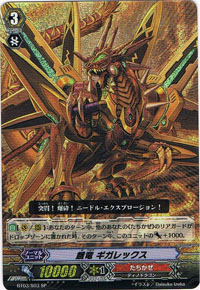
Gigarex was envisioned as the grade 3 in the Savage series of units, much as Alice was the grade 3 incarnation of Bunny and Mirror Demon. The problem with this is that the Savage cards themselves were only used to fill deck space so that a full 50-card Tachikaze deck could be built. Each of them gained +1000 power when a Tachikaze rearguard was retired, which could potentially stack to build up heavy numbers by turning something like the grade 1 Savage Warrior into a 9000-power booster or Gigarex himself into a 13000-power attacker that could break 21000 with Sonic Noah except for the part where the only card that could retire multiple units in a turn was Dinochaos and it only worked once, at grade 2 when Gigarex couldn't even be on the field. So at most Gigarex was limited to becoming an 11000-power attacker after Deathrex went off early in a fight for independent action or picking off the opponent's key rearguards like Crimson Beast Tamer or the Amon series with specifically scaled attacks.
Nothing in BT03 actually retired rearguards, so Gigarex couldn't even have his skills triggered by someone who was picking up Tachikaze from the set without them first getting Deathrex copies from BT01.
The second grade 3 that BT03 gave them was Raging Dragon Blastsaurus, a 9000-power unit that when moved to the drop zone could have a skill activated where he discarded a Tachikaze to search the deck for another Blastsaurus and call it. He also had a much weaker, 5000-power grade 1 incarnation in Sparksaurus with a similar discard-and-call skill, but the key point to these two is that they couldn't ever be put in the vanguard circle because of their extremely low base power and that they didn't actually counteract the loss in card advantage taken from Deathrex's attack connecting as Skyptero and Dragon Egg could. They did give the deck a more concrete strategy as supporting rearguards than Gigarex did, since Tachikaze cardfighters could use this to constantly thin the deck of nontrigger units while also being able to have a third attack that turn that they could use to attack an opponent's intercept with, as the new Blastsaurus would come out in the stand position.
Unlike the Irregulars or Pale Moon, Tachikaze wasn't really built up to live to any expectations, and you weren't so much running Tachikaze in this era so much as you were running Deathrex with 46 other cards that let you play him. This is the rawest hand that BT03 dealt to any of the clans it supported, and it's made worse by Gigarex having had to contend with Palamedes from the same set.
Swordsman of the Explosive Flames Palamedes is another entry in the long Royal Paladin threatlist that has become ingrained in pro play, and effectively the final culmination of the set's rearguard-powering strategies. Unlike Alfred or Soul Saver Dragon, Palamedes' effect on the game was much more subtle and it took some time for the impact of it to really sink in within the community. Palamedes' skill gives him +3000 power for the turn when he attacks if there are two or more grade 3 Royal Paladins present, but the skill also counts
himself in that, and so as long as Palamedes is in the rearguard the skill is effectively a free 20-21000 power lane. Palamedes also had a grade 1 counterpart in Toypugal, a 6000-power unit that gained +3000 power while boosting if there were two or more grade 3 Royal Paladins present, and a grade 2 variant that was much less notable. While his artwork was featured prominently on posters, Palamedes' actual skill wasn't known until the set itself was released, and it's fairly clear why. The Palamedes cards put the Amon and Beast Tamer series to shame, easily breaking their own hard cap of 20000 power with Marron and Toypugal. This issue could have been resolved simply by having grade 3s of either line that had rearguard +3000 skills, but BT03 was following up on a certain design philosophy first tested in BT02 that prevented this.
For all the good it did,
Demonic Lord Invasion was the first time that the game was very strongly shifting toward boss cards that did nothing in the rearguard circles. If you consider BT01's design philosophy, most of the bosses like Alfred, Lohengrin, Dragonic Overlord, Amaterasu, Apollon and Mr. Invincible all did something in the rearguard circles that extended beyond what they were capable of in the vanguard line. BT02 retained some of this with Blazing Flare Dragon, Lion Heat and Basskirk, but the reality is that the future of
Vanguard lay in cards like Soul Saver Dragon, Seifried and Blockade. Stil Vampir was still part of the old V/R card design and it was perfectly possible to get off his megablast without ever riding him, but the changing design of
Vanguard was clearly evident in Amon and Manticore. Palamedes was able to get away with V/R by not being an intended vanguard ride at all but by being an intended rearguard like Alice, and while this splitting of the grade 3s into vanguards and rearguards wasn't necessarily a bad thing, having bosses that could do things in the rearguard made the original
Cardfight much more freeform and fun to play. By BT04 there's really only one key grade 3 left that does something in both the vanguard and rearguard circles, and by BT05 they've evaporated entirely; the center lane focus at the point of BT10 has gotten to the point where megablasters can't megablast in the rearguard anymore.
Palamedes was what rounded out the Royal Paladins into a deck with no flaws, something that very few clans can actually attest to. Unlike with the previous three clans, assuming that you could afford all of the cards spread out across the different booster sets, there was really no reason
not to play Royal Paladin if you wanted to play it. The intended design was probably that the Royal Paladin offense would be offset by every grade 3 having just 10000 power, but the lack of an 11000 defense was negligible from the perspective of Royal cardfighters in a format where every lane was effectively Deathrex. While it's true that the ever-snowballing numbers game was churning out consistent 20000-power lanes that would not have threatened an 11000 defense, and that those lanes would become even more well proliferated as new sets were released, all of the front row units that were key to these lanes from before BT03 and after BT05 would have a base power of 9000 or less, so even when the opponent had a defensive vanguard that could shrug off Alfred's attacks, the same was
not true of their rearguards. The Royal Paladins could match and then surpass the numbers of the Irregulars, Pale Moon and so many decks to come while picking off the key rearguards of those decks and overwhelming their vanguard. I should highlight that even in the face of this, BT03 was a relatively balanced format that saw serious diversity, and that the point being made with Palamedes here is that the need to balance clans by giving them crippling flaws is illusory.
Ideally every clan eventually gets developed to the point that they are all decks with no flaws, as this is how decks like Soul Saver Alfred become so attractive to professional cardfighters in the first place. When you looked at a strong Alfred build from this period, the dominating phrase that I recall was there being "nothing wrong with it." There were no overbearing problems that could internally cripple the strategy, and this was similarly true for Oracle Think Tank at this period.
Part of this was because of the updates that Oracle Think Tank received in BT03. The Tsukuyomi cards used
Demonic Lord Invasion's soul focus as a springboard to launch the idea of ride evolution, where instead of having a first vanguard that would move out from the soul when ridden over, you would have one that would help secure cards of other grades. The basic idea is that each card in the series looked through the top 5 cards of your deck at the beginning of your ride phase to find the next card in the series, then ride it and put the remaining 4 cards on the bottom of your deck. If you got the card, then you would get an immediate +1 in card advantage by not having to expend cards from the hand to ride, and if you didn't get the card you could just ride normally at no extra cost. Furthermore, riding the grade 2 Tsukuyomi over the grade 1 Tsukuyomi would then let her soulcharge 2, for a total of five soul at the moment that she rode a grade 3. That grade 3, Goddess of Full Moon Tsukuyomi, was at the time Oracle Think Tank's only 11000-power unit, with the caveat that she would lose -2000 power if the other members of the series were not all in the soul, which meant that she could either be the strongest or weakest grade 3 in the clan based on how effective these evolutions were in any given cardfight.
Her skill could only be used if she had six or more Oracle Think Tank in the soul--achieved through riding the previous cards in the series to build up to five and then using units like Psychic Bird, Amaterasu or from the same set Oracle Guardian Red-Eye to get that sixth card in. For 2 counterblast, Tsukuyomi could then draw two cards and put one into the soul, getting an immediate extra card while filtering out less useful ones like draw triggers or other copies of Full Moon. This could be done two to three times per game, and together with the evolving Moon cards that set a possible bar of a +
6 throughout, while also providing an alternative strategy if you didn't get the Full Moon by providing a five soul base for Amaterasu to quickly accelerate her own soul into eight with. Tsukuyomi was designed to offset her advantages through her -2000 if you missed one member of the series while also providing a serious setback in that you would have 3 soul the moment that she was ridden, a loss in momentum that was very difficult to come back from. What wouldn't be realized until five months later was that these disadvantages could be outright negated, but this is far ahead of where we are now. At her release, Tsukuyomi was easily the best thing to ever happen to Oracle Think Tank, and I would argue that she remains so. For future generations of cardfighters, Amaterasu could never be played the way that she was in March 2011 again. There was no reason to not run Godhawk through Tsukuyomi's Crescent Moon form after they were released, even if you weren't running the Full Moon, as being able to amass a large base of soul for Amaterasu and potentially get a +3 out of it was too good. It speaks a lot to how much of an upgrade she was that most incarnations of Oracle Think Tank to come would have to have clauses that would specifically rule out the Tsukuyomi line from being used to ensure that she
wouldn't be played in those decks.
The Royal Paladins also received their own version of Tsukuyomi's evolving cards in the Galahad line, but with the soulcharge 2 condition being swapped to ride the grade 3 over the grade 2 to prevent using it in normal Alfred decks with Soul Saver Dragon. Galahad's grade 3 skill wasn't especially notable as it had the same six soul conditions with less soul support and only gave him +3000 power with an extra critical. In contrast to Palamedes, Galahad's impact on the game was practically invisible.
Nova Grappler was the clan that had the most difficulty with BT03. The clan had been looking for a good partner to Asura Kaiser ever since BT01, but neither of their other options were exceptionally compatible. Mr. Invincible was good for setting up Genocide Jack and Kirara, while Lion Heat was the most common choice at this point for being able to stand the boosters of units that Asura Kaiser had just stood.
Demonic Lord Invasion did not alleviate these problems. The grade 3 that it introduced, Ultimate Lifeform Cosmo Lord, was another victim of the vanguard-exclusive design philosophy when it probably could have stood to have a rearguard skill too. His activate skill was to rest another Nova Grappler and then get +3000 power. Cosmo Lord was thus one of the few Novas that could make a 21000+ line consistently, but it came at the expense of making other attacks that turn. Earlier in a fight you could call something that wouldn't be otherwise boosting or attacking that turn to force Cosmo Lord's hit to go through, but later on it was harder to pay because it meant that one of your attacks for the turn wouldn't be at full power when it would usually be better to have three normal attacks than one weak, one exceptionally strong and one normal. Cosmo Lord did come with support that diehard fans would swear by, but the card was far from being the monster that he would become in 2012 and that support was generally put to better use by Asura Kaiser decks running one of the other two grade 3 options at the time.
 |
| Infinite Phantom Legion reprint. |
"That"
support was the Death Army series, the most important rearguard development that Nova Grappler saw in its first year. Like Tachikaze, Nova Grappler had a pretty raw deal in BT03, but BT03 was a good set to have a raw deal in. The Grapplers were never the same after Death Army hit the scene--the grades 1 and 2 Guy and Lady shared an autoskill that when a grade 3 Nova Grappler was checked, they would stand. The idea was that you would rest the Death Army cards for a +6000 power boost to Cosmo Lord and then stand them during the drive checks so that you could get that normal attack in addition to the power boost, but because this skill was lifted straight from Asura Kaiser's playbook they had natural synergy with him such that Kaiser could stand both left and right rearguard columns at once in a good game. More commonly, Nova Grappler cardfighters would run Guy behind a normal Nova rearguard like Genocide Jack so that Asura Kaiser would actually have something to stand. The most important factor was that the Grapplers could now stand whole columns without stand triggers, which represented a major step toward seriously breaking them into high-end play as they could maintain their core mechanics while running additional critical triggers. Conveniently, the set also introduced their second critical trigger Red Lightning, and their first draw trigger Three Minutes, so that for the first time Nova could play without stands.
Immediately preceding the release of BT03, around the 25th of July, Nova Grappler received a somewhat surprising update in the Joker half deck inside the August issue of KeroKero Ace magazine, which brought them the new grade 3 Genocide Joker. Joker was a base 10000 unit that could counterblast 2 in the main phase to get +4000 power, which was useful as a supporting unit to Kaiser because it could form a consistent 21000 line with Death Army Guy that would completely restand for consecutive high-power attacks. The dominant pro deck of the time didn't have any base 11000 options however, so Death Metal Droid was generally more popular for doing effectively the same thing for a single counterblast and being much more easily available in TD04.
These were all the most notable changes brought on by
Demonic Lord Invasion. Following Barcgal's restriction, the Soul Saver deck did not ever entirely die off. The restriction was designed to take place one month after the release of BT03, so most fighters simply converted to the new Galahad evolving cards. With the basic deck already so heavily proliferated, amassing the R and RR grades 0, 1 and 2 cards was fairly simple. This Royal Paladin pastiche was interesting because its existence depended on Barcgal's restriction--it shows fighters of the time overcoming a technical limitation by fusing two disparate strategies. Similar combinations were necessary for Nova Grappler from the beginning, who up through the last half of 2011 and early 2012 were forced to run a "best of" deck drawing from the three existing sets that combined Asura Kaiser, the Death Army units, and in October the Blau series into one all-star strategy. Probably the most disappointing thing about this period is that there was no major tournament between BT03 and BT04, as in many aspects the third booster set was the last time that every clan was introduced with a completely unique identity, while the fourth booster was the beginning of standardization.
 |
|
Also translated as
"Empty Shadow God Eclipse" and
"Eclipse of the
Hollow Shadow God," VG-BT04:
Eclipse of Illusionary Shadows was first made available in Japan on October 29th, 2011. This set was noted for the expanding the concept of evolving cards and building on the soul mechanics of BT03, giving evolution lines to five different clans with a heavy overall focus towards defensive vanguards that gained power for having specific cards in the soul. The set's cover cards are Blaster Dark, Blaster Javelin, Fullbau and Darkside Trumpeter. Megacolony, Dimension Police and Shadow Paladin were completed in this set.
To give some background on the set's development, the completion of Shadow Paladin was the main draw of the set itself. Blaster Dark was shown in a promotional poster before any actual information on BT04 was circulated, the card then debuted in ride 33 of the anime series ahead of the set information, and some key cards like Phantom Blaster Dragon were shown sans their actual skill text in one of Bushiroad's live web broadcasts. Bushiroad's advertising engine had the public absolutely hooked on the Shadow Paladins without ever actually showing what they would
do.
Of the clans BT04 supported, only the Shadow Paladins featured on the set's cover could really own evolution as a mechanic. This was their defining feature. Where all of the other clans would go on to abandon BT04's evolution mechanics at their first opportunity, the Shadow Paladins would stick with it for the next two years in part because that was the defining support base for their boss card and in part because they had no other options. Even after they were given a new first vanguard in December 2012, some Shadow Paladin decks would continue to use the grade 1 part of the line for his search skill. Unlike BT03's evolving cards, BT04's operated by adding a specific grade 2 directly from the deck to your hand when you rode a specific grade 1 over the grade 0. The grade 2 would then have a vanguard circle skill to reward you for riding it, that would snowball the advantage from riding the grade 1, and the grade 3 would build on that with a skill that would force the opponent to defend in some way or otherwise destroy their resources. Each member in the line would get a passive power bonus of +1000 or +2000 power for having the previous member in the soul, so that they would have the highest unrestrained possible power for their respective grade. For better consistency, the grade 1 part of the line--in the Shadow Paladins' case, Blaster Javelin--could also discard any grade 3 of the same clan when called to a rearguard circle to search for the evolution line's grade 3 and add it to the hand. This is one aspect of BT04-style evolution that is missed out on in later sets, as later refinements to the model would omit the search aspect in favor of giving the grade 1 a higher base power and a unique skill.
The first Shadow Paladin ever revealed was actually a promo card, Cursed Lancer, who was included in the in the CD release of the anime's second opening, "Believe in My Existence" almost a month before BT04 went on the shelves. Lancer was a copy of Super Electromagnetic Lifeform Storm from the Nova Grapplers, a 9000 power grade 2 that could unflip one damage when his attack hit a vanguard, and established one of the early characteristics of the Shadow Paladins that would be expanded on more thoroughly in the third season; damage unflipping. This card was one part of the mass promotion Bushiroad set up to get the public interested in the Shadow Paladins, but it turned out to be one of the more lackluster ones since there was never much room for Lancer in any of the Shadow Paladin builds. It did spark some heavy speculation at the time as to what ShadowPala would actually do to necessitate using more than five counterblast in a game. During his actual English release, Lancer was packaged with BT04 as an extra Rare, but this created more problems than it solved because while in the Japanese release you were guaranteed one of each Rare with one repeat, Lancer's inclusion alongside Megacolony Battler B in the English edition instead meant that
none of the BT04 Rares would repeat in a box and you would be missing one, and the prints of BT04 were biased to not include the Shadow Paladins' core grade 2, driving his secondary market price up to eight times the cost of any other Rare.
 |
| Fighter's Collection 2013 reprint. |
That core grade 2 was Blaster Dark. This card was the selling point of the clan and the driving force behind public interest in the set well before we had any idea of what he did. He was a mysterious unit with unknown skills, the best we could guess at the time was that he increased his own power in some way because of how Ren's match with Koutei played out in ride 33, and he was a darker counterpart to Blaster Blade, the face of the TCG itself. One thing that
KeroKero Ace magazine's editors pointed out right away is that Blaster Dark was directly based on the first promo card, a Blaster Blade with no skill and alternate artwork drawn by Itou--something that the editors were very familiar with, as they were responsible for distributing that same card. You really could not overstate how hyped the public was for Blaster Dark at the time, or how much effort Bushiroad was putting into the set.
So while it's unlikley that Bushiroad could ever create a card that would live up to what their hype machine had made, they certainly could have done better than making him a dedicated part of an evolution line. All of his skills were vanguard-exclusive. If Blaster Javelin was in the soul, Blaster Dark's power would jump up to 10000, and when he was ridden Dark could counterblast 2 to retire one of the opponent's rearguards. The strong defense was probably his best quality and the only real edge that Dark had over Blade. His on-ride counterblast was lifted straight from Blaster Blade, but being at 2 or more damage at grade 2 was unlikely because it meant either the opponent had gotten a critical trigger or that you were letting rearguard attacks through early on that you should not be. Furthermore, the Shadow Paladins turned out to be an immensely counterblast-heavy clan and there wasn't a whole lot of
room to use Dark's skill because it was bettered budgeted for their other grade 2 units. Blaster Dark's evolution line was inconsistent on its own because their first vanguard, Fullbau, would never move out from the soul so the extra one-card advantage could
only be gotten from riding Blaster Javelin, which meant that four copies of Javelin were stapled to every Shadow Paladin deck when riding him was only a 46/100 chance. Blaster Dark really ought to have had a rearguard skill in the first place, and it speaks to how uneven the situation was that when the two Blasters were later redesigned to have the same skills in 2013, Blaster Blade's downgrade was Blaster Dark's
upgrade.
While BT04 was released in October, all this promotion actually began in late August and went up until the day of release. The clan's boss card, Phantom Blaster Dragon, had been known about from the beginning because he was namedropped in Javelin's skill text, and his Special Parallel alternate artwork created by Itou himself was previewed in promotional images, but his skills remained a mystery until the end of September. The card itself was highly experimental, being the first time that the game really played around with built-in extra critical as a mechanic, and the results worked against the Shadow Paladins.
 |
| Fighter's Collection 2013 reprint. |
As the final stage of the Blaster evolution line, Phantom Blaster Dragon received a passive +1000 power bonus for having Blaster Dark in the soul. His unique skill was to counterblast 2, retire three Shadow Paladin rearguards, and then get +10000 power and +1 critical until the end of the turn.
This didn't work.
Coming on the heels of BT03's amazing innovations, Phantom Blaster was probably the most
disappointing card of the whole set. There were already a lot of expectations riding on his shoulders, but the card would have remained disappointing even if there weren't. The first problem was the counterblast cost, which in a clan that would go on to be very reliant on counterblast 2 and counterblast 1 rearguards, there wasn't much room for. Factoring into this is that any variant on retire or discard are
the biggest costs you can pay in Vanguard because you are either removing units that you will then have to put further cards down from the hand to replace, weakening your defense, or you are outright sending that defense to the drop zone. Any skill that requires a main phase retire is actually double its stated cost because of the replacement rearguards you have to put down. So having to counterblast as well as retire was redundant and made the skill immensely overpriced. With retiring rearguards for power as their main theme and counterblast-heavy rearguard skills to support that, the Shadow Paladins really needed to have counterblast-free retire skills, but this is something that they wouldn't get for two years. The second problem was the retire 3 itself, which is too much for ten thousand and a crit. Every other unit printed with this type of skill paid less than drop 3, typically taking a drop 2 loss. Phantom Blaster went with retire 3 chiefly to create a contrast to Soul Saver's empower 3, but the skill was not scaled accordingly.
The third problem was that +10000 power and +1 critical wasn't something anybody was asking for. The skill probably should have been a retire cost to retire the opponent's rearguards, or a self-stand skill, both skills that would go to other grade 3s also in BT04 and that the Shadow Paladins would receive in BT12, but because of how it was designed Phantom Blaster Dragon inevitably ran into a perfect defense card every time that his skill was used. Since perfect defense cards were going to be used anyway at the stage of the game when the extra critical and power would be helpful for overwhelming their hand, the opponent was taking a -2 that they were always going to take while Shadow Paladin cardfighters were throwing a -3 at themselves that they didn't need to pay in the first place. So it was better to not use Phantom Blaster's skill at all and sit on a vanilla 11000 vanguard--this was the first boss card in the history of the game where it was always better to
not use his skill when able to do so. Where BT03 answered all of the fans' expectations with things beyond their imagination, BT04 advertised something that wasn't actually very good.
Part of the issue was that the Shadow Paladins were made to be defeated. The various Dark Zone clans, Megacolony and some of the Dragon Empire crowd were certainly antagonistic, but the Shadow Paladins were the ultimate evil of the first season, led by a wicked dragon that wanted to plunge everything into despair, and as a whole they were created with the idea in mind that they couldn't be
too powerful because Aichi had to beat Ren and Phantom Blaster Dragon had to lose to Blaster Blade. This design would thankfully not carry over into subsequent years as the developers learned from this, but that didn't help the clan when it was actually being released.

Several days after Dragon was made public, many of the remaining cards for the Shadow Paladins were revealed in KeroKero Ace magazine, with the final cards in the clan being shown in the days leading up to release. The main supporting grade 3 shown at the time was Dark Mage Badhabh Caar, a Shadow print of the Royals' Gigantech Charger from BT02, and the partner unit to Phantom Blaster Dragon. When ridden or called, Caar would reveal the top card of the deck, and if it was a Shadow Paladin, he'd then call it to a rearguard circle. The concept was to fill up the rearguard circles with Caar to mitigate the cost of offering up sacrifices to Phantom Blaster, and because the Shadow Paladins would go on to receive numerous on-call counterblast skills, Caar could also act as a gateway card to triggering skills in succession. The problem is that the resulting fields were awkward, and the damage zone was extremely tight, so anything Caar called was contending with Blaster Dragon for counterblast usage if the plan was to actually use that skill. With just 9000 base power, Caar couldn't actually be ridden either, so if you were stuck with him as your only grade 3 in hand you'd have to sit on Blaster Dark and wait to draw Dragon. This is one point that the evolution line actually functioned pretty well on, since Javelin could use his rearguard skill to discard Caar and search for the Dragon, but the overall synergy between the Shadow Paladin grade 3s was low compared to how well the Irregulars and Pale Moon functioned in the previous set.

The final grade 3 option that the Shadow Paladins were given was Dark Metal Dragon. His skill was set up so that when he drive checked a Shadow Paladin, he would get +2000 power until the end of the battle. This was deliberately worded so that Dark Metal would always have 14000 base power during his attack, letting him hit 20-21000 easily, and it's for this reason that Dark Metal Dragon was the most used Shadow Paladin vanguard on release. Phantom Blaster was crippled by his skill's overpriced cost, lack of cohesion, and the simple fact that he had to lose three rearguards to maintain 20000+ power when Dark Metal and the Shadow Paladins' contemporaries like Alfred, Amaterasu and Amon did all that for free. The Shadow Paladins' main mechanic was retiring rearguards for power, but the best way to play them was to never use their one retire skill. I need to emphasize that these were your
only options for building the clan back when they were released. There was no Dark Dictator, no Ildona, and definitely no Overlord. The only options for the vanguard circle were Phantom Blaster Dragon or Dark Metal Dragon. This is the main reason why the Shadow Paladins didn't break into senior class play during the Grand Prix further down the road. They did not have a good high-synergy boss card, while every other clan save for Tachikaze and Spike Brothers had two.
Japanese fans in general were more receptive to this skill than westerners, but the tourney results can stand on their own for how ineffective the Shadow Paladins were. By contrast, Megacolony in this set made much better use of the retire mechanic. They
shared the Shadow Paladins' evolving mechanics, here based around the
Giraffa cards, but their grade 2 and 3 units were far superior and
naturally outlasted both Blaster Dark and the Dragon. Elite Mutant Giraffa had the same stats as Blaster Dark, but when his attack hit he could choose an opponent's rearguard and prevent it from standing at no extra cost. This skill was useful no matter the situation because it would either restrict the opponent's plays or convince them to defend earlier than normal without taking any resources away from the user.

Elite Mutant was really just a bonus though. Evil Armor General Giraffa was the main draw for this incarnation of Megacolony, because it gave the clan a second competitive vanguard and one with 11000 power. Giraffa's skill was like Phantom Blaster's a counterblast 2, but this one was an autoskill that activated when the attack hit a vanguard. This skill retired two Megacolony rearguards to retire two of the opponent's grade 1 or lesser rearguards, making an efficient use of retire mechanics by trading a -2 for a -2 while also not requiring the same dedication that Phantom Blaster did by only activating when the conditions were met, while also forcing extra defense out of the opponent if they wanted to avoid the attack. One common setup was to see two copies of the Megacolony draw trigger, Raider Mantis, called to form a 10000 power rearguard line that would attack an opponent's intercept to lower their card advantage beforehand, then with Giraffa's skill retire those draw triggers to almost wipe out the opponent's boosters. The unfortunate thing about the skill is that it compromised Megacolony's main mechanic in the process. Their theme was preventing the opponent's rearguards from standing to lock down their field and make defensive play easier, but Giraffa gained his competitive status chiefly by ignoring that mechanic altogether and doing his own thing. There's definitely a case that Giraffa didn't
need to stick to the theme though, because it was already done for him by Megacolony's plethora of rearguards that could counterblast on-call to choose an opponent's unit and prevent it from standing.

Chief among these was Hell Spider, who was actually from BT01 and served as Megacolony's original competitive vanguard. The strategy at this time was to play Giraffa up until the opponent was at 4 damage and could no longer safely let the vanguard attack pass, then switch over to Hell Spider. When all of the opponent's rearguards were at rest during his fighter's turn, Spider would get +3000 power in the vanguard circle, which could lead into an easy 20-21000 line to strain the opponent's hand when they were already exhausted from struggling to stop Giraffa each turn, who was going for the same numbers with the clan's 10000-power vanguard booster Stealth Millipede. Hell Spider's other skill was a counterblast 2 for the same stand-denial effect described above, and it worked in either the vanguard or rearguard circles, so that he was an effective unit no matter where you placed him. Furthermore, Giraffa and Hell Spider aged like wine. When 13000-power defense was introduced in the later sets, Spider's playability would only increase, since with Stealth Millipede he could stay relevant by consistently hitting 23000 when even the new clans were struggling to get those kinds of vanguard lines, and he stilled served as an excellent followup to Giraffa in that period because that 13000 defense was set up by starting with an 11000 base that Giraffa could pressure and potentially steal supporting units from.
Overall this made for an incredibly consistent deck whose only real issue was that it was still struggling with an enforced trigger pool of 4 Heal 4 Draw 4 Critical and 4 Stand, but even after Megacolony's second critical trigger was introduced in EB01 the clan would remain underhyped and underplayed. In fact, Megacolony is probably
the most underplayed clan in the history of pro play considering that it avoided many of the pitfalls of contemporary decks like the Irregulars and Shadow Paladin. Megacolony hasn't ever had the same cool factor as the Paladin decks or Oracle Think Tank, and suffered from a lot of complaining about the stand denial skills being less useful than Kagerou's straight retire, but its results were consistent and Megacolony fans have had less actual flaws to complain about than any clan short of the core 4 throughout
Cardfight's history--in spite of having less support than the other clans. Megacolony was designed just about perfectly in that its build was consistent, competitive, and actually felt like you were playing the clan that you had chosen, something that not all clans can attest to.
Up there with Megacolony were the Dimension Police. The clan's boss card, Super Dimensional Robo Daiyusha, had been previously introduced in BT03 but the support that he really needed all came from BT04. The basic focus of the clan was to have a passive vanguard that couldn't do much on its own, whose skills were triggered by those of the rearguards. Daiyusha was exemplary of this practice, as he was normally a vanilla 10000 grade 3, but if his power was increased to 14000 or greater before he attacked (that is to say,
without his booster being factored in) he would get an entire extra critical, which made for what was one of the best midgame skills overall since you were looking at a vanguard line that was guaranteed to be at 20000+ power too early in the game for the opponent to actually put a perfect defense down against without falling behind drastically in card advantage but still necessitated them to defend it because eating the extra critical was not an option.
Daiyusha's main support card for reaching that number was Cosmo Beak, who had an on-call counterblast 2 to give the vanguard +4000 power, immediately triggering that extra crit. There were a lot of other rearguards that could provide lesser boosts in lots of +2000, like Masked Police Grander from BT03 and Cosmo Roar from BT04, but this was the big important rearguard for a long time and it was even more important for its synergy with the other key grade 3, Enigman Storm.
Storm's skill was actually close to identical to Daiyusha, but the power bar was raised from 14000 to 15000. This was because Storm was the final grade 3 in the Enigman evolution line, and so had a potential 11000 power base to work with. So you effectively had two options in the mainstream Dimension Police deck, Daiyusha and Daiyusha with 11000 defense, and this made for a very effective grade 3 setup that was mainly being held back by its trigger pool. What Dimension Police really
wanted was a second critical trigger, but that was a year off. The clan did have enough synergy with stands to play well, but by this point competitive fighters were complacent with the idea that there were only three triggers and so Dimension Police generally flew under the tournament radar despite being more visible than Megacolony.

The card that put Dimension Police in the competitive spotlight was Commander Laurel. He was an amazing success for the D-Police because he gave an overwhelming advantage with minimal commitment. When the vanguard's attack hit, his skill would rest four rearguards to stand the vanguard, denying immediate rearguard attacks for a long term advantage in extra drive checks. With any grade 3 vanguard Laurel would give a +2, and this was complemented by D-Police's enforced stand triggers since you would get that plus while also still getting some rearguard attacks in, and because the overall goal of the deck was to trigger extra power and critical in the vanguard line, Laurel had a lot of synergy with the established strategy, multiplying the effects of the extra critical so that the center lane that was typically at 24-25000 power / critical 2 could deal a maximum of
ten damage in one turn with critical triggers, almost double what was necessary to actually win a game. In games were D-Police was behind, Laurel let them go from a score of 5 damage to 1 to 5 and 5 in a single turn. Keep in mind that it wasn't so much actually doing these things that was great, it was the opponent being afraid of it that was--Laurel either gave a +2 to D-Police cardfighters or a -2 to the opponent every single turn. The center lane was not allowed to hit but was also at such ridiculously high power that Laurel ate through the opponent's perfect defense cards starting at turn 3, sometimes as early as turn 2 if the Enigman evolution was going off, and eventually the opponent was taking a -3 or -4 each turn. The card aged beautifully too, as future D-Police support sets would only make this setup easier and easier to pull off.

Stern Blaukluger followed a similar theme to Laurel. The Blau series as a whole represented Nova Grappler's first major upgrade of the season since their debut, giving them BT04's model of evolution where Oracle Think Tank had received BT03. In that respect the Grapplers definitely received the shorter end of the stick, but Stern made up for it with a vanguard stand skill built into him. Stern's skill triggered when his attack hit the vanguard, paying a counterblast 2 and discard 2 to stand his entire column. This played into Dancing Wolf from the same set, a base 7000 grade 1 that gained +3000 power when it stood in the battle phase, so that against contemporary 11000-power units Stern could actually make his attack hit with just one stand trigger because the power from Wolf's boost was applied continuously. If the opponent guarded for two triggers and Stern pulled a stand trigger, his line with Wolf would go from 18000 to 26000, promoting a synergy with stands that the Grapplers needed in order to really come into their identity as the restanding clan.
After the cost was paid, Stern would lose his twin drive, so the skill itself was actually a -1 unlike Laurel, but it shared several of Laurel's strengths because the opponent could never afford to just eat the skill. The chances of Stern checking critical triggers was just too high, and like with Laurel any damage that Stern dealt was multiplied by his stand skill, so that any no-guard was risking four damage instead of two as with any other vanguard. Dancing Wolf also made the second attack stronger than the first, and as with Laurel, Stern required minimal commitment. Even without the bonus of card advantage, Stern still had a devastating effect on the game because of how he ate up the opponent's perfect defense cards at no cost. The overall strategy then became to build up with the Blau series until the opponent had very few cards in play and took an attack that brought them to five damage, then switch over to Asura Kaiser and the Death Army units, as the endgame of the fight when the opponent is at five damage are when stand skills go from annoying to the most dangerous ability in play.
It was in November that the first official international tournament was held, in Australia. The first Australian national championship, Grand Prix 2011, was done using Japanese cards from BT04 and earlier. National champion Zachary Rappold won the tournament using a Stern Blaukluger deck. Even though it was smaller than the tournaments of the future like WCS2012 or the international Team League, this attests to Stern's strengths as a unit and how much of an upgrade he was to the Nova Grapplers.
The disparity in support should be visible by now. These key units of BT04, Giraffa, Storm and Stern Blaukluger were all what Phantom Blaster was really contending with at release. Why counterblast 2 and drop 3 for +10000 power and +1 critical when you could
just counterblast 2 to grab the extra crit with a 21000 line that would hit the same perfect defense but not cost you any card advantage in the process? Why counterblast 2 and go -3 to the opponent's -2 with Phantom when you could go 21000 with Giraffa and Stealth Millipede to pressure the opponent into dropping a -2 every turn at no cost to yourself, or otherwise go -2 to -2 trading out bad rearguards to kill the opponent's good ones? Why jump through all these hoops with Phantom when you could take a -1 with Stern Blaukluger and get a third drive check with a vanguard line that's
already pushing 21-26000 power and multiplies critical just through playing normally? The problem is exacerbated by every single one of these decks getting better with age, not worse, while halfway through 2013 Phantom Blaster has
still not developed into a playable skill.
The main issue was the commitment factor. While it would still be a heavy cost, his retire 3 would be much more playable if it were an autoskill that triggered when attacking the vanguard, because the rearguards could actually be used to attack the opponent beforehand instead of demanding that Shadow Paladin cardfighters lose three rearguards, then call three replacements,
and then still be able to defend things like Daiyusha or Stern after all that commitment. In fact, this exact idea would be done two years later in BT11 with Tachikaze's Ancient Dragons. BT04 did a lot of things right, but the Shadow Paladins were not one of them. The professional scene at the time saw primarily Soul Saver, Goku, Tsukuyomi and Stern Blaukluger in senior class play, but even Daiyusha and Giraffa made appearances during the ensuing tournament season while Phantom Blaster Dragon never showed up as his own deck.
Even so, the months closing 2011 were something of a golden age for
Cardfight. For the first time, every clan was playing with an even field, with no real top deck or strategy controlling the format. Royal Paladin would eventually continue its train of dominance, but this was nowhere near the level of format control that SSD had previously exerted, and the top brackets were still very closely divided with Oracle Think Tank and Kagerou in an equal position to RoyPala. If anything, the most frustrating part of the period was that the less visible clans were not leaving enough of a tournament impact, as people really wanted the BT03 clans to do well when it was the clans from BT01 and BT04 that were seeing the most play. It is generally believed that any clan could have taken the winter cup, but first we need to dive into how the 2011 Grand Prix began.


 All
of the (many) Gold Paladin cardfighters that first picked up the deck
in 2012 will recall playing Gigantech Destroyer as one of the staples of
both Garmore and Spectral Duke Dragon. Gingatench is a clone of the Kagerо̄ promotional card Dragonic Executioner, but you have Neo Nectar to thank for incorporating these clones into main booster sets; Laurel was the first Executioner clone to make into a BT, and that eventually
spun off into Magnet Crocodile, Midnight Invader, and countless others.
All
of the (many) Gold Paladin cardfighters that first picked up the deck
in 2012 will recall playing Gigantech Destroyer as one of the staples of
both Garmore and Spectral Duke Dragon. Gingatench is a clone of the Kagerо̄ promotional card Dragonic Executioner, but you have Neo Nectar to thank for incorporating these clones into main booster sets; Laurel was the first Executioner clone to make into a BT, and that eventually
spun off into Magnet Crocodile, Midnight Invader, and countless others.


