|
| Photo by rawritzrichii, not to be reposted elsewhere without the original photographer's express permission. |
Mythic tradition and legends are an important part of human culture. Although mechanical in nature, the
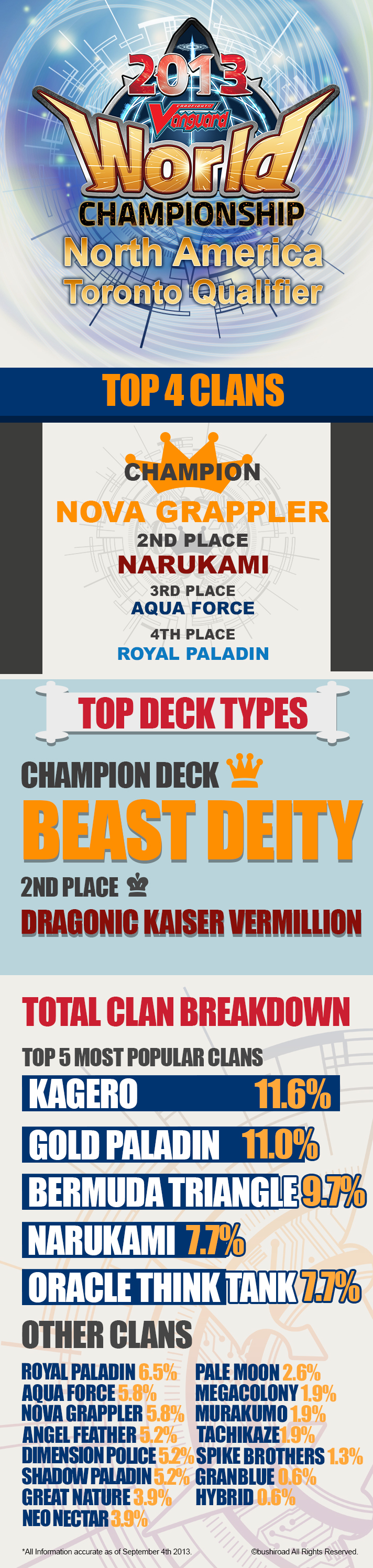
Nova Grapplers are frequently designed to fuse those mechanical elements with legend to create artificial gods of the ring. While it has received nowhere near the same amount of attention, the Beast Deity subgroup is one of the most cohesive decks in pro play, on par with the interclan
Blaster series for how much synergy the individual cards have with one another. Drawing its origins from BT06:
Breaker of Limits, the Beast Deity cards have seen repeated revision with the progression of the game, reaching a crescendo with the coming of BT09:
Clash of the Knights and Dragons and finding another leg of support in BT10:
Triumphant Return of the King of Knights.
The first vanguard introduced for them in BT06 is Beast Deity, White Tiger. To recap our introductory model's treatment of him, Tiger is an important milestone in Nova Grappler play as a base 5000 power FVG that can be moved out from the soul when ridden over, providing an extra card and booster that can form basic 15-18000 lines. The other use of White Tiger, exclusive to the Beast Deity cards, is to counterblast 1 and move him back into the soul when an attack that he boosted hits a vanguard, and then stand a Beast Deity rearguard. This costs you the card advantage that Tiger gained, but it can potentially be offset by the extra defense that this draws out from the opponent, and is further intended to combo with two other cards in the Deity series, Scarlet Bird and Black Tortoise.
Together these three cards make up three fourths of the four gods, mythical rulers of the constellations. Bird and Tortoise, representing Suzaku and Genbu respectively, are base 6000 and 8000 grade 1 and 2 units that when their attack hits the vanguard can look through the top five cards of the deck for a copy of the grade 3 Beast Deity, Azure Dragon. This provides quick, counterblast-free grade security while also grabbing you card advantage and playing into Azure's own skill later on. Since all of the Beast Deities so far share the same hit condition, you can combo this early on when the opponent is not able to defend as easily, using White Tiger to stand a Beast Deity whose attack just hit to try and make use of their skill again. Grabbing that Azure Dragon from the deck can offset the advantage lost by Tiger going into the soul, and like
Tsukuyomi you can also gradually form a stack of triggers at the bottom of the deck while using the Nova's cycling trigger
Battleraizer to reshuffle the deck if that stack turns out badly. While the Full Moon's stacking capabilities in normal play are capped at fifteen and sixteen cards, the Beast Deities' shared ability to do this when attacks hit instead of at the beginning of the main phase leaves the potential for twenty cards with a likely cap of twenty five to be stacked instead.
Azure Dragon is the Nova Grappler analogue to the fourth god Seiryuu, dragon of the east. His 11000 base is the same strong defense that Asura Kaiser boasted, and over that when his attack hits the vanguard he can activated his
persona blast, to stand two rearguards. This is where the previous Deities come in outside of just providing grade security, as a persona blast that can be searched right from grade 1 on is much more playable than it would be otherwise. Being able to guarantee that two rearguards will stand without relying on Death Army units is important, and the presence of all these on-hit skills gives the Beast Deities a very strong early to midgame. If the opponent feels pressured to block the attacks to prevent those skills from going off, then they're usually being forced into a misplay by overthinking the situation, which weakens their defense and opens them up to taking more damage and being unable to protect their rearguard lines later on. The main issue with this is that the Beast Deity deck by itself has no concrete endgame. Once the opponent is at four damage, there's very little that you can do to decide the match on subsequent turns beyond protecting your existing lead.
Entire BT09 and Azure Dragon's crossride; Ultra Beast Deity, Illuminal Dragon. Representing Ouryuu, the golden dragon of the center, Illuminal occupies a very tall throne within the Nova Grapplers as their first
crossride, getting a constant +2000 power bonus for having Azure in the soul for a 13000 power defense overall. This forms a 21000 power offensive line with Tough Boy, and while the Nova Grapplers lack the soul manipulation to finalize their crossride if they miss their initial Azure ride, Illuminal's offensive power makes up for this. At limit break 4, when Illuminal attacks he can counterblast 3 to stand two Beast Deities rearguards, with no on-hit attached. This is the endgame that Azure was looking for. Being able to forcibly stand an entire column after driving the opponent to five damage with that same column beforehand is devastating, and the skill can even be repeated by sampling cards from the Nova Grappler's original unflipping engine like Claydoll Mechanic.
Of course, the Beast Deity restriction means that you need stronger rearguards to be able to actually use that limit break with.
Clash of the Knights and Dragons brings us Golden Anglet and Yamatano Drake, grade 2 and 3 variations on the same core skill of gaining +3000 power when they stand in the battle phase, over respective 9000 and 10000 power bases. With Illuminal Dragon these cards are guaranteed to hit even opposing crossrides for relevant numbers, and versus other decks by lining the new Deities up with Tough Boy you can ensure that the lines will go for 20-21000 power so that their second attack will always be tougher than their first.
BT09 also brings us Blank Marsh, a functional grade 1 variation on White Tiger with 7000 power. While Yamatano was the Beast Deity incarnation of the eightheaded serpent Yamata no Orochi, and Anglet was a representation of the "dragon horse" Ryuuma, Marsh is analogous to a Hakutaku ("White Marsh"), a legendary beast whose image was used to ward off disease. When an attack that Marsh boosted hits a vanguard, he can counterblast 1 and move to the soul to stand a rearguard. White Tiger and Marsh can both do the same jobs, standing Anglet and bumping him up to 12000 power to ready him for an independent attack or using this with one of the older Deities to perform another Azure search. Damage triggers are generally the biggest hazard to these skills, so it is important to read the situation and be aware of when it isn't the right time to use the Deities' stand skills. Fortunately, the timing of them is such that you don't have to actually choose to activate them or not until after your opponent has completed all of their damage checks.
Scheduled for an October release,
BT10:
Triumphant Return of the King of Knights introduces a series of Beast Deities derived from the two zodiacs and a new first vanguard in Beast Deity, Riot Horn. Representing Taurus and the Ox, Riot Horn is like White Tiger before him a base 5000 first vanguard that moves out from the soul when ridden over with a unit of the same clan. Horn's autoskill is designed so that when a Beast Deity in the same column as Horn stands, he can also stand, allowing for a full-power attack using Blank Marsh, and multiplying Illuminal's impact on the game by allowing for two columns to attack, one unboosted and one with Horn to assist it.
Sagittarius and the Horse are represented by Hilarity Destroyer, a base 7000 grade 1 that can discard a card to draw one when his attack hits. While Destroyer won't see a heavy amount of play later on in a match, he can be good for the early game if you want to replace Scarlet Bird in your Beast Deity deck, as he forms an anticrossride 18000 line with any of the Grapplers' many 11000 power units, makes for a good grade 1 ride and can help improve your deck's consistency.
At grade 2, Hatred Chaos is affiliated with both Leo and the Tiger. With a 9000 power base, Chaos gets +3000 power when he attacks from the rearguard if there is a Beast Deity vanguard, although unlike with Golden Anglet this power bonus only lasts through the battle that he attacks in. Because of that, Chaos' power increases cannot be stacked. Instead, he and Anglet act as complementary rearguards that can be used in place of one another. Hatred Chaos' imagery is a little looser than past Deities, as while his face and nose are based on a lion, and he has stripes taken from the Tiger zodiac, his appearance is also derived from the thunder god Raijin and the ring of drums that Raijin uses to summon storms.
Finally, Ethics Buster. This Beast Deity is unique, based on the unused thirteenth sign of the Cat from the Chinese zodiac. Like Azure Dragon and Illuminal Dragon, Ethics Buster has an 11000 power base, but he differs from them in that he is a break ride, harbinger of a highly explosive endgame but being limited in what he can do by himself. Ethics gets +2000 power in the vanguard cricle when he is boosted by a Nova Grappler, creating a 20-21000 line. But when you ride a Nova Grappler over him while at limit break, Ethics Buster gives your vanguard +10000 power and an autoskill that stands all of your front row Nova Grapplers when that vanguard attacks. Using Illuminal Dragon with this skill, you can unfailingly stand all of your rearguard columns while having a center line in the range of 21-31000 power, taking around six cards to block all of the attacks without any triggers coming through. This makes both decks that use Azure with Illuminal and Ethics Buster viable, as well as just Illuminal-Ethics decks, and while Ethics Buster is a Beast Deity, his break ride skill is compatible with
all Nova Grapplers, effectively updating Illuminal Dragon,
Stern Blaukluger and Asura Kaiser all at once.
The Beast Deities are an extremely diverse subgroup with a heavy amount of support, and there is a lot of freedom of choice between how you want to build your deck, whether you choose to go for a four deities or zodiac deities model, or some combination therein. Next time that we revisit the Nova Grapplers I will be discussing the new Death Army series cards from EB04:
Infinite Phantom Legion and the ultimate lifeform, Cosmo Lord.