Showing posts with label limit break. Show all posts

Friday, April 20, 2018

Flower Power: Neo Nectar's Break Ride years

Where we last left Neo Nectar, they were in a similar spot to Great Nature; invested with high-complexity high-reward decks like Musketeers and Arboros, yet neglected by the player base. One of their major deck types was too unstable in its grade 1-2 makeup but made for a solid finisher in any other deck, and as with much of the second block of support fighters on the whole were unimpressed with what they could get from BT08 compared to what they already had from BT05. The clan had a poor reputation, and in one particularly memorable incident recounted on Yahoo Answers Japan dated August 2013, a new fighter interested in the clan recounted a senior player at his shop telling him to specifically avoid Neo Nectar after he expressed interest in Maiden of Trailing Rose:
"Neo Nectar is weak. Maybe one of the top 10 wimps out of all the clans. Beginners should shut up and play Shadow Paladin. There's no stability, MTR is a dead meme, Musketeers are s**t, it's just easy to build because it's cheap. No matter how you look at it, it's an obsolete deck and it's been obsolete for a while. The format chewed it up and spit it out. It's hopeless to try and bring it back, so just go with it and play Shadows. Anybody that plays it or seriously wants to play it is s**t."
(The top responses told him not to listen.)

After a seven month interim, Bushiroad would seek to bring Neo Nectar into the fold of the third block with support aimed at addressing its stability issues and making its win condition easier to achieve. Expectations were riding high; Sephirot had wowed the world with one of the few Limit Breaks of the Asia Circuit block to be entirely worth the high damage requirement, and we were eager to see Neo Nectar follow up on one of the game's most creative decks.

Unlike some of the other less-supported clans of the day like Dark Irregulars or Shadow Paladin, Neo Nectar didn't have a steady trickle of promo cards to assist it. An alternate artwork print of Laurel was packaged with one of the Asia Circuit novels, but this was long after she was out of relevance. What the clan did get was support in the Japan-only Fighter's Collection 2013, in the form of a Dandelion Musketeer Mirkka. Mirkka was effectively Toypugal for Neo Nectar--if you had shuffled your deck that turn, she became a 9k booster.

Mirkka was not Musketeer-specific and could go in any Neo Nectar deck, but the intended use of her was with Augusto, the subclan's 12k attacker. Cecilia effectively didn't need to run Arboros if she didn't want to, as Mirkka-Augusto could replace Arboros, though this came at the expense of the center column being able to hit any numbers over a functional 16~18k.

(In fairness, Arboros could only do better in Musketeers if you were running the non-searchable Corolla Dragon.)

Playing Neo Nectar in the early break ride format wasn't exactly rough, as sans break rides they were still largely on par with the newer cards. During Booster Set 10: Triumphant Return of the King of Knights and BT11: Seal Dragons Unleashed, Sephirot was approximately equivalent to Zerachiel, and MTR was aging gracefully considering she was sharing the format with Dauntless DOTE. The Tyrannolegends and Revonns of the world were downright unimpressive compared to slamming the opponent with three lanes all demanding 15k guard.

The problems arose at the format's exact shifting point, Trial Deck 10: Star-vader Invasion and BT12: Binding Force of the Black Rings. This was the booster set that introduced Link Joker, and with it the "lock" mechanic that gave rearguard-dependent decks so much trouble. With a break ride, Nebula Lord could completely shut down Sephirot's entire Limit Break. Consider the following setup;

This is a fairly standard Sephirot field post-BT08. Both the vanguard and rearguard Sephirot have +3k since there's at least two of them in play, as do the two Blade Seed Squires, and Hey Yo will give himself 3k on-attack because there are 4+ Neo Nectar units. The columns thus read 21-21-23k. Now let's say Nebula Lord Dragon Break Rides over Infinite Zero Dragon, and locks the Blade Seed behind Pineapple, the rearguard Sephirot, and uses his counterblast 2 to lock Corolla Dragon.

Your center column is now an 10k instead of 21, your right column can't attack, and Hey Yo Pineapple is stuck at 8 since you only have 3 Neo Nectars in play now and can't get more until those cards unlock. In essence, your entire deck has just been turned off, going from triple 21k columns to a 10k center and nothing else. None of your remaining units can hit without getting a trigger first, and Sephirot's Limit Break is functionally useless. He's just become Stardrive Dragon.

This illustrates the general issues with running Neo Nectar in this format. Nebula Lord was a fragile build dependent on its break ride to get going, but even something as rudimentary as his main phase CB2 could wreak havoc on Sephirot, and Link Joker was immediately popular on-release. Chaos Breaker Dragon's debut in BT13: Chaotic Outbreak made things even worse, as Chaos Breaker's once-per-turn lock wasn't limited to the back row and with Palladium he could easily shut down both front rearguard circles. Even once the Palladiums ran out, Chaos would just retire the units as they unlocked, ruining your Sephirot formation. Without a self-standing vanguard, guard restrict, or unlocker, Neo Nectar had no way to fight back other than try to rush the deck to death early. Potentially Musketeers could do some pity swings with Augusto and Hermann.

Think about it from the perspective of a Chaos cardfighter: if you saw your opponent stand up Ratoon or Shield Seed Squire, you were very comfortable with the free win you were about to get.

So for BT14: Brilliant Strike, Bushiroad sought to reinvision several key elements of the clan to bring them into the new era. Unlike past sets, the reveals for BT14 Neo Nectar came in the form of a slow burn from the anime series. The end-of-episode preview for 149 left us with a few brief frames of Nagashiro Maki using generic Neo Nectar cards for us to dissect and speculate on, filling up a whole week wondering what Master Wisteria would do and whether Trailing Rose or Sephirot would be the clan's first crossride. The end of 2013 was anxious time for Neo Nectar, whose domineering concern was not standing up to Nouvelle or Raging Form, but how to deal with the one matchup that loomed over every cardfighter's mind.

Two grade 3s became the focal point for the new Nectars. The first was the Deep Green Lord, Master Wisteria. Wisteria's role was as the clan's break ride, a form of generic support intended to provide a second vanguard option to every Neo Nectar deck past and present.
AUTO [Limit Break 4]:[Counterblast 1] When a «Neo Nectar» rides this unit, you may pay the cost. If you do, choose up to two of your «Neo Nectar» rear-guards, search your deck for up to one card with the same name as each of those cards, call them to separate Rearguard Circles, shuffle your deck, and choose your vanguard, and that unit gets Power +10000 until end of turn.
Compared to most break rides, Wisteria's skill was a little wordy and confusing. It was designed so that you could clone up to two of your rearguards, but it was only one-for-one. So you could not, for example, target one Corolla Dragon on the field and call two Corolla Dragons from the deck. To call two Corolla you would need to have two Corolla out already.

The card was instantly recognized as Arboros support the world over, as it was effectively an improved version of the Arboros ride chain that let you copy two rearguards instead of one. Provided that you ran Iris Knight and Lily Knight of the Valley, Master Wisteria could set Sephirot up with 26k columns straight across the board. You could use the card with Trailing Rose, but it didn't work out all that well due to Trailing Rose's early game focus clashing with a limit break card. Unfortunately while Wisteria went far to build on the existing Arboros deck, he didn't exactly do anything that Neo Nectar didn't do already, and in particular he didn't do anything to fix the grueling Link Joker matchup. Perhaps his most important use was the second skill anyone rarely paid much mind to--gaining +2k when boosted, so that he was an 11k base that could become a 21k center, or match crossrides innately. This skill was common to almost all Break Rides, and it was one of the ways Bushiroad sought to push greater aggression within the Break Ride format.

The clan's new boss card was Maiden of Venus Trap “Яeverse,” one of the latter entries in a long line of grade 3s built around the “Яeverse” theme. These were units implanted with the power of Void, who had both their desires and their strengths amplified by it, turning them on their comrades. Their core mechanic was locking their own rearguards as a cost, and the most celebrated among these were actual inversions of their traditional play mechanics; “Яeverse” Daiyusha reduced the opponent's power rather than increased his, Ramiel “Яeverse” sent the opponent's rearguards into their damage zone rather than swapped her rearguards into her own, and Ethics Buster “Яeverse” stood himself rather than his allies.

BT14 was the first set to introduce “Яeverse” units that were not crossrides of existing cards, so rather than gain 2k for having a prior form in the soul, Maiden of Venus Trap had an Activated skill that gave her 2k for counterblast 1.

Using that counterblast correctly could actually define the flow of a match--just like Wisteria, with Corolla Dragon Venus was a consistent 21 center, and unlike the crossrides could become 23 at will to threaten their own base powers. That wasn't why we were running her though.
ACT [Vanguard Circle] [Limit Break 4]: [Counterblast 1, choose one of your «Neo Nectar» rearguards, and lock it] Look at up to 5 cards from the top of your deck, search for up to 1 «Neo Nectar» among them, call it to a Rearguard Circle, shuffle that deck, and that unit gets Power +5000 until end of turn.
Venus Trap was seen as an instant upgrade over Trailing Rose, for being able to fill the field at her leisure while thinning the deck of nontrigger units and create rearguard columns that exceeded 21k. And while many fighters were eager to jump on 4 Draw 8 Crit, 6 Draw 6 Crit, or 12 Crit builds, Venus Trap synergized incredibly well with Stand Triggers by making Hey Yo Pineapple and any grade 3s she called 16k bases. She was in fact a Neo Nectar clone of a Pale Moon grade 3, Silver Thorn Dragon Queen Luquier “Яeverse,” calling from the top 5 rather than from the soul.

This was promising, seeing as Luquier had won the Japanese national championships not all that long ago, but the Pale Moon deck of the day had the absolutely incredible Miracle Pop Eva to create a cohesive endgame strategy with while Neo Nectar had...well, consider the following.

The optimal way to use her lock was with a break ride, locking the vanguard booster and one rearguard booster, to make one rearguard lane 21~23k to save as that turn's finisher, and the other one 16~18k as a Stand Trigger target. The problem with this was that Master Wisteria's break ride skill was redundant in the deck, since he could only clone existing units and thereby required you to already have 2 rearguard circles occupied. But after using his skill you would have 4 circles occupied, and Venus wanted to call 2 units to have the power set up. If you only had 1 rearguard in play it would work out, but you weren't getting your full money's worth for Wisteria's CB1.

Once again, being limited to 5 rearguard circles hurt Neo Nectar, and so while Luquier “Яeverse” had Eva's sequential attacks to bring the game in, Neo Nectar didn't have a clear endgame plan beyond "vanilla break ride and make a 21k rearguard." In a format where the clan was contending with self-standing vanguards like Dragonic Descendant, Dauntless Drive, Raging Form, and Minerva, as well as with multiple attack decks like Eva, Ethics Buster Extreme, and Gancelot Zenith, Venus Trap was at an odd intersection of having the superior calls of Luquier “Яeverse” at lesser power level than “Яeverse” Daiyusha. Sadly, it was difficult to argue with the idea that this was anything more than a bad Sanctuary of Light clone. People would ask why you were playing Neo Nectar, and it was hard to answer.

Nowhere was that more clear than in the turn after your break ride, where the optimal play became to either Lock Pineapple's booster to make your vanguard/other rearguard column 21k, or to Lock a booster with an empty circle in front of it to make a 16k attacker. No matter what you did, you were just shuffling 5k around the board to demand functionally the same guard as a vanilla "swing with everything" turn, just with a +1 off the superior call.

Venus Trap on her own did not have an endgame to speak of, and the only alternative was to fall back on Sephirot, which left Neo Nectar more or less back where it started.

“That's great, but what if you run into Chaos Breaker/Glendios/Freezeray?

In concept Venus Trap was great. A bioroid made to defend the World Tree Yggdrasil, Link Joker implanted her with the power of the Void and turned her on her own homeland. The card was made as a bridge with Royal Paladin's lore, connected with the Lock Break Campaign promotional card Knight of Extravagance Toulouse; Toulouse's lore was that after learning to harness the power of unlock, he journeyed to Zoo to break Link Joker's hold over the inhabitants, rescuing his friend Venus. Appropriately, Toulouse's art was designed with Neo Nectar's aesthetics in mind. It was one of those neat moments where just looking at the cards you could infer a relationship.

(Venus Trap being illustrated by Bayonetta character designer Shimazaki Mari was just icing on the cake.)

Maiden of Cherry Bloom
Two unique rearguards came out of Brilliant Strike, the grade 1 Maiden of Cherry Stone and the grade 2 Maiden of Cherry Bloom. When her attack hit a vanguard, for counterblast 1 soulblast 1, Cherry Bloom brought the chance to superior call a Cherry Stone at rest; meanwhile if the attack Cherry Stone boosted hit, she could return to the deck to search for a copy of Cherry Bloom and call her at rest. This meant that with Stone behind Bloom, Bloom was effectively CB1 SB1 to superior call a grade 2 or 1 depending on what you wanted to do that turn. You could return Stone to the deck to call out a Bloom, then use Bloom's skill to bring that same Stone back out behind her, or you could skip using Stone to just call out another copy of her to a different column. It all depended on what you needed at the moment.

The two of these cards together could effectively replace Seed and Gene from BT05, but they could also be used in tandem with the legacy cards. You effectively had two different means of securing identical rearguard columns for Sephirot, though the Maiden cards had a slight edge due to the grade 2 being capable of searching the grade 1.

With the new support came a new First Vanguard, Maiden of Physalis. While Shield Seed Squire was restricted to calling a specific grade 1 from the deck, Physalis instead could call any grade 1 but only from the top 5 cards. And rather than needing her attack to hit, Physalis' condition was needing an attack she boosted to hit, with her then going into the soul as a cost. The downside to this was that while you could fetch that essential 8k booster for your vanguard, there was also a real chance for Physalis to fail and leave you down a card for no payoff.

Venus Trap decks thus had three options to consider. They could run the Shield Seed-Blade Seed line, up to grade 1, or up to a tech Knight of Harvest to try to build up the field for a Sephirot turn. They could run Physalis for the chance to grab a Corolla Dragon or a Cherry Bloom to kick off their superior calls. And finally, they could run Broccolini Musketeer Kyrah from Blue Storm Armada, a grade 3 searcher that nobody really wanted to have to use due to their ~30% success rate.

(Musketeers ran her just to retire her.)

Maiden of Cherry Stone
The Shield Seed option had the advantage that a Shield Seed Squire boosted by Maiden of Cherry Stone would be able to create a 16k column on the other side of the field if its attack hit. Physalis' failure rate should have been around 15-20% (approximately equivalent to the failure rate for G Assisting from grade 0 to grade 1 in later formats) but because you didn't want to call perfect guards when they were the only grade 1s in the top 5, she actually had a higher chance to whiff than you'd expect.

Even if she failed to find a grade 1, going into the soul meant more soul for Cherry Bloom, which was never an option for Shield Seed. Thus your choice of FV would be impacted primarily by whether or not you felt it was worthwhile to integrate the Blade Seed line into your deck and how much you valued being able to use Cherry Bloom a second time on grade 2 or third time on grade 3. The Cherry sisters were now instant staples in every Neo Nectar deck, which was more than acceptable seeing as they were Single Rares.

In fact, BT14 marked Neo Nectar's return to budget status--once again they had no Triple Rares, with Wisteria and Venus Trap both stopping at Double

Unfortunately, beyond these five cards Neo Nectar didn't receive much from the set. They got an on-hit countercharge in White Rose Musketeer Alberto, a new Musketeer perfect guard for the Cecilia deck, and a Starlight Unicorn clone in the form of Lotus Druid. Lotus Druid was likely intended as a Lock target, since you could call it to power something up and then do away with it, but Lady of the Sunlit Forest or their local damage inducer Tulip Musketeer Mina were both more compelling. Eventually Cardfight Pack Vol. 11 brought one more promo card for the Musketeer deck, Pansy Musketeer Sylvia. She was a Devil Summoner clone but instead of calling the top card if it was grade 1 or 2, she could call it as long as it was a Musketeer, more or less guaranteeing a +1 that could then be retired and turned into another unit.

While the future had looked bright for Neo Nectar at first, by the end of set reveals the general sentiment was that Neo Nectar had been shafted hard. Trailing Rose was no longer a practical deck in a world where 11k bodies were no longer exceptional, which left the contemporary builds of the day as Sephirot, Cecilia, and Venus. It's a little strange to say that Sephirot was his own deck seeing as the card could be a finishing move for almost every Neo Nectar deck made at this time, but this was a matter of focus; dedicated decks ran the entire Arboros Dragon ride chain for its synergy with Master Wisteria and the chance to make Sephirot an 11k, while Venus and Cecilia decks didn't bond as well with the break ride.

None of these decks had a compelling gameplan if they were put up against Chaos Breaker. Sephirot would get a turn of his Limit Break before Chaos-Palladium shut him down, Cecilia would be able to set up some 21k Augusto-Mirkka columns before Chaos-Palladium stopped her cold, and Venus Trap could hope to check some of those Stands with her 16k columns before falling prey to the same combo as the entire rest of the game not named Dragonic Nouvelle Vague or Raging Form Dragon. Arguably Venus had the best deal since she at least could swing 21k while the others were stuck in the 16 range, but that's grasping at straws. Venus' matchup was much worse because the cards she locked for her cost could trigger Chaos's Limit Break in the end phase, and when Glendios eventually debuted its omega lock posed similar problems for her. Eventually the Chaos Breaker fighter would run out of Palladiums and one column would have to open up, but by that time they would have saved up sufficient hand size from not having to guard for three or four turns to survive multiple Limit Breaks.

Aside from these specific matchups, several weaknesses became apparent in this era that weren't exactly issues in the previous two blocks. With the rise of Sweep Command, Ignition, Tempest Bolt Dragon, and Dragonic Nouvelle Vague, late Limit Break format was the first time rearguard-dependent clans had to deal with the very real prospect of having all of their units retired in one turn. For Neo Nectar this was especially devastating, as both the Arboros ride chain and Master Wisteria depended entirely on already having rearguards out at the moment you rode. Otherwise, Wisteria was just a counterblast 1 for 10k. Even late into the game, staring down a Nouvelle persona blast could immediately put Nectars back to square one because of how Arboros depended on mirrored rearguard setups. Couple that with the extreme shutdown lock represented, and you had several decks that could turn off Neo Nectar's win condition at any given moment, putting a stop to any hope of a comeback unless you could field 5 replacements instantly. It wasn't a good time.

The updated and new decks were both mechanically interesting and powerful if they could get going. You just needed to pray you didn't run into the 7% of fighters still playing Link Joker post-Nouvelle, and you had to build and play with the idea in mind that your whole field could simply be wiped off the map at key junctures in the game. And in large part because of that, Neo Nectar once again failed to court competitive play. At least now you would see one or two fighters in a deck breakdown running it, and right on the precipice of the transition to legion format Neo Nectar secured its first top ever, but the reception was lukewarm for a reason.

Neo Nectar did get one more option before the end of this format, the promotional card Maiden of Venus Trap, Muse. Representing Venus Trap after having been unlocked by Toulouse, Muse was distributed in Japan's Cardfight Pack Vol. 12 alongside the other big grade 3 of the pack, Shadow Blaze Dragon. Unfortunately, while Shadow Blaze would make for an awesome generic Shadow deck of his own, Muse proved less than persuasive as a core for Neo Nectar. She shared “Яeverse's” Activated skill to gain 2k in the main phase, but her Limit Break was a different beast altogether.
AUTO [Vanguard Circle] [Limit Break 4]: [Counterblast 1] When this unit attacks a vanguard, you may pay the cost. If you do, look at up to 5 cards from the top of your deck, search for up to 1 «Neo Nectar» with the same name as a unit on your Vanguard or Rearguard Circles, call it to a Rearguard Circle, and shuffle your deck.
Muse had potential.

She had the potential to be a Neo Nectar Zenith, just as “Яeverse” was a Neo Nectar Luquier. The key issues were twofold; first, she didn't give power to the unit she called, so to use this skill to initiate multiple attacks your only valid targets were copies of herself, your other grade 3, Irminsul on a coin flip, and Hey Yo Pineapple. The second issue was that Venus contradicted Neo Nectar's overall theme. Where Sephirot and Wiseman wanted you to have three identical boosters and two to three identical attackers, Muse wanted all six of your units to have different names so that you would have as many valid targets in deck as possible. Except that Neo Nectar had no viable grade 1 attackers at the time, so Muse truthfully was only relevant to your front row, and like Physalis had a high chance of finding nothing callable in the top 5. Reliable multi-attacking is something the "Maiden of" cards have always tried to push ever since Trailing Rose was first printed, and Muse could have gotten it right, but for LB4 should have been able to target anything in the top 5 and give it +5k.

(And if we have to adhere to Zenith's costs to get Zenith's effect, why not make Muse put a card from her field to the bottom of the deck, just to finally give Nectars something to do versus Link Joker?)

So what decks did Muse work in? Ostensibly you were to run her with “Яeverse,” as she had next to no synergy with Wisteria nor with Sephirot. Unfortunately the card just wasn't all that well designed, and “Яeverse” had better synergy with any kind of Break Ride or field power bonus regardless.

In terms of tournament results, you would now see a few straggling Neo Nectar fighters turn up in deck breakdowns. The Second Pitarui CS in January 2014 was the first time more than 1 participant played Neo Nectar, with a whole 3 fighters turning out for the clan, but none of them made the top cut. No one topped with Neo Nectar during Bushiroad's Fighter's Climax 2013 or VF High School tournaments. Outside Japan, Neo Nectar went untouched during the European BeNeLux tournaments and during the global Team League 2014 tournament series.

All that said, when someone sat down to play Neo Nectar, what made it to the table? Let's ask them.

On Vanguard Vault, a Japanese site for sharing decklists, the most upvoted Neo Nectar deck of 2013 was a 6 grade 3 Musketeer build that ran 2 copies of Venus Trap “Яeverse” as its backup grade 3. Uploaded by tera01, it received 107 "good job" votes from readers; the objective of the deck was to attack three times every turn from the very beginning of the game, capitalizing on Ruth and Augusto's +3k while using Sylvia to build up the raw materials to retire and replace. Second place (to the tune of only 23 "good jobs") was a very standard “Яeverse”-Wisteria build running Physalis, Cherry Bloom/Stone, and Mirkka. Mirkka may seem like an unusual choice in this deck, but she was run primarily to make 9k units form 18k columns versus crossrides, and because she could fill Corolla Dragon's roll as a 21k+ with Wisteria or “Яeverse.”

Musketeer Neo Nectar
Grade 0
x1 Broccolini Musketeer, Mirkka (FV)
x4 Hibiscus Musketeer, Hanah HT
x4 Blue Rose Musketeer, Ernst ST
x4 Night Queen Musketeer, Daniel CT
x4 Bullet Chestnut CT
Grade 1
x4 Red Rose Musketeer, Antonio (Perfect Guard)
x4 Water Lily Musketeer, Ruth
x3 Tulip Musketeer, Mina
x4 Dandelion Musketeer, Mirkka
Grade 2
x4 Cherry Blossom Musketeer, Augusto
x4 Lily of the Valley Musketeer, Kaivant
x4 Pansy Musketeer, Sylvia
Grade 3
x4 White Lily Musketeer, Cecilia
x2 Maiden of Venus Trap “Яeverse”

Maiden-type Neo Nectar
Grade 0
x1 Maiden of Physalis (FV)
x4 Sweet Honey HT
x4 Four Leaf Fairy DT
x4 Watering Elf ST
x4 Bullet Chestnut CT
Grade 1
x4 Maiden of Blossom Rain (Perfect Guard)
x4 Maiden of Cherry Stone
x3 Dandelion Musketeer, Mirkka
x3 Lady of the Sunlit Forest
Grade 2
x4 Maiden of Cherry Bloom
x3 Hey Yo Pineapple
x4 Maiden of Rainbow Wood
Grade 3
x4 Maiden of Venus Trap “Яeverse”
x4 Deep Green Lord, Master Wisteria

As for tournament lists, Vanguard Card Lookup is another Japanese site that indexes card lists, but it also has distinct categories for official and unofficial tournament-winning decklists. This Venus Trap list was the winner in one of the Planet Cray Total War tournaments, a side event held at regional qualifiers where fighters could play in a format with no restricted list and where the grade 4 Epitome of Knowledge Silvest would be legal. This deck ran Trailing Rose with “Яeverse” for pressure, a choice that was somewhat popular at the time; in this shop tournament finals from January 2014, we can see another Venus Trap cardfighter running the both of them, alongside Muse.

Planet Cray Total War (February 9th 2014) Winner
Grade 0
x1 Maiden of Physalis (FV)
x4 Sweet Honey HT
x4 Maiden of Egg Plant DT
x4 Watering Elf ST
x4 Bullet Chestnut CT
Grade 1
x4 Maiden of Blossom Rain (Perfect Guard)
x4 Maiden of Cherry Stone
x3 Dandelion Musketeer, Mirkka
x3 Lady of the Sunlit Forest
Grade 2
x3 Tulip Musketeer, Almira
x4 Maiden of Cherry Bloom
x4 Maiden of Rainbow Wood
Grade 3
x4 Maiden of Venus Trap “Яeverse”
x4 Maiden of Trailing Rose

In the final word, what was the best Neo Nectar deck of this format? I think it's a toss-up between “Яeverse” Wisteria, and Sephirot Wisteria. The logic behind “Яeverse” is this; if you ran her as a setup card to call things for Sephirot, what you were really running was a Sephirot deck without Wisteria or the ride chain. You weren't playing to Venus' strengths, but trying to make up for her endgame weaknesses by turning her into a bad Sephirot deck. Running her with Wisteria was an overall better gameplan because of how Wisteria's 2k pushed the game state forward and his 10k synergized with her lock cost.

However, Wisteria was also absolutely redundant in Venus and phenomenal in Sephirot. In most Venus games you would be overpaying by dropping counterblast on the break ride due to either already having a full field or not having an empty enough field for it to work. Or you had just suffered a field wipe the previous turn, and had nothing to clone. No matter how you played her, the deck kept pointing you back to Sephirot as the better option.

The Sephirot deck's synergy with Wisteria came from the design of the ride chain. In this deck, if you failed to get the break ride you were still able to clone a card from Sephirot-Timber's on-ride. On the other hand, if you drew the break ride first you would be rewarded for waiting by being able to clone 2 instead of 1 the moment you hit Limit Break, and the card would free you up to use Cherry Bloom's soulblast on your grade 2 turn because you wouldn't need the grade 0 in the soul for the Timber-Arboros on-ride anymore. Even if you whiffed the initial Branch ride, the new support encouraged you to keep Ratoon in the soul to pay for the cost of multiple Blooms. It was easier than ever to get Sephirot's setup going, and Ratoon's worst-case-scenario was what Physalis was doing in about half her games.

The price you paid for that was having to run 8 additional vanilla units and a lackluster starter. Venus Trap gave you access to Shield Seed and the entire Gene line, as well as your choice of Rainbow Wood/Glassbeads, Alberto, or Mina. Sephirot needed both Cherry Bloom to set up his clones and Pineapple to make up for missing a clone, so he didn't have that kind of freedom in deckbuilding. Thus the “Яeverse” deck pointed you to Sephirot, and the Sephirot deck pointed you to “Яeverse.” Venus Trap arguably had the better Kagerо̄ and Narukami matchups, as she could literally take one rearguard and make it into five, but Sephirot could also make it through by not dedicating too early, playing carefully, and saving up rearguards in hand to call later by letting his clones of existing cards stand in for them.

Another leg up “Яeverse” had over Sephirot was having adequate room for its grade 1s--Sephirot decks would at times run just three perfect guards in order to go 4-4-3 on Branch-Cherry Stone-Corolla because the alternative was either cutting a Pineapple to run 10 grade 2s or only running 2 Corolla. (2 of any grade 1 was terrible in Sephirot, but it was especially bad for Corolla since that meant not making adequate 23k columns versus crossrides.) “Яeverse” didn't have to put up with the constraints Sephirot's Limit Break added to deckbuilding.

Having experience with both of these builds, I'm inclined to favor Sephirot as the overall best-deck-in-format for Neo Nectar. The deck has a much more impressive endgame than “Яeverse,” and while it's not quite as versatile as "put literally any card in your bottom left circle and start locking," it has plenty of ways to reach that endgame thanks to the BT14 support that leave it far more stable than it was in 2012.

Arboros Dragon, Sephirot
Grade 0
x1 Arboros Dragon, Ratoon (FV)
x4 Sweet Honey (HT)
x4 Maiden of Eggplant (DT)
x4 Bullet Chestnut (CT)
x4 Night Queen Musketeer, Daniel (CT)
Grade 1
x4 Maiden of Blossom Rain (Perfect Guard)
x4 Arboros Dragon, Branch
x4 Maiden of Cherry Stone
x2 Corolla Dragon
Grade 2
x4 Arboros Dragon, Timber
x4 Maiden of Cherry Bloom
x3 Hey Yo Pineapple
Grade 3
x4 Arboros Dragon, Sephirot
x4 Deep Green Lord, Master Wisteria

Maiden of Venus Trap “Яeverse”
Grade 0
x1 Shield Seed Squire (FV)
x4 Sweet Honey (HT)
x2 Four Leaf Fairy (DT)
x2 Maiden of Eggplant (DT)
x4 Watering Elf (ST)
x2 Bullet Chestnut (CT)
x2 Night Queen Musketeer, Daniel (CT)
Grade 1
x4 Maiden of Blossom Rain
x2 Blade Seed Squire
x4 Maiden of Cherry Stone
x3 Corolla Dragon
Grade 2
x4 Maiden of Cherry Bloom
x4 Hey Yo Pineapple
x4 White Rose Musketeer, Alberto
Grade 3
x4 Maiden of Venus Trap “Яeverse”
x4 Deep Green Lord, Master Wisteria

Despite attracting some level of attention from tournament players, Neo Nectar still went largely overlooked in this time period. No go-to deck emerged out of the competitive scene. The clan's first big break tournament-wise came with the dawning of the new year in January 2014, when Musketeers made second at the first Kansai Vanguard Championship. The Kansai VGCS was one of the bigger unofficial tournaments of the era at 96 participants, and the metagame of the time revolved heavily around Dragonic Nouvelle Vague. Link Joker had an especially poor matchup against Nouvelle, which created a kind of rock-paper-scissors scenario.

Other decks with superior call or draw options like Musketeers, Jewel Knights, and Tsukuyomi could beat Nouvelle but would have almost guaranteed losses against Glendios or Chaos Breaker, which Nouvelle crushed with its guard-restricted restand and field-wipe persona blast. The exceptions to this rule were a handful of Lock Break decks like Ezel and Seal Dragons, which had all-around neutral matchups that were neither incredibly bad nor incredibly good, but depended mostly on the fighter piloting them.

Cardfighters gravitated primarily towards Nouvelle because even its worst matchups weren't that bad, with the other big names of the day being Raging Form, Minerva, and Reit--if you had a restanding vanguard, you were in. Seeing Musketeers top in that environment felt incredible, and what Tomato did at that championship essentially codified Musketeers for the period. Augusto, Mirkka, and Sylvia were the cornerstone of the deck for 21k lanes and card advantage, with “Яeverse” as the alternative grade 3 and an emphasis on rushing the opponent down.

Things looked bleak for the clan for a fair few months, until March arrived and brought Bushiroad's annual Cardfight!! Vanguard grand strategy conference with it, bestowing a solitary ray of hope: Neo Nectar was to be one of the feature clans of BT16.

It was an exciting time for the game. Limit Break, long criticized as a redundant mechanic on top of counterblast that needlessly constrained a huge pool of skills that didn't need it, was finally being dispelled in favor of a return to the faster pace of block one. The new Legion mechanics dazzled us--turning two cards into one continuous unit, returning Trigger Units to the deck, making use of the previously-panned Quintet Walls, and leaving us with question after question ranging from if we could attack the Mate rather than the Legion Leader to if we lost a rearguard circle by Legioning. The world didn't make sense for a few days, but it was a good kind of nonsense we were lost in.

And the underdog plant clan that spent nearly two years overshadowed by control decks was finally going to headline front-and-center at the very outset of the game's fourth block. In just two short months Booster Set 16: Legion of Dragons & Blades would breath new life into Neo Nectar.

All would be well.

Monday, June 5, 2017

Let's Translate Cardfight!! Vanguard: Lock on Victory!! Part 1: Joining the Cardfight Club

Index
Part 1: Joining the Cardfight Club (06/05/2017)
Part 2: Freetime Events (06/06/2017)
Part 3: THE Kai Toshiki (06/07/2017)
Part 4: Kamui (06/08/2017)
Part 5: Yuri (06/09/2017)
Part 6: Kyou (06/10/2017)
Part 7: Freetime Events 2 (06/11/2017)
Part 8: Misaki (06/12/2017)
Part 9: Freetimes Events 3 (Ren) (07/08/2017)
Part 10: Freetime Events 3-2 (Nagisa) (07/10/2017)


Lock on Victory has three different story modes; Fukuhara High (left) featuring Suzugamori Ren and his team of Foo Fighters, Miyaji Academy (center) featuring Sendou Aichi and his cardfight club, and Hitsue High (right) featuring Kai Toshiki's band of misfits. Not only does our school of choice determine what story elements we experience, it also affects the uniform of our online avatar! To complete the game we'll have to finish every mode eventually, but we'll be starting at Fukuhara.

There are ten playable avatars to choose from, five male and five female, each with a general personality (Hotblooded/Cool/Dark/Shy/Quirky) and accompanying voice quotes. Six of these are the returning playable characters from Ride to Victory, now high school-aged rather than late middle school. Outside of the original Hotblooded and Dark protagonists Ryouta and Luna, none of the Victory!! characters recur in any subsequent media, so we'll shine a light on one of the other kids.

This is Amagi Subaru, the Shy-archetyped male protagonist. (His character select quote is "I-I'm nervous, but I'll do my best!!") Since he'll be reflecting me online as well, I renamed him Kōyō Tōya, and that's the final name we'll be running with throughout this LP.

LtV is the first Vanguard 3DS game to feature multiple difficulty modes right out the gate, which can be changed at any time. "Easy" approximately corresponds to the (fixed) difficulty in the previous game, while "Normal" is more challengings. The sequel Stride to Victory added Hard Mode, a welcome improvement over not just for ramping up the AI, but for greatly improving payouts on higher difficulty levels.

Fukuhara High is an upscale school for elite students, founded about four years before the game begins. Although on the surface it's a simple school of repute, it's actually a front for one of the most elite cardfight institutions in the world--the Foo Fighters. (Named for the WWII UFOs, not the rock band.)

Suzugamori Ren: Oh, you there, did you need something of us?

Shinjou Tetsu: Perhaps you wanted to join our Vanguard club?
Ren: Is that so? Hmm...Well then. Welcome to the club.

Narumi Asaka: Wait, Master Ren. We can't admit someone completely untested. It would disgrace the name of Fukuhara High's Vanguard club!!
Ren: Asaka, wouldn't it be better if you didn't use such strong words? I think it'd be best if we got busy with club activities.
Asaka: I-if Master Ren says so...

Asaka still refers to Ren as "Ren-sama," while Tetsu calls him just "Ren."

Tatsunagi Suiko: How about if we just observe for now?
Suzugamori Ren: That's a good idea.
Tetsu: You're too easygoing. Ren...Regardless, you. What are you called?
Suzugamori Ren: Kouyou Touya...I'll remember that. I'm Suzugamori Ren. Nice to meet you.
Tetsu: Hah. Ren only remembers names when it suits him most. I am Shinjou Tetsu, the coach of this Vanguard club.
Asaka: I am Narumi Asaka.
Suiko: And I am Tatsunagi Suiko. But Suiko's just fine.
Ren: By the way, have you had a Vanguard fight before? ...I see. You're beginning today, and still don't grasp all the rules yet. Then I'll explain from the beginning.
Asaka: There's no need for Master Ren to go out of his way for you! I'll do it!
Tetsu: Wait, Asaka. It's been a while since Ren smiled like that. It seems he senses something in our new applicant. Let him do as he pleases.
Suiko: I'm interested in this one as well.
Ren: Then, let's begin.

Each Victory game gives you a list of terminology at this point. I'm going to assume you know how to play Vanguard and skip past it.

Ren: Do you understand how to play? Don't rush, and think carefully. If there's ever something you don't understand, ask without hesitation.
Ren: Oh? You don't have a deck of your own yet. In that case, I'll give you a trial deck.
Suiko: Hah, what surprising kindness.
Tetsu: Ren's taking good care of you I see. You must be a particularly interesting fighter.
Suiko: Hmm. ...You seem very pleased. But a deck that doesn't match you won't be easy to use.
Ren: That's certainly true. Would you like me to diagnose which trial deck suits you best?

This is a Victory tradition. Every game has a quiz at the beginning to determine what deck it should recommend to you; we'll humor Ren and see what we get. I have an idea of what I'm choosing, though.

Ren: Then I'll begin the questions. Have you ever had a Vanguard fight before?
>I never have
>I sometimes have
>>I fight every day
Ren: Are you bad at thinking about complicated things?
>I'm bad at it
>Both are fine
>>It's my strong point
Ren: Between powerful cards and cute cards, which do you prefer?
>>Powerful cards
>No preference
>Cute cards
Ren: Are you the type to buy something new the moment you see it?
>I wouldn't
>>I'd be thinking about it
>I'd buy it right away
Ren: Between attacking once with great power, and attack countless times, which do you prefer?
>>Attacking countlessly
>No preference
>Settling everything with one all-powerful shot
Ren: The deck which suits you best is this one.

I'm pretty sure this result hinged entirely on that last question. Regardless, it's not the deck we're going with. Lock on Victory lets you access every trial deck right from the start, and goes up to TD13: Successor of the Sacred Regalia. (And yes, the cover art for each deck is unchanged, meaning the trial decks technically contain spoilers for the game's plot right off the bat.)

Of the thirteen decks available, the optimal choices are a toss-up between the six subclan decks spread from TD08 to 13. You get a freebie pack from whatever booster pack corresponds to your trial deck of choice, so it's in my best interest to pick Sacred Regalia and get a BT14 pack.

Ren: And take this, too.

Our first booster pack of the game is as average as all get-out.

Tetsu: A booster pack, huh?
Suiko: Strengthening your deck is the foundation of cardfighting.
Asaka: Going so far, Master!! Aren't you overdoing it?
Tetsu: Don't pout. Won't you be happy for your cute understudy?
Asaka: W-what are you saying!? I-it's not like that at all!
Ren: It's written all over you, Asaka.
Suiko: Hahh, what a sweet scene.
Asaka: All of you, no making fun!

Ren: With this, all of the fight arrangements are complete.
Tetsu: That's right. But, to make it easier to assemble your own deck, I've provided a few more cards.
Suiko: If you go to the card shop, you can get booster packs of your own.
Asaka: On that subject, Ren-sama! Today, were you planning on going to Card Capital?
Ren: That's right. I completely forgot. Thanks, Asaka.
Asaka: This much should be expected for the Master's sake. Supporting Master Ren is my duty as assistant manager.
Ren: I have friends over there. Why don't we all go together?
Tetsu: Yes, let's. We can teach Touya about card shops.

At this point there's a small intermission. If we can answer all of Ren's randomized questions about Ride to Victory correctly, demonstrating that we've played it, we'll receive a present. You can actually ignore this and do it at a different location, which is why the post-quiz shots in this chapter don't match up with the pre-quiz ones.

What character was the first fight in Ride to Victory?
>Kai Toshiki
>>Morikawa Katsumi
>Suzugamori Ren
When I first played Ride to Victory, I got gradelocked at 0 for three turns straight. But since Morikawa was playing a mostly-grade 3 deck, he was *also* stuck at grade 0 for the same amount of time. So it ended with both of us having ridiculous hand sizes, but since he had so little shield and I had the classic Goku + Dragonic Overlord pair, he got wiped.

What character was fought in the national championship finals?
>Sendou Aichi
>>Kai Toshiki
>Suzugamori Ren

What booster pack did the game stop at?
>7
>8
>>9
I remember this last one not just because I reported on it years ago, but because Clash of Knights and Dragons is also the final set of support for Shadow Paladin prior to the first Revenger cards. It seems most people didn't think to run Blaster Dark Spirit in Shadows, but in the Ildona deck he effectively replaced Dordona/Rugos for me, since you could topdeck him off of Badhabh Caar and surprise the opponent with a frontrow retire.

SLEEB GET! For answering his questions correctly, Ren grants us 3000 VP and a pair of card sleeves based on Ride to Victory's cover art, the first set featuring Blaster Blade, and the second Blond Ezel.

This is the general flow of the game. We play against other characters in VS fights, aiming to challenge the VF High School Championships, and set our end goal to getting past the finals. We also get a notification at this point about the version of the Fighter's Rules Lock on Victory uses; neither Barcgal nor Lizard Soldier Conroe can be placed as a first vanguard, and Eradicator Dragonic Descendant is limited to 2 per deck.

This is the default configuration of our trial deck. Overall, it meets what you would expect from a trial deck of that period; only one copy of the core grade 3, numerous vanilla units and generic clones, and in general if you were serious about this then you would either drop the $100 on four copies of the trial deck, or you'd order singles instead.

Fortunately for us, we don't have to do either. One of the special characteristics of the Victory games is that they give you 4 copies of every card in a TD right off the bat, which makes the early game much less painful.

So here's the quick and dirty guide to tuning up Genesis. These cards are a little dated now, so I'll go over them in detail during the actual fights, but what I did overall was;
  • Max out Angelica (the breakride) seeing as she's our overall mechanism for gaining card advantage
  • Max out Mizuha, our secondary grade 3, as her SB3 gives her extra power and critical to try to push for the endgame
  • Bump Saohime up to 4, as her CB2 lets us soulcharge 3 to prep Angelica
  • Swap the 6k vanilla starter with the non-vanilla one we pulled out of our booster pack
We start the game with 3000 VP and gain 3000 more from Ren's quiz, but we can't visit the shop until we complete our first objective. The in-game map is more detailed than Ride to Victory's, and is actually pretty huge given the size of the 3DS screen, so it's hard to find a way to show it adequately. The map has just 12 recurring locations in all, only one more than the previous game, and there's some shenanigans being pulled with the geography--for example, in the first title Card Shop Handsome was to the far west of Card Capital, and Foo Fighter HQ was to the northwest, while in this game Handsome is east of Card Capital and Fukuhara High/FFHQ is still to the northwest.

Next stop, Card Capital!

Nitta Shin: Welcome to Card Capital. Oh, you're all from Fukuhara High's Vanguard club.
Ren: Is Aichi here?

Sendou Aichi: Ren! And everyone else. What brings you here today?
Ren: Something incredibly important brought me here. ...Something so incredibly important that I forgot.
Tetsu: Ren...
Ren: Hmmmmm. If I can't remember it, it'll just have to wait til another time. Actually, there is one more reason. We wanted to show the latest member of our Vanguard club around the card shop. Let me introduce them; Kouyou Touya.
Asaka: We haven't officially admitted them yet! Admitting a complete novice would only bring trouble.
Ren: My, my. Asaka's so stubborn...
Aichi: So it's Touya. I'm Sendou Aichi. Nice to meet you.
Tetsu: There may be no need to explain, but Sendou Aichi is the previous winner of the VF Circuit. His abilities are in the same rank as Ren's, said to be foremost among all of Japan.

Aichi: That's...I don't think I'm there just yet.

Morikawa Katsumi: That's right! Because Aichi is my disciple, after all!
Aichi: Huh!? Morikawa...Umm, this is Morikawa, a classmate from my middleschool days.
Morikawa: So you're Touya. Let me see where your strength places for myself.
Suiko: Oh, how interesting. I'm loving this development.

Morikawa: Learn my power, and feel the profundity of Vanguard! Let's rumble!!

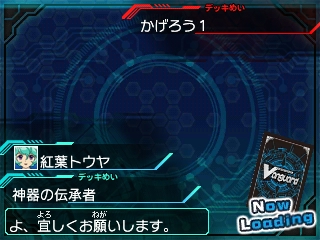
At the beginning of each fight, after choosing your deck, you get a lineup of your opponent's name, deck name, title, and personal phrase. The format is used for the player regardless of whether you're facing the AI or an actual opponent, only the AI only shows its name. Our current title is "Beginner;" additional titles are earned through doing "mission fights," basically premade puzzles.

We win the rock-paper-scissors to go first. This may sound strange to the kids today, but for a good three to four years it was considered superior to be the first place to reach grade 3. You whippersnappers with your strides and GB8s don't know how bad you have it.

When it comes to redrawing, I'm a conservative. I've known players that swear by keeping four cards in their redraw when they don't even have a grade 1, purely because those cards are combo pieces. Personally, I live by the idea that you should always have a grade 1, 2, and 3 in hand (these days 2 grade 3s, or a grade 3 and a stride fodder) and if you have the 2 and 3 but no 1, you should put back everything. It's better in my view to be living off of topdecks to get to the next grade than to be stuck at grade 0 for even one turn.

Whether or not our opening hand got worse after that redraw is a matter of opinion. On the one hand, we traded grade 2s for trigger units and didn't get any closer to grade 3. But on the other we now have defensive options for preventing the opponent from rushing us. One of the things I like about Vanguard is that the game is more about playing the hand that you're given rather than trying to execute the same single-minded strategy from start to finish every game.

Morikawa: Learn well my incredible power.

Mid-battle opponent dialogue is a new addition to LtV, and probably a necessary one given how much more dramatic the game is.

Morikawa is playing a generic Kagerou deck with a rainbow trigger spread built around a lot of miscellaneous grade 3s from multiple clans with unique skills that don't require a same-clan vanguard or rearguard. It's a strong idea in theory because you get a diverse skill set that mixes and matches the best aspects of each, but in practice it falls apart because it's so grade 3 heavy and those same skills are balanced by not being as strong as the exclusives. I've seen him play Hell Spider, Vortex Dragon, Dual-Axe Archdragon, Seal Dragon Blockade, Magnet Crocodile, Silver Spear Demon Gusion and Stealth Dragon Voidmaster; of these only Hell Spider and Voidmaster have ever been particularly splashable, being that they were designed for a time period when their respective clans were incomplete, while the rest are functionally vanillas in his deck.

Aside from the grade 3s, this deck uses a lot of vanilla units and skills that aren't actually unique to Kagerou, but shared with other clans. For example, his first vanguard is Egg Prison Seal Dragon Knight, which (depending on whether you count reveal order or set release date) is either a clone of Starting Legend Ambrosius or it's the other way around. By sliding the card into the soul and discarding one, Morikawa draws one card--a net negative, since he's giving up two cards to gain one. And it leaves his vanguard unboosted, so we're free to drop one of those 10k shields from our starting hand down to keep him from hitting this turn.

We ride a vanilla 10k and crit our way through the second turn.

Morikawa: My hand is so overwhelmingly awesome that I can't even ride!

This allows us to one-pass Morikawa without even guarding.

It's hard to be mad when somebody crits their way through a scenario they're still losing no matter what.

The Victory series covers up the limited animation of its character cut-ins by overlapping them with whatever incredible grade 3/4 is being played, which helps conceal how the cut-ins don't always line up with multiple variations on voiced quotes.

Mizuha gains 3k power when attacking a vanguard, which vs a gradelocked Morikawa is enough to make a "magic number"--i.e. her boosted power equals exactly the opponent's power plus 10k, and so requires a minimum two cards to guard. While in the format we're playing 21k is still a huge deal, these days the minimum magic number worth making is probably around 31k, what with G Guardians and all.

Morikawa goes into my second grade 3 turn with only grade 3s in hand, having spent all of his shield on Mizuha the turn before. I knew a Morikawa fight was probably not going to satisfy, so I've prepared something else to end this first chapter on.

At the end of each fight, you're awarded VP based on your performance. Your base VP depends on the opponent (Morikawa awards less than any other character) and then there's bonuses for doing things like activating limit breaks, persona blasts, or double triggering. Here we got a base win worth 250 VP, and 100 more VP for the opponent 6th damage healing.

Once you start stacking skill activations and things like reaching power benchmarks, the VP bonuses can get really crazy. This is from one of my Gust Blaster games in Stride to Victory;
That's 900 for a win (vs Kanzaki, I think) 300 for dealing six damage in one turn, 50 for using a limit break, 100 for break riding, 50 for reaching 30k power, and 100 for reaching 40k.

You also get a random card copied from the opponent's deck after winning. This time we got Vortex Dragon.

Morikawa: Guhhh...I can't believe I lost...
Ren: And that's that. I saw it all.

Tetsu: It's a little rough, but I do sense the makings of something.
Suiko: I'm glad our newest member is so interesting.
Asaka: Wait! I won't accept this yet! There's no victory to be found in defeating a hack fighter like this.
Morikawa: H-hack!? Guhhh...
Asaka: Perhaps I could accept this newcomer, if they defeated me. Is that acceptable, Master?
Tetsu: A fight between Touya and Asaka? Hm...
Suiko: That could be interesting, too.
Ren: ...I understand. Do as you please, Asaka. Is that all right with you too, Touya?
Tetsu: In that case, buy some booster packs and build a deck yourself. On top of that will be your entrance exam.

We began the game with 3000 VP, received 3000 from the RtV quiz, and 350 from cleaning Morikawa's clock, so in all we have 6350 VP. I'm sinking every last point into BT10: Triumphant Return of the King of Knights, which will be the basis for our Royal Paladin deck. The main body of Sanctuary of Light is in BT14: Brilliant Strike, but the supporting cards and (most importantly) perfect defense cards are all in BT10. Barring a brief weird moment for one particular deck during legion format, you can't play a deck without perfect guards, as there are always going to be attacks capable of exceeding all other available shield in a deck. (This has been the case ever since Cosmo Lord was printed.)

Time to open two entire boxes. Normally, each box contains 3 triple rares and two double rares. If a box has an SP, then it replaces one of the RRRs or RRs of the same rarity.

Highlights of our first box;
x1 Pure Heart Jewel Knight, Ashlei (RRR)
x1 Leading Jewel Knight, Salome (SP)
x1 Liberator of the Round Table, Alfred (RRR)
x1 Battle Deity of the Moonlit Night, Artemis (RR)
x1 Beast Deity, Ethics Buster (RRR)
x1 Grateful Catapult (RR)
x1 Liberator of the Flute, Escrad (RR)
x1 Flashing Jewel Knight, Iseult (RR) !!
x1 Halo Liberator, Mark (RR)
x1 Goddess of Self-sacrifice, Kushinadahime (RR)
x2 Eradicator Wyvern Guard Guld (RR)

With that grade 3 lineup, we're well on our way to assembling Royal Paladin.

Box #2:
x1 Pure Heart Jewel Knight, Ashlei (RRR)
x1 Leading Jewel Knight, Salome (SP)
x1 Eternal Goddess, Iwanagahime (RRR)
x1 Eradicator, Gauntlet Buster Dragon (RRR)
x1 Dogmatize Jewel Knight, Sybill (RR)
x1 Broom Witch, Callaway (RR)
x3 Supreme Army Eradicator, Zuitan (RR)
x1 Flash Shield, Iseult (RR)
x1 Halo Liberator, Mark (RR)
x1 Cheer Girl, Marilyn (RR)

I was originally uncertain about this, until I saw that I pulled two SPs in two boxes and ended up halfway to having my perfects finished. With our heavy Jewel Knight base, we're ready to start building.

To top things off I enter two secret passwords, netting us a playset of promotional cards. The first is a set of Seeker of Bravery, Ars--the Royal Paladin clone of Super Electromagnetic Lifeform Storm, an on-hit countercharge grade 2. The second code is for Clowdia, a generic Royal Paladin first vanguard that gives +3k to a unit by sliding it into the soul. It's not great, but under these circumstances it'll do.

Not a fantastic start, is it? One of the nice things about the set design at this point though is how Vanguard sets in this era were designed around providing substitutes for additional copies of other cards. Beginning with BT10, you start getting generic 8k grade 2 attackers that get 3k if you have a vanguard or rearguard with limit break, and similarly-powered attackers that just pay CB1 to meet their condition. The former works so well that it'll be a mainstay in our Sanctuary of Light deck.

Embedded into Card Capital is the Free Fight space. This is where you can play against characters you've already beaten at will, using specific decks, or connect online with other players. The main purpose of it is for VP grinding; I'll spare you the grief of seeing ten Morikawa fights.

There are a total of 81 fightable characters in Lock on Victory, 65 in Ride to Victory, and 59 in Stride to Victory. LtV has the largest cast of any Vanguard game, for reasons that will become...very much apparent, probably in Kai's story.

With another 3k VP under our belt, we're ready for our third box of BT10.

x1 Pure Heart Jewel Knight, Ashlei (RRR)
x1 Liberator of the Round Table, Alfred (RRR)
x1 Eradicator, Gauntlet Buster Dragon (RRR)
x1 Eradicator, Dragonic Descendant (SP)
x2 Grateful Catapult (RR)
x2 Bad End Dragger (RR)
x1 Dogmatize Jewel Knight, Sybill (RR)
x1 Liberator of the Flute, Escrad (RR)
x1 Flashing Jewel Knight, Iseult (RR)
x1 Goddess of Self-sacrifice, Kushinada (RR)

In the first game, once a box was bought the game would back up its contents so that you couldn't reset to try for a new configuration. This extended to multiple sequential purchases. Beginning with Lock on Victory, boxes no longer do this, so you're free to savescum to your heart's desire.

This is also when we start getting serious CP from our boxes, as we now have maxed out most commons and some single-rares. Collection Points are effectively a secondary currency used to get promo cards, given to you whenever you pull a duplicate of a card you already have 4 of. Stride to Victory revises them to be usable to purchase singles of cards you already own, a system I find vastly preferable.

This is what our deck looks like going into the next main mission. I swapped out the generic first vanguard for Dreaming Jewel Knight, Tiffany. At one time Tiffany was a staple of Royal Paladin decks, mostly for the purposes of mixing Jewel Knights into non-Jewel Knight builds--she can slide into the soul at any time during your main phase and give two Jewel Knights 3k, making if you have the setup you can have 21k columns the moment you ride a grade 2. Since most Jewel Knight support intentionally doesn't require a specific vanguard, instead just targeting Jewel Knight rearguards, it's easy to splash into other Royal decks.

 Our next main mission is against Asaka.

Asaka: All of the fight preparations are complete.
Tetsu: Asaka's fight...This should be enough to gauge your ability.
Ren: Touya, do your best.
Asaka: Master...
Suiko: I'm looking forward to seeing what kind of fight this turns out to be.

Asaka: Since this is your entrance exam, I will fight with test deck suitable for you. Let's go!

VS Narumi Asaka
Magicians of the Moonlit Night

We're second this game.

Asaka: If you can win against me, I will accept your admission.

As Asaka said, right now she's not playing any of her Luquier, Farah, or Chelsea decks from the anime, and we can see this right from how she starts the game. The grade 1 she rode is Magical Partner, the special booster for Nightmare Summoner Raqiel--a Silver Wolf Garmore clone for Pale Moon that superior calls on-ride. I have some special memories of this deck; back in the days when the western world primarily played Vanguard through the BYOND client Cardfight Capital, a friend of mine in France mained Raqiel from the moment it was revealed.

Of course, on CFC cards were available practically from the moment they showed up in the Japanese COTD or in KeroKero Ace magazine, so we weren't even waiting for BT09 to come out at the time.

Our opening hand post-redraw doesn't give any promises of a grade 3 ride, but it does give us options to poke the opponent on our grade 2 turn. That draw trigger will make a 17k column with either of the Julias, so effectively the worst part of our hand is that stand.

The first turn is ultimately nothing special--we drive check a vanilla heal trigger, Asaka damage checks a Dark Metal Bicorn. But on her own turn Asaka starts doing some prep work; her first vanguard, Girl Who Crossed the Gap, moves into the soul to bring out the Magical Partner she rode before, setting up her 11k booster for next turn. Magical Partner is one of many such boosters that doesn't have to boost a vanguard to give its power boost, turning additional Raqiels from being hand-cloggers into highly threatening rearguards. Granted, this was back when 21k rearguards mattered.

Asaka could have approached this from a quantity-over-quality angle and called that backrow Bicron to the front to score three attacks, but by placing it behind the vanguard instead made a magic number; 10k greater than our vanguard's base power. These older format plays may look empty on the surface, but they matter in a time when the game as a whole was transitioning out of high-base power vanillas and into weaker bases with crazy skills. The 17k is functionally unguardable for us, and had Asaka scored a crit here, playing that Bicorn would have been game-defining.

Going into our turn 2 we topdeck Ashlei, which pretty well cements our gameplan. Ashlei is as close to a vanilla breakride as you can get, her only secondary effect to the normal 10k you gain from riding over her is +1 critical. This early in the game, when the AI runs few to no perfect guards, breakriding Ashlei while the opponent is at 4 damage can be enough to bring an end to the match.

Asaka makes an important misplay on this turn. Our vanguard, Claudine, is an 8k base that when boosted she could have dropped a single 10k shield against and stopped dead in its tracks. By not doing so, Asaka functionally agreed to go to 4 damage at a point in the game where her limit break only serves to buff an attack that would never be guarded in the first place.

Asaka: Now look, on this splendorous show!

Next turn, Raqiel comes out. Asaka uses his counterblast 2 to superior call the Jumping Jill she rode last turn, then Jumping Jill gains 3k from her own skill.

With Skull Juggler behind it, that Jill now requires 15k shield that we don't have. So our recourse is to block the first attack of the turn and take the next two, accepting whatever damage that puts us at.

"Limit Break!"
Like Garmore, Raqiel's limit break grants him +5000 power when he attacks. The idea is to use that in combination with Magical Partner for a 26k endgame. (Or as we call it now, "vanilla stride.") Asaka drive checks a Barking Cerberus and Hungry Clown--nothing we need to worry about.

I don't like dropping a perfect defense as a booster ever, but at this stage in the game doing so will allow us to use Tiffany while keeping Tracy's power boost live. Essentially, one Tracy becomes a 15k unboosted versus Raqiel's 10k defense, the other one makes a 20k, and Asaka has 20k shield between her two intercepts and the two cards we've seen in her hand. Pushing her to 5 and making her guard at least one 15k this turn will put us in a position to win on the next turn, while saving that perfect guard will only constrain how we defend using our (probable) 4-card hand.

So, Tiffany's power goes to both Traceys, and Iseult goes behind Ashlei.

Asaka reveals just how bad her hand is, dropping both the Cerberus and Hungry Clown along with a Magical Partner she was saving to two-pass Ashlei--then this critical trigger raises our boosted Tracy to 25k.

If Asaka has even a single grade 3 in hand, she loses on this turn.

Asaka double intercepts and drops another Cerberus along with a Bunny from hand to block Tracey. On this turn alone, she's given up seven cards, all because she didn't use two 5ks on Claudine. Had she done that, then at this point she would have been able to no-guard the vanguard, still losing 3 cards to block Tracy but keeping a field to attack with.

On her turn, she topdecks Barking Wyvern. This is a clone of Martial Arts Sirius, Daikengo; it's a 10k base that gains 6k when it attacks by discarding a card. If Asaka had anything in hand, she could force us to give up an intercept to avoid dealing with Raqiel's limit break, but it still wouldn't save her from next turn.

Asaka heals down to 4 on her drive check, and we damage check a draw trigger, but that's all. She's going into our turn with 15k shield in hand, and all of our attacks will swing for 10, forcing her to take two damage. The "Final Turn" button wasn't added until Stride to Victory, but if we had it I would press it going into this.

She still attempts to one-pass our vanguard, probably not accounting for both Tracys being 12k attackers.

Asaka: My circus...

Asaka is worth a base 750 VP per win, considerably more than Morikawa. We get a Midnight Bunny for beating her.

Tetsu: There. Touya wins.
Suiko: My, my. He pulled it off.
Ren: That was a good fight. My eyes didn't lie.
Tetsu: Well, Asaka? Is this enough for you to accept Touya?

Asaka: ...I get it. I will accept Touya's admission! Get ready to train mercilessly from now on!

Ren: Congratulations. Touya. From now on, you're one of us.
Tetsu: I'm glad for you. Just like the deck Asaka was using this time, there are many test decks and trial decks here at Card Capital. As the clans differ, so too do their specialties. Try out many different kinds. Understanding the specialties of other decks is the most important thing in a fight.

This marks the effective end of the game's tutorial. From here, we have the freedom to do as we please. But first...

A word about my return.

Part 2: Freetime Events 
Part 3: THE Kai Toshiki
Part 4: Kamui
Part 5: Yuri