Sunday, May 10, 2015

Today's Card Analysis: Sovereign Dragon, Claret Sword Dragon

 "A claret sword. There lies a history of fresh blood."
The Japanese card of the day is one of the lead figures in Shadow Paladin's rebel faction, the military leader Claret Sword Dragon. A generalissimo seeking to take advantage of the clan's weakened leadership in Mordred's absence and overthrow Blaster Dark “Diablo,” Claret Sword will ring familiar for the supporters of Shadow Paladin's former patron deity Phantom Blaster Dragon. The Sovereign Dragon is to Blaster Dark as night to day, and a visionary for a different future for the clan.

ACT (Vanguard circle) Once per turn: Generation break 2: (Active if you have 2 or more face-up G Units in your vanguard circle or generation zone) [Choose two of your rearguards, and retire them] During this turn, this unit gets Power +10000 / Critical +1.
AUTO (Vanguard circle): [Counterblast 1] During your turn, when your G unit strides, you may pay the cost. If you do, search your deck for one grade 1 or less card, call it to a rearguard circle, shuffle that deck, during this turn, that unit gets Power +2000.

As was predicted, Claret Sword's on-stride counterblast 1 superior calls a grade 1 or lesser card from the deck and temporarily increasing its power, allowing a weaker unit with a utility skill to temporarily serve as a valuable booster before being retired by stride skills. The primary issue working against Claret Sword is the lack of genericized support for Shadow Paladin; the Revengers are the clan itself, and most effective support cards that do not belong to them instead go to the Blasters specifically.

Of the pre-Sovereign Star Dragon units, the card Claret Sword fighters will want to take advantage of the most is Black-winged Swordbreaker from BT15: Infinite Rebirth. Swordbreaker's on-call soulblast 1 to draw will build a net +2 in card advantage if Claret was strode over neutrally, refreshing the hand, providing a temporary base 8000 power booster and providing fuel for retire-based strides. Another potential target is the original Black Sage Charon from BT04: Eclipse of Illusionary Shadows and TD10: Purgatory Revenger, who with the power bonus will become a 10000-power booster that can form 21000-power lines with either Triple Dark Armor or the generation break 12000-power attacker Belberith.

Generally the cards introduced in G-LD01: The Dark “Ren Suzugamori” will not be compatible with Claret Sword because these units require a Blaster vanguard, but if your stride target is Phantom Blaster “Diablo” this won't be a problem for that turn. You can use Claret Sword to superior call Darkheart Trumpeter, use Darkheart's soulblast 1 to superior call Pitch Black Sage Charon, and since you have Blaster “Diablo” as your vanguard you'll be able to use Charon's Blaster-exclusive skill to make him count as two units at once, incurring a net change of 0--the same exchange as if you'd called Swordbreaker. The difference between Pitch Black Charon and Swordbreaker is that Charon allows you to maintain field presence, while Swordbreaker maintains handsize. Charon is an offensively-minded play, while Swordbreaker is defensively-minded.

Claret Sword is bringing his own leg of support with him, but with so little known of Sovereign Star Dragon it's difficult to say at this time precisely what to rely on. The promotional card Decipherer of Prohibited Books is one such option; her on-call generation break 1 counterblast 1 can superior call any grade 0, but in a generation break-centric deck with no recycling options where triggers are a finite resource, this is of dubious value compared to simply pulling out a Swordbreaker. Knight of Contempt Giiva is designed to support heavy retire skills, but as a grade 2 can't be superior called by Claret Sword and has to be brought out from the hand. The same holds true for Skull Witch Nemain, an old standby for Shadow Paladin veterans.

In terms of his stride targets, while Phantom Blaster “Diablo” is far and away the most desirable option for Claret Sword's endgame at this time, it should be kept in mind that Claret's on-stride counterblast sets up the otherwise-conditional Dark Knight Efnysian from Fighter's Collection 2015. Efnysian's on-stride skill retires one of your own rearguards to gain +7000 power and an on-hit retire skill, which can be impractical if you have no rearguards in play as a result of the opponent's card effects. Claret Sword gets around this by superior calling a card that can immediately be retired for Efnysian's skill to break even on your end and incur a -1 in card advantage against the opponent if the attack hits, and if you call out Swordbreaker this results in a net +1 to your own advantage and -1 against the opponent. Since Efnysian's skill makes him reach 33000 power by himself, if you do already have rearguards in play you can use Claret Sword to bring out a booster for Efnysian and increase its base power so that he breaks the 41000+ threshold.

Finally, Claret Sword's generation break 2 must be put under consideration. While his on-stride skill is reminiscent of Mordred Phantom, his generation break falls squarely within the realm of Phantom Blaster Dragon, down to its timing. Everything learned from Blaster Dragon years ago is applicable, including its shortcomings, but lets consider first how Claret improves the skill. Claret Sword does away with the counterblast cost entirely to get rid of the redundant costing on Blaster Dragon, meaning that so long as you have cards you can put into play, you can use his generation break. And only costing two units instead of three helps offset the lack of access to Pitch Black Charon for the Sovereign's retire skill. Phantom Blaster Dragon does have access to the generation break skills of Knights Dorint and Claudas from their legend deck to unflip damage with, and can make use of Darkheart, Swordbreaker and Charon, while on his own independent turns Claret does not have access to either Darkheart or Swordbreaker (the latter by connection to the former.)

Thus Phantom Blaster is generally looking at a counterblast 1 soulblast 1 retire 2 for his skill, sometimes at a net -1 rather than -2, and because Claret Sword has to wait so much later in the game to get his skill online in the first place, it's less immediately available by comparison. The major shortcoming of the Sovereign Dragon's generation break is that there are so many other cards with almost identical skills that are able to make use of them without paying any cost at all; Dragonic Blademaster, Battle Deity Susanoo, Dragonic Vanquisher and Charharlot Vampir all receive similar benefits passively rather than by actively needing to pay a cost. Secondary to this is that like with Phantom Blaster Dragon because Claret Sword's retire skill is a main phase retire that requires fronting two rearguards it has a hidden second cost, that essentially takes four cards out of your defenses. Every two units that you retire in the main phase have to be replaced with two more from the hand, weakening your overall ability to defend. A further discussion of these types of abilities is addressed in the History of Professional Cardfight. Where Claret has a leg up over his predecessor is that across several cumulative turns he is able to amass greater overall card advantage through repeated on-stride superior calls, and this can make him more viable in the long term. It simply weakens his overall offensive gameplay in terms of the generation break, which like Damned Charging Lance before it is destined to go unused.

Finally, Claret Sword's lore;
神聖国家の闇に生きる黒き騎士団“シャドウパラディン”の騎士。
血のように赤く染まったその剣から「クラレットソード」の名で呼ばれる。
「力こそ正義」という信念を持ち、騎士団に属していながら「神聖国家を影から支える」という思想に異を唱える。

Shinseikokka no yami ni ikiru kurokikishidan "Shadou Paradin" no kishi.
Chi no you ni akakushimatta sono kenkara "Kuraretto Soodo" no na de yobareru.
"Chikarakoso Seigi" to iu shinnen wo mochi, kishidan ni zokushiteinagara "shinseikokka wo kagekara shieru" to iu shisou ni i wo tonaeru.

Living in the darkness of the holy nation, there is a knight of the black order "Shadow Paladin."
Because of his blade stained red with blood, he is called "Claret Sword."
Believing that "power is justice," he opposes the ideal of "supporting the holy nation from the shadows" in spite of belonging to a knightly order.

Saturday, May 9, 2015

News: Japanese “Abyss” Prices Double, Raven Haired Ezel Debuts in Manga

Price charts coming out of Japan this morning have demonstrated that the average selling prices of the Shadow Paladin legion leader Phantom Blaster “Abyss” and his mate Blaster Dark Revenger “Abyss” doubled between the months of April and May. Phantom Blaster skyrocketed from a below-1500 yen average to 2500~2700 yen apiece. (Approximate conversion is going from $13 to $21~23 in US money.) For comparison, Thing Saver Dragon is current available in Japan for ~400 yen and Dragonic Overlord “The X” for ~600 yen. The “Abyss” price rise is reflective the results of the fifth Sapporo VGCS, in which “Abyss”-“Diablo” decks both dominated top spaces and accounted for 46% of all decks entered in the tournament, as well as the results of the West Japan and Kansai Spring Cup where Shadow Paladin made up 24% and 41% of the participating entries.

Blaster Dark Revenger “Abyss” has actually turned out as the more expensive of the two, starting at a similar price point and jumping up to 2600~3000 yen apiece. This is arguably based on Blaster Dark's greater utility in the “Diablo” deck, as the actual use of Phantom Blaster “Abyss'” restanding skill is low compared to Blaster Dark's cheap retire skill, which can be used to help force a win condition with “Diablo.” The original Blaster Dark Revenger has not experienced any comparable rise despite seeing similar levels of play, likely due to his widespread availability in VG-TD10: Purgatory Revenger. Both “Abyss” units were printed as triple rare cards in EB11: Requiem at Dusk, increasing their scarcity and making them subject to greater market fluctuations.

Original images donated by inaisekai.
In other news, this month's issue of Monthly Bushiroad magazine has come packaged with the latest chapter of Itou Akira's Cardfight!! Vanguard manga. Featuring a fight between Tatsunagi Kourin and Tokura Misaki, at the climax of the chapter Kourin rode a new unit "Raven Haired Ezel" in a bid to end the game. The new unit was ridden over Incandescent Lion Blond Ezel, potentially making Raven Haired a crossride of the original card. However, its actual skills were not explained before the fight ended.

Unlike in the anime series, for the manga Ezel was originally designed by Itou as one of Kourin's units, and she's used the Ezel deck since her introduction. During the Asia Circuit arc of the anime she gave her Blond Ezel to Aichi as a nod to Itou's original plan. Early on in her introduction to the manga, Kourin had a fight against Misaki in which the Magus cards debuted, and Kourin crossrode Platina Ezel over Blond Ezel; this latest chapter bringing in Raven Haired Ezel parallels their past battle.

The current arc of the manga approximately corresponds to the Link Joker arc of the anime, with Ibuki Kouji replacing Kai Toshiki and "PSY Qualia Zombies" replacing the Яeverse fighter phenomenon. (Itou had suggested the Яeverse concept to the anime staff while Link Joker was in its planning stages.) The previous chapter established Kourin to be working for "Cold Walker," an antagonist that seeks to control destiny and works from within Tatsunagi Takuto.

Thursday, May 7, 2015

Today's Card Analysis: Genesis Dragon Amnesty Messiah & Alter Ego Messiah

The Japanese cards of the day are the G unit Genesis Dragon Amnesty Messiah from G-BT03: Sovereign Star Dragon and her corresponding grade 3 Alter Ego Messiah from G-TD05: Fateful Star Messiah. Amnesty is the second Generation Rare from G-BT03, and the Messiah faction's new finishing move. The Amnesty stride functions like an inverted Tempest Bolt Dragon that gains power from unlocking rearguards, refunding the costs of her rearguards that lock themselves while also granting her opponents field presence in exchange for giving her power.

AUTO (Vanguard circle): [Counterblast 1] When this unit attacks a vanguard, you may pay the cost. If you do, choose any number of locked cards, unlock them, during that battle this unit gets +3000 power for each unlocked unit, and if the number of cards unlocked is 3 or more, during that battle this unit gets Critical +1.

Although this may seem lacking compared to something like the Abhorrent One that comes with innate guard restriction, the real value of Amnesty is in the combos she can pull of with skills that activate when cards unlock. Typically you can turn Amnesty into an unboosted 34000 power 2 critical line, and the purpose of this is to force guard from the opponent's hand and bait perfect defense cards if possible. The second critical gives the opponent no choice but to guard the attack when they're in the 4~5 damage range, even if it's only for one trigger to pass, and that can strategically ruin their hand to guarantee you the game. But when used in conjunction with the new Messiah support's bevy of on-unlock skills, you can strategically lock your own rearguards and then unlock them to draw benefits from that.

There are three primary units to use this with right now. The promotional card Dark Metal Chameleon is a good choice because his generation break unflips a damage when he's unlocked, refunding the cost of Amnesty. Moreover, Dark Metal has Resist and so can't be chosen by the opponent's card effects to be prematurely locked or retired, so there's very little to prevent Dark Metal from going off. Since you get to choose as many units as you like to be unlocked, having multiple Chameleons in play can also refund the cost of Amnesty's supporting units.

The Messiah subclan's first vanguard Neon Messiah is another good choice; when unlocked, by putting Neon Messiah into the soul you can search your deck for a grade 3 Messiah unit, enabling your stride for next turn. While you lose out on the boost of Neon for that turn, the net power Amnesty derives from unlocking at least two units will exceed that of Neon's boost, and the additional soul can be used for soulblast skills.

Heavy Material Dragon doesn't have an on-unlock skill, but actually locks one of your rearguards for his cost. He has the Nemain-like generation break of paying counterblast 1 discard 1 and locking a rearguard to draw two cards; by unlocking the rearguard with Amnesty, this is a net exchange of +1 while still getting your full offensive for the turn. You can also combo Heavy to Dark Metal Chameleon above, locking Chameleon for Heavy's cost and then unlocking Chameleon with Amnesty to unflip the damage that Heavy Material flipped. However, running Heavy also necessitates using base 8000 boosters to get your full offensive out for the turn.
The question remains of how you're going to get multiple rearguards locked in the first place, as just drawing Heavy Material Dragon isn't going to be reliable. By using Amnesty in tandem with the Fateful Star grade 3 Alter Ego Messiah, you can both increase the power of your center lane and ensure that you have rearguards to unlock. Alter Ego's on-stride skill locks both one of yours and one of the opponent's rearguards, creating a strategic gameplay where you can either choose to unlock only your own rearguards and activate their on-unlock skills, or you can choose to also unlock the opponent's to raise Amnesty's power further and try to go for broke on the offensive with a second critical. During the early to midgame it will be wiser not to do so, as a particular reward waits for you if you keep the opponent's rearguards locked...

AUTO (Vanguard circle): Generation break 2: [Soulblast 1] When a locked card unlocks, you may pay the cost. If you do, draw a card.
AUTO (Vanguard circle): [Counterblast 1, choose one of your rearguards and lock it] During your turn when your G unit strides, you may pay the cost. If you do, choose one of your opponent's rearguards and lock it, and choose one of your vanguards, during this turn it gets Power +5000.

Alter Ego's ultimate skill is a partial generation break revival of Chaos Breaker Dragon's limit break, one of Link Joker's most fearsome metagame giants. And unlike Chaos Breaker, Alter Ego's skill is not constrained to the end phase; if your opponent tries to use Lock Break Campaign units or Mithril Ezel to unlock their rearguards, you can soulblast to draw off of those unlocks. If the opponent unlocks five rearguards, you can draw five cards so long as you have the soul to fuel it. Since Alter Ego doesn't include the retire portion of Chaos Breaker's skill, your opponent will still return to the level of card advantage they were at prior to the lock, but thanks to the modifications made to the end phase last April, Alter Ego Messiah can now draw off of his own rearguards unlocking because skills with a timing of "when a card is unlocked" are put into standby with the same timing as "when put to G zone." The primary function of Alter Ego is to perform a burst draw during the opponent's end phase so that you can replenish your hand immediately before your turn starts and open up options, but after a point in the game you can also keep up continuous card advantage at the end of your own turn to turtle through the opponent's. The primary issue is keeping up the soul count, as a key difference between Chaos Breaker and Alter Ego is that Chaos Breaker had multiple turns of Infinite Zero Dragon and Palladium to sustain the necessary soul count. If Neon Messiah's skill will go off, Alter Ego will only be able to activate three times before you need to ride to rebuild the soul--which brings into question if running multiple Neon Messiahs is viable or not. With over twenty cards from Fateful Star Messiah and Sovereign Star Dragon yet to be revealed, the future remains open as to what kind of additional soul support the Messiahs will have, if any.

Shadow Paladin Extra Study Material: Revenger Series

Phantom Blaster Dragon, by himself, has never been a very good card. This is an unfortunate truth that Shadow Paladin cardfighters have had to live with. He has always been defined by his support system, and dependent upon it. The unit takes an enormous amount of skill, prediction, practice and good fortune to use competitively, so much so that virtually ever other grade 3 in his clan outmatches him in sheer practicality. So compared to his counterpart Soul Saver Dragon, Phantom Blaster has always fallen short of the mark. This was the status quo for two years, during which time Shadow Paladin continued to lag exponentially behind the progression of the game's most firmly buried decks like Deathrex and Cocytus; enter the Revengers.

This is the subclan that has answered virtually every issue that the original Shadow Paladins had. Where Fullbau was their only first vanguard in BT04, BT12 and BT15 brought two much more reliable units Frontline Revenger Claudas and Judgebau Revenger. Claudas' counterblast 1 sends him into the soul when you have a grade 3 vanguard to superior call Blaster Dark Revenger from the deck. This incarnation of Blaster Dark still costs two counterblast, so at face value Claudas is a counterblast 3 to rearrange your formation and retire a rearguard, which can be offset with other cards in the clan but is still not necessarily the optimal choice for FVG.

Judgebau meanwhile has the makings of one of the best first vanguard options in the game, rewarding the wait for grade 3 more than Claudas. When he boosts any Phantom unit and the attack hits you're cleared to counterblast 1 and throw him into the soul to call out any two grade 1 Shadow Paladins at rest from the deck. On the surface this is a +1 in card advantage, but with his skill you can target two copies of Black Winged Swordbreaker and then use Swordbreaker's on-call soulblast twice to draw a card off of each Breaker. This gives the Revengers draw power on par with Duo and Oracle Think Tank, and is one of the primary reasons that the Revengers outclass all of their competition within the clan.

Being able to jump up by +3 in a single turn sans limit break or legion is an enormous benefit, and as long as Judgebau is behind a Phantom unit that threat is constantly live. In contemporary times that Phantom unit will typically be a stride that has inherited the name of a Phantom heart card. Swordbreaker herself cannot be targeted for Revenger-specific retire skills and so should only be run at a maximum of two copies, and you may often find yourself using her exclusively as an intermediary booster before calling a Revenger over her later in the game. Swordbreaker also incentivizes the use of 10000-power grade 1 attackers like Masquerade and Lifechur, who form a 16000-power column with her. In the all-too-common event that a Swordbreaker is drawn, drive or damage checked and only one remains in the deck, superior calling a Swordbreaker with a Masquerade behind her that you can move up front next turn is an ideal play.

(Note that there is a misprint on the first English runs of Judgebau Revenger, which incorrectly states the attack he boosts has to hit a vanguard. This has been subject to an errata.)

The Revengers currently have two incarnations of Blaster Dark to their name, which like Judgebau go above and beyond the Shadow Paladins' original design methodology. Blaster Dark Revenger, introduced in TD10: Purgatory Revenger, can counterblast 2 on-call and on-ride when you have a Revenger vanguard to retire an opponent's frontrow rearguard, an improvement over the original incarnation's vanguard-exclusive retire skill. This is not Dark Revenger's real use, though. From BT12 the grade 1 Barrier Troop Revenger Dorint has the ability to unflip a damage every time Dark is placed on the same column as him, turning him into a counterblast 1 retire. The timing of Dark Revenger and Dorint is flexible, so that you can either retire a rearguard first and then unflip a damage, or unflip and then retire, allowing for punishing moves when you only have a single counterblast available. This is how the Revengers' strong pre-limit break midgame originally developed, using their superior call skills to bring out every single copy of Blaster Dark Revenger in the deck to repeatedly retire and unflip damage.

What Japanese cardfighters realized soon after the set hit is that Dorint and Dark Revenger are oftentimes potent as a pure unflipping engine, abandoning the retire entirely to compensate for other counterblast skills. To this day, this is the primary use of the Revengers' first Blaster Dark, keeping damage open while his second incarnation does the primary work with retiring. This use of the card is encouraged by a specific ruling (Card No. BT12/021EN) that states if a Blaster Dark Revenger is called over a Dorint, Dorint's unflipping skill will still trigger. This works because Dorint meets its check timing of "When your "Blaster Dark Revenger" is placed on vanguard circle or rearguard circle in the same column as this unit" causing its skill to queue prior to it being retired by game mechanic. This also means that if you only have one Blaster Dark Revenger in hand but two Dorints, you can call two Dorints to the field, a Blaster Dark Revenger over them, and unflip two damage after the Dorint you called over is retired. Thus while Revengers do not have access to a true Battle Sister Lemonade clone, they do have a massive supply of counterblast available through Dorint. While the Dark Revenger-double Dorint combo does cost you a net -1 in card advantage, the reason this ruling is so critical is because simplifies the number of working parts; it only requires three cards to unflip two damage instead of four.

Introduced in EB11: Requiem at Dusk is Blaster Dark Revenger “Abyss,” a legion mate reimagining of the card. “Abyss” consolidates Dorint and Revenger into a single card. When placed on the rearguard his counterblast 1 retires one of the opponent's grade 1 or lesser rearguards, giving up vanguard effects and intercept control entirely in exchange for being able to cheaply eliminate the opponent's boosting units. In general booster control is superior to frontrow control, giving “Abyss” an edge over his predecessors. Determining how best to utilize the two Blasters is probably the most challenging part of playing a Revenger deck. While “Abyss” is a permanent addition to many Revenger builds, other variations are better off without any forms of Blaster Dark. When it comes to playing both incarnations in tandem, there is a particular balancing act between using Dark Revenger for unflipping damage, or trying to retire entire columns for counterblast 2 by combining Dark Revenger, Dorint and “Abyss.” (Bearing in mind that Dorint specifically works with Dark Revenger and not “Abyss.”) If and how you will play these cards is primarily determined by your grade 3 lineup.

The Revengers have been subject to a number of updates through promo cards and alternative bosses, but the four truly competitive grade 3s used by professional cardfighters are Mordred Phantom, Raging Form Dragon, Dragruler Phantom and Phantom Blaster “Abyss.” As the subclan's break ride, Illusionary Revenger Mordred Phantom is a consistent staple of most Shadow Paladin decks. In light of how many different decks he can support, Mordred is arguably the best or second best grade 3 in the entire clan. When ridden over while at limit break 4, his counterblast 1 can superior call a grade 2 or lesser Shadow Paladin from the deck and give it +5000 power, while granting the standard +10000 power to your new vanguard. This works out as a net change of +/- 0, giving you back the card you put onto the vanguard circle as a card on the field, provided that you already had an open rearguard circle. (Superior calling over an occupied rearguard, while possible, counts as a loss in card advantage.)

As the humanoid alter ego of Phantom Blaster Dragon, the possibilities with Mordred's break ride skill are deliberately limitless. You can superior call one of the Blaster Dark variations from the deck to use their retire skill, and if you have Dorint on the field then regardless of which Dark you call it works out to a net counterblast 2. But you can also use Dorint with the first Dark Revenger to unflip the damage expended by Mordred and make the break ride completely costless, or you can superior call a unit that will itself superior call, like Dark Cloak Revenger Tartu or Wily Revenger Mana. Tartu is one of the primary reasons cardfighters originally latched onto Dark-Dorint as an unflipping engine.

She's a Revenger reimagining of Darkness Maiden Macha, with higher base power and the ability to counterblast 2 to superior call a grade 1 Revenger to the same column as herself. Meanwhile Mana is another variation on the formula with the same power as Macha, superior calling the grade 1 Revenger for no up front cost, but in exchange sending it to the bottom of the deck at the end of the turn. The two represent fundamentally different approaches, with Tartu providing a long-term advantage by superior calling a card like Dorint that can be put to use later after Tartu is retired or has intercepted, where Mana instead sets herself and the card she calls as sacrificial targets to compensate for the retire costs ahead of time.


If the opponent tries to spend the match denying Judgebau from going off by playing early defense, Mordred can superior call one of the Swordbreakers that Judgebau was unable to fetch and activate her draw skill while turning her into an 11000-power booster, forcing the card advantage out and partially negating their efforts. However, Mordred's primary use is with Raging Form and Blaster “Abyss,” making their initial attacks swing for exponentially higher numbers while ensuring that they also have a strong rearguard lane that turn which will draw out ~15000 shield before triggers are applied.

Since July 2013 Raging Form has reigned as the undisputed god of limit break Shadow Paladin, for good reason. While the other Revenger bosses are variations of Phantom Blaster Dragon, mechanically and visually Raging Form is a successor to Spectral Duke Dragon. His skill has no counterblast requirement; by retiring three Revenger rearguards at the end of the battle that Raging Form attacked, you can ride a copy of himself from your hand and give it +10000 power, allowing for a second attack at a 21000 power base. His secondary skill gives him +3000 power when he attacks for counterblast 1, allowing him to stand up to crossrides on a power level that pushes past the 23000 mark. Accounting for the sum -4 you take from retiring three rearguards and playing a copy of Raging from your hand, and the additional twin drive you gain from this second attack, his limit break works out to a net -2 overall in exchange for additional drive checks that can dramatically power up the last standing rearguard lane. Because riding over Form wipes the power gain he received from the break ride and any potential triggers, there is a particular incentive to keep a standing rearguard lane around to receive those triggers, which with Mordred's +5000 power boost can snowball into an unguardable rearguard lane once Raging Form's two attacks take out the opponent's perfect defense cards.

The only thing remotely difficult about Raging Form is getting the opponent to high damage before your break ride turn. During the BT12 period the general gameplan was to use Tartu to build up the field and serial call Dark Revenger with Dorint to repeatedly push the opponent down, then break ride Raging Form and continue on with an endgame plan to rapidly chew through the opponent's hand. If the opponent was already at 4~5 damage then each Raging Form attack would take at least two cards from their hand, and following the drive checks the last rearguard lane would average out to 26~31000 power. Today the fight is slightly more uphill for Raging. The retire cost and additional drive checks tend to consolidate all of your resources into your hand, which leads to large hand sizes in spite of the decreased card advantage, and also tend towards acquiring the remaining Raging Forms more easily as the game progresses. The primary opposition that Raging Form faces in present times is the format shift to legion instead of limit break, which took place in November 2014 for the English-language game. Starting in July 2014 Japanese cardfighters began pairing Raging Form with Phantom Blaster “Abyss,” eschewing the break ride entirely to focus on using two restanding vanguards in tandem.

Arguments against this deckbuild include that Raging Form is too slow for the format by needing to be at four damage while most legion decks will gladly stay at 2~3 damage for a much longer period of time, that Raging Form has always lacked synergy with Judgebau and the option for a restanding Phantom unit means that Judgebau ought to be paired with two Phantom grade 3s to ensure that double Swordbreakers can go off consistently, and that Raging Form's persona blastesque condition is too demanding when it may be better to reride “Abyss” than sit on Form until copies of it are exhausted. Raging Form apologists contend that even in “Abyss” the necessary damage required to make use of skills is so high that it may as well be a limit break, and that Raging Form is primarily intended as a finishing sequence after “Abyss” has gone off once or twice. The counterargument to this is that if “Abyss'” damage requirements are truly so high, then it benefits more from being paired with Mordred's limit break than it does Raging Form's, that because Raging Form cannot be searched by rearguard skills in the way that Mordred can trying to set up a clean transition from “Abyss” to RFD consistently is too demanding to be practical, and that Raging Form has better synergy when paired with its original base of support rather than by trying to go halfway in and halfway out of legion.

An explanation; Phantom Blaster “Abyss” is one of two successors to Phantom Blaster Dragon, and is part of a legion pair with Blaster Dark Revenger “Abyss.” At the end of the battle that “Abyss” attacked a vanguard during the turn that it performed legion, you can counterblast 2 and retire three Revenger rearguards to restand it. Because there is no reriding with “Abyss,” his power gain is not wiped by using the skill, which means that he retains both the triggers placed on him and the power from Mordred Phantom's break ride skill. Accounting for his own legion 20000 and the +2000 that “Abyss” gets just for attacking the vanguard, this is a ~32000 power column that restands just as big as it was before, which can easily overwhelm even a well prepared opponent. As a Phantom unit, “Abyss” can trigger Judgebau if you fail to set up your Mordred ride, and his 22000-power legion attack ensures that even after your resources are exhausted, unlike with RFD he will always attack with a strong center lane.

The caveat to “Abyss” is that his skill only works on the turn that he performs legion, and you can only legion once with each copy of “Abyss,” which provides a very limited window to restand with. Unlike RFD, “Abyss” does not have the benefit of being able to restand after attacking a rearguard. This may seem trivial, but one of the last support cards keeping the Link Joker clan's “Ω” Glendios deck relevant in the format is Rubidium, a grade 1 that when placed on the guardian circle can retire itself to redirect an attack to a rearguard with “Яeverse” in its card name. Because it changes the target of the attack to a rearguard, this deck can actually prevent “Abyss” from restanding, something which Raging Form need not fear. However, Glendios' status in the progressing legion format is in serious question, as it is not only competing with units that do not depend on limit break, but also with legion cards like Blaster Joker from within its own clan.

Perhaps the strongest and most overlooked argument in favor of Raging Form-“Abyss” lies in the data it provides you. A skilled fighter will always know exactly what kind of position they are in relative to their opponent because of the feedback the deck provides. If at any point prior to your third ride phase you draw “Abyss,” that is then your grade 3 ride. If you open with Raging Form in hand, this changes things; your second turn play is (if possible) Creeping Dark Goat to try to switch over to “Abyss,” but from the moment you ride Raging Form the role of the two grade 3s reverses. In order to avoid wasting copies of it, each Raging Form Dragon has to hit the vanguard circle before you can even consider “Abyss,” who has now become your endgame play to restore the deck after three restands with Form. Furthermore, riding Raging Form immediately makes Tartu live, as you now only need to maintain two counterblast for the endgame, and can generally anticipate healing at least once and set up an unflip with Blaster Dark Revenger to open up that counterblast. Raging Form-“Abyss” can also go to much higher damage numbers earlier as a safe play, maintain a strong hand size throughout the fight, and with two retire-based vanguards can play a defensive game of preventing the opponent from retiring or locking their own cards by racing to be the first to retire them.

So there are multiple ways to play both Raging Form and Blaster “Abyss,” and strong arguments in favor of each. Restanding is not the limit of the Revengers, however. Phantom Blaster has one last incarnation to draw on. Revenger Dragruler Phantom is a crossbreak ride of Mordred that rarely sees play as an independent deck, but often works as a supporting intermediary ride for both Raging Form and “Abyss.” Where other retire grade 3s hybridize Spectral Duke's restand into the clan, Dragruler instead reimagines Phantom Blaster Dragon's extra critical as an extra damage. During the main phase Dragruler can counterblast 1 and retire two Revengers to gain +10000 power and deal a point of damage to the opponent if they are at 4 or less.

This has been incorrectly characterized as burn damage by some fighters, but because it cannot actually kill the opponent it should be understood as a more dedicated form of extra critical attack. In a pre-legion format Dragruler effectively controls when the opponent is allowed to use their limit break, allowing you to starve them of their resources until you're certain that they're incapable of winning, and then send them to 4~5 damage. As a supporting unit to Form he works as one more step between Mordred and RFD, forcing the opponent to stare down a ~38000 power center lane and rearguards attacking for ~21000 power before they are adequately prepared to defend. Dragruler's crossride defense helps to survive the opponent's next turn so that you can transition into Raging Form for the coup de grace.

In legion format Dragruler serves a similar purpose, but for Phantom Blaster “Abyss” instead. This is a contested pairing because it eliminates the benefit of break riding with “Abyss” over Mordred, but the rationale behind it is that because damage and defense are much more important in legion format, the opponent will be both more devastated by and less prepared to guard Dragruler's limit break. The opponent will still benefit from their damage triggers, and in legion format because you are sending them to more damage than in limit break format there is a greater risk of this occurring, but at the very least Dragruler's power boosts will outweigh the opponent's defensive checks. Dragruler is a bizarre boss card because with every limit break after the first, the less you have to use him the better off you are. Retiring two rearguards to deal a damage is not so bad, but having to give up four or even six is a ridiculous cost to pay within a single turn and can cripple you beyond recovery if used poorly. Dragruler Phantom is thus the least self-writing of the Revenger bosses and also the most difficult to use, because he does not inherently dictate when or how to use his skill within his own card text. You have no option but to use Mordred, Raging Form and Blaster “Abyss” whenever you are able to; Dragruler gives you the option to use him as little or as much as you like, and to play him correctly you have to be keep an awareness about the opponent's drive checks and hand, the state of the game, and whether limit breaking is really necessary or not. If you choose to play him, there will both be games where Dragruler is absolutely pivotal, and games where he is completely useless. You do not always need to deal an extra damage, and if you choose to do so it may cost you the game because of the resources this demands.

As his own deck, Dragruler is one of the few vanguards to benefit from not running Blaster Dark variants. In place of them you use the Overcoming and Self-control Revengers, Rukea and Rakia. Rukea is a grade 2 that gains +3000 power whenever a grade 1 or lesser rearguard is called, while Rakia is his grade 1 counterpart that gets +3000 power whenever a grade 0 rearguard is called. Grade 0s like Freezing Revenger make ideal retire targets for Dragruler, and Swordbreakers cannot be retired for his limit break and so serve only as intermediary boosters in that deck. So after crossbreakriding Dragruler over Mordred and superior calling a rearguard (like the Revenger Masquerade variant) with Rukea and Rakia in your other column, you call two grade 0s (potentially over your Swordbreakers) from your hand and then retire them for Dragruler's limit break to send the opponent from 3 damage to 4.

By repeating this skill a second time with two more grade 0s, you not only get the opponent to 5 damage, but Dragruler is now a 43000 power column unboosted and Rukea and Rakia each have +12000 power on them; the column's total power is 40000. Your last rearguard lane, having the power from Mordred's break ride, will be at around 21000 power when boosted. Some Shadow Paladin fighters have been tempted to run stand triggers in the deck to capitalize on these high power lanes, but the problem with stands is that they force you to dedicate to a strictly chance-based element of the game that you have no control over, and in doing so you are required to play and attack with any available rearguards you have on preceding turns just in case you drive check a stand trigger, which conflicts with waiting for Judgebau to go off before making serious field dedication. This also unduly exposes yourself to opposing attacks on rearguards and/or retire skills. Rukea and Rakia have an incredible amount of synergy with Mana and Masquerade, as Mana can target grade 1 or less Revengers for her skill, and so pull out a Freezing Revenger that pumps up their column by +6000 power before she sends the trigger back to the deck at the end of the turn. Even if you don't draw Rukea, Rakia can still act as a 10000+ power booster for Masquerade, making a 22000-power column.

Rukea also has strong synergy with Judgebau, as he does not require the grade 1s called to be Revengers, only that the vanguard be a Revenger. Hence if you use Judgebau to go into double Swordbreakers while Rukea is on the field, Rukea will get +6000 power and spring a surprise attack on the opponent with more power than they were expecting.

The Dragruler deck is generally more difficult to master than either Raging Form or “Abyss,” but whether it's more rewarding or not is questionable. There's no doubt that he's effective as a supporting unit. Transforming the additional critical into an extra damage that makes every rearguard lethal is a brilliant reimagining of Phantom Blaster Dragon, and unlike his predecessor there is a genuine element of risk and reward to the card. One of the primary reasons that Dragruler is so effective as a supporting unit is because of the risk associated with him; in the games where you are better off not using his skill, having the option to transition into Raging Form or “Abyss” gives you an effective finishing move in what would otherwise be a vanilla deck. With Shadow Paladin having not yet received one of the proper BT17-on limit break enablers, playing dedicated Dragruler has become more and more difficult each day, so if you are to play him then you are better off weighing the options of Raging Form and “Abyss” as your primary grade 3s.

In addition to Phantom Blaster “Abyss,” Requiem at Dusk introduced a pair of new Revenger support cards that have proven invaluable in legion format. The first is the grade 2 Fighting Spirit Revenger Macart, whose rearguard skill superior calls a grade 1 or less Revenger at rest when you perform legion. Unlike Tartu and Mana, Macart is not restricted to calling units into the same column as himself. This allows you to easily replace your Swordbreakers once they've outlived their usefulness, offset the cost of retire skills and serves a powerful midgame purpose in building or recovering card advantage. Because of Macart's existence and the ability to fetch him with Mordred Phantom, it is incredibly difficult to punish Revengers for making aggressive plays. You're free to push the game early with both versions of Masquerade, and after the opponent has tried to retaliate by attacking and/or retiring your rearguards, respond by using Macart to get back to the units they thought you had lost.

Macart also allows for normally impossible plays. If you breakride Blaster “Abyss” while having only two available counterblast, you can superior call a Macart with Mordred's counterblast 1, then when you perform legion use Macart's skill to superior call Dorint to your opposite rearguard column. Dorint does not have to be standing to use his skill, so you're free to then call a Blaster Dark Revenger to his column to unflip a damage, leaving you again with two open damage for “Abyss'” retire skill.

Unfortunately, Macart also introduces the great flaw of Mordred-“Abyss.” Because of the high damage requirements of the deck to pull off its winning play, its ability to easily recoup lost card advantage, and the way in which this aspect both encourages open aggression and minimal defending, at every turn in the fight Mordred-“Abyss” incentivizes advancing the tempo of the game as much as possible. Every rearguard you have available sans Macart and Blaster Dark Revenger should be played the moment they are in your hand, to force the opponent to the lethal point at which your restanding 32000 power vanguard becomes a game-winning condition. You must convince the opponent to put you at limit break by pushing them to that same limit, and Macart dangerously enables this. If you refuse to do so, it gives over control of the game to the opponent and threatens to let them control your own damage. Ideally, they should be panicking, not choosing between putting you at limit break or otherwise, but giving you the fourth damage because they have no choice. Because of this rapid tempo, Mordred-“Abyss” games are often decided by initial hands rather than agency or smart play. Once you have the key combos down, it becomes a game of outrunning the opponent.

Hence, a saving grace of Raging Form-“Abyss” is that it shifts the timing of the limit break. Instead of needing limit break to begin your endgame gambit, in this deck you can pursue legion at the first opportunity and begin mowing into the opponent with Phantom Blaster “Abyss” early on, taking advantage of how it consolidates your rearguards into your hand to maintain a strong offensive and defensive midgame while protecting your field from retire skills, devouring them yourself to prevent them from being devoured by the opponent. Once at limit break and after your counterblast is exhausted, you can transition into Raging Form Dragon as your finisher. This option would eschew Macart entirely due to the removal of Mordred and subsequent lack of ability to search for him, instead taking advantage of Tartu or Mana with Rukea, alongside the two Blasters. The Mana option is a strong one, but comes with baggage attached. Running Mana generally means running Rakia, and if one goes then so does the other; Rukea and Rakia's power bonuses synergize with Mana superior calling the units that trigger their skills, and Rakia is one of the few units that can make Mana attack for more than 15000 power. Having a counterblast-free call option is excellent for Ragming Form-“Abyss” because it avoids dedicating counterblast entirely and provides the one superior call option that exists at a point of equilibrium between the others, being equally beneficial to both Raging Form and Blaster-“Abyss.” However, turning to Raging Form is not the only means by which to break the aggressive impetus of Mordred-“Abyss.”

Macart is related to a lesser used legion, Ambitious Spirit Revenger Cormack. His base skill gives him +3000 power when there is another unit in the center column, which can take the form of either a boosting unit or that of his legion mate Macart. If you take the first move then Cormack is an elegant means of forcing the opponent to take damage while still at grade 2, as he'll form a 19000 power line with any base 5000 or greater booster. And while in legion, by retiring any Shadow Paladin rearguard when he attacks, Cormack can gain an additional critical. Early game critical skills are excellent way of pushing the game, and Cormack synergizes with Macart by retiring the rested unit that Macart superior called when he performed legion.

If you run Cormack with Mordred, then he can either use the Swordbreakers as retire targets to make a double critical line with upwards of 33000 power, or after several turns of the opponent attempting to deny Judgebau from going off with high shield and perfect defense cards, you can then breakride Cormack and render all their efforts at midgame defense for naught. Having already exhausted most defensive options against Mordred while at 3 damage leaves the opponent in a precarious position against a double critical vanguard. The trick with Cormack is how many you're willing to dedicate to; three copies of each grade 3 including both Mordred and “Abyss?” Two Cormack, two Mordred and four “Abyss”? Balancing the grade 3 ratios in this deck is a matter of personal experience.

For now the last word in Revengers comes from G-FC01: Fighter's Collection 2015, out June 19th. While the future will see many strides released for the clan that the Revengers are capable of interacting with, at this time FC01's triple rare Shadow Paladin is the only stride that makes Revenger use a prerequisite. True Revenger, Dragruler Revenant's once-per-turn skill is activated in the main phase; by retiring one of your Revenger rearguards, if you have a heart card with Revenger in tis card name, you can search your deck for a grade 1 or less Revenger, call it to a rearguard circle, and have both Revenant and that unit gain +3000 power.

Revenant's skill is subtle in its importance. In a Phantom deck you can use it to make a solid midgame push, calling Rukea and Rakia to give Rukea +3000 power followed by Mana to bring out a Freezing Revenger, whose call will give both knights an additional +3000. Then by retiring Freezing Revenger for Revenant's skill and pulling out a Rakia or Masquerade, you can give another +3000 power to Rukea while solidifying Mana's +1 by exchanging the unit she called for a different one. This will result in Mana attacking for 18000 power, Dragruler Revenant for 36000 boosted, and Rukea for 28000 power, all prior to trigger checks. In an “Abyss” deck you can use Revenant to pull out a Dorint for Blaster Dark Revenger, or a Masquerade to make an unboosted 13000 power attack. While not an endgame card--nor even something remotely approaching Dragruler's "true" form--Dragruler Revenant is a consistent means to glue together your midgame and push the opponent into a difficult situation that will lead you to the end path. The card primarily benefits “Abyss” rather than a Phantom deck, and will likely be a staple one-of in Revenger decks for months to come.

In summary, the Revenger subclan has addressed every issue faced by the original run of the Shadow Paladins, and has carved a niche for itself in retiring multiple units per turn while also making high power vanguard and rearguard lanes. What the subclan lacks in a diversity of explosive card advantage options it makes up for in the high quality of what it has to work with. At this point in time the Revengers are Shadow Paladin itself, and face virtually no competition for that title. Hardcore Revenger fans will want to look into a Revenger-specific playmat from Ultra Pro; but those looking for a group truer to the spirit of the original Shadow Paladins will want to pass this one over, as for all their mechanical improvements the antiheroic tone of the Revengers is discordant with what once was.

Today's article was made possible by the donations of our patrons at Patreon. Cardfight Pro is funded by public contributions from readers like you.

Wednesday, May 6, 2015

Today's Card Analysis: Storm of Love, Kiskil-Lilla

The Japanese card of the day is a single rare stride for Dark Irregulars from G-BT03: Sovereign Star Dragon, the Storm of Love Kiskil-Lilla. Named for the Sumerian incarnation of the night-storm demon Lilith, Kiskil-Lilla is an early game on-hit stride on the same level as Gablade and Grim Recruiter in other clans. Like those units, Kiskil-Lilla's primary role is to act as a high power pressure unit that baits opponents into dropping more guard to block her than her cardfighter would gain from her on-hit, but in the event that her attack does hit the setup it grants will greatly expedite the process of setting up killing moves like bringing out the Abhorrent One.

AUTO (Vanguard circle): When this unit's attack hits a vanguard, Soul Charge 2, and if the number of cards in your soul is six or more, draw a card.

Counting the cards granted from her on-hit, to reach the six soul skill for Kiskil-Lilla's draw skill you'll generally need to soulcharge 2 beforehand. The easiest way to do this is with the House of Amon series, as in addition to the Hell's Draw, Deal and Nail soulcharge support they already have, in G-BT03 they've also received a new first vanguard "Amon's Follower, Barmaid Grace." When striding with Kiskil-Lilla you'll also receive the name of the unit in the heart, and by striding over either Astaroth or Amon himself you'll be able to use their skills to reach Grace's conditions. Using the Amon series also grants access to the trigger unit Amon's Follower Grausam, who when soulcharged can pay a cost of counterblast 1 to retire an opponent's unit. G-BT03 introducing on-soulcharge skills scales up the threat of Kiskil-Lilla immensely, as without any particular dedication on your part the opponent is now threatened by these skills giving you forms of advantage in addition to Kiskil-Lilla's draw. This incentivizes them to put down their hand guarding a high power center lane they should be ignoring, weakening their defenses for later on in the fight.

Alternatively, when using the on-stride counterblast of Charharlot Vampir the soul will already be at 4 from Charharlot's soulcharge 2 and so naturally reach 6 if Kiskil-Lilla hits. The skill that Charharlot gives to Kiskil-Lilla when she strides will also trigger with a timing just prior to her draw effect ("when this unit attacks a vanguard"), so that if you reach the 6 soul threshold prior to attacking you can both draw a card and retire an opponent's rearguard that turn while getting the soul prepped for the Abhorrent One. Werbat Ordonnanz, Dimension Creeper and the Alluring/Flirtatious Succubi can all enable this. In other words, both Amon and genericized Dark Irregulars give you access to similar soul engines as well as draw and retire skills, but they come attached to different timings are each convenient in different ways. Using Charharlot generally means losing access to the benefits of legion as well as quick on-call soulcharge skills, while using Amon takes away the guaranteed nature of your retire skills and makes you dependent on rearguards for soulcharging. The choice of which to use is up to you.

One should be careful not to make the mistake of trying to combo Kiskil-Lilla's soulcharge to Doreen the Thruster; because Doreen only benefits from main phase soul charges, and Kiskil-Lilla's on-hit takes place in the battle phase, it's impossible for Doreen to power up from the Storm of Love. Similar mistakes were common with No Life King Death Anchor several years ago, with many newer Irregulars cardfighters mistakenly believing they could put +15000 power on Doreen from Anchor's on-attack skill because it put five cards into the soul, and it would be easy to make the same mistake with Kiskil-Lilla's soulcharge 2.

News: “∞” Glendios Tops West Japan and Kansai Championships, Kagerou Disappears Overnight

"The unending apocalypse, infinite Ω."
Link Joker made an unanticipated return at the apex of two major tournaments yesterday, with both the West Japan VGCS and Kansai Spring Cup seeing Death Star-vader “∞” Glendios in first place. In both cases, Link Joker represented a minority among the participants. At the Spring Cup 35 3-man teams (105 persons) participated, but only two cardfighters played Link Joker among them. At the West Japan CS there were 86 participants, with the 5 Link Joker fighters split between Glendios and Blaster Joker. With the support that it's received in Fighter's Collection 2015, “Ω” has come out as a dark horse answer to the swarm of “Diablo” decks now flooding tournament play.


"Sold out." Photo by inaisekai.
Unusually for a post-Generation Stride tournament, no Kagerou cardfighters were present at the 86-person West Japan Vanguard Championship. The clan collapsed entirely in the face of “Diablo,” with many cardfighters jumping ship to Shadow Paladin and Narukami. Meanwhile at the Spring Cup only 10% of all fighters present played Kagerou--occupying the same niche that “Abyss” filled prior to the Legend Deck's debut. Meanwhile the Legend Deck is selling out in stores across Japan, and Japanese card shops are struggling to keep up with demand. “Abyss” made up 24% of all tournament entries at the West Japan CS, and 41% of the entries at Kansai. Glendios' top at the Spring Cup was complementary to this; while team forward Shokushu lead the way for his mates by going undefeated in the nine rounds he played, both of his teammates were playing Revenger decks with “Diablo” support. (Unlike other team tournaments, the Spring Cup did not prevent teammates from using the same clan.)


Shokushu's “Ω” Glendios deck focused on using its Fighter's Collection 2015 upgrade Death Star-vader “∞” Glendios. (Read as "Omega Loop" Glendios) For counterblast 2 and by turning a copy of itself face-up in the generation zone, “∞” places a card from the top of the opponent's deck onto their field locked for every “Яeverse” rearguard the Omega cardfighter controls. The stride's skill also effectively incorporates an ultimate break of its own, as if the Glendios fighter has five damage then the opponent's rearguards will not unlock during their end phase. This means that, barring any changes in damage as a result of trigger checks, an “∞” deck with five “Яeverse” units in play and five damage will guarantee themselves to automatically win through “Ω” Glendios' World End ultimate break during the main phase of the next turn, provided that the opponent does not have any unlock skills attached to their vanguard and that the Link Joker cardfighter is able to defend through their opponent's turn.

By cutting out even more grade 2 space than is standard, Shokushu was able to make room for both thirteen grade 1s and twelve grade 3s, helping accommodate  “∞'s” stringent requirements. His opponents were forced to avoid granting him five damage, only having the option to send him directly from four to six or not at all. Shokushu reported his individual matchups; six of the nine rounds he played were against Shadow Paladin cardfighters. (Shokushu's other rounds were against Narukami, a team that forfeited and Aqua Force.) He did not lose a single game during the tournament, despite some of the advantages Phantom Blaster “Diablo” had in those matchups. This record may be attributed to his teammates--the team's midfighter Nero and its captain Buretan both played Revenger decks, hence Shokushu had ample opportunity to practice for the matchup. Shokushu was also no stranger to playing Glendios, as he had topped the third Kansai CS sub tournament with it back in July 2014.

Another potential reason for Shokushu's success was the tournament format. Prior to top 16 the Spring Cup used a five-round Swiss system, with each round lasting 20 minutes and being constrained to best-of-one games. The first round began at 11:00 AM, the second at 11:35 AM, and so on. The tournament finals were best-of-three with a 50 minute time limit, and clan fight rules were enforced throughout. But because the initial five rounds were in best-of-one and every opponent facing “∞” Glendios had an incentive to keep the deck at four damage, the format was arguably biased in Glendios' favor. In any given game the looming threat of “∞” hitting the field prevents opponents from putting Glendios fighters to five damage, while still staring down 22000-power “Яeverse” rearguards every turn and having higher damage incentivized by the time limit. Conflicting priorities force poor decisions out of the opponent, to either risk putting the Glendios cardfighter at five in the belief that they will be unable to guard the next turn's stride attack, or to go to five damage themselves to scramble for an additional counterblast while in the immediate short-term putting down less guard. With a 20-minute timer, trying to send a Glendios cardfighter straight from four to six damage becomes less viable as the clock may finish counting down before that can happen.
Kansai Spring Cup Clan Distribution (105 participants)
43 Shadow Paladin
16 Narukami
11 Royal Paladin
11 Kagero
6 Aqua Force
4 Megacolony
4 Oracle Think Tank
3 Great Nature
2 Dimension Police
2 Link Joker
1 Nova Grappler
1 Pale Moon
1 Spike Brothers
The Kansai VGCS Spring Cup took place over the course of two days from May 4th to 5th at the Naniwa Citizens' Hall. 48 teams (144 participants). Entry was 4500 yen (approx. $38) and first place won a carton of G-BT03: Sovereign Star Dragon and were qualified for two byes for the second day of the tournament. Second place won six boxes of Sovereign Star Dragon, third place three boxes, and fourth place one box. Clan fight rules were implemented. The decklists for Shokushu's teammates are still forthcoming.

Do-re-mi Town. Original image by Morichan.
Second place at the West Japan VGCS was Sanctuary Guard Royal Paladin, third place Thavas-Strikehead Aqua Force, and fourth place Exxtreme Battler Nova Grappler. The tournament was sponsored by Cardbox, one of the original shops to support Cardfight!! Vanguard in Japan. It was a singles division tournament, held on the third floor of Do-re-mi Town, an entertainment center in Okayama prefecture. The first round began at 11:00 AM, with each round lasting 20 minutes. The tournament finals began at 2:30 PM, and the closing ceremony was held at 6:30 PM. Entry at West Japan was 1000 yen for those that preregistered and 1200 yen for those that registered on-site. First place won eight boxes of Fighter's Collection 2015 as well as a voucher for 5000 yen. Second place won four boxes of FC2015 and a voucher worth the same, third place two boxes and a 3000 yen voucher, while fifth through eighth places won a single box.
West Japan VGCS Clan Distribution (86 participants in total)
21 Shadow Paladin (Revengers and Blaster Dark "Diablo," 1 Witch reported)
12 Royal Paladin (Thing Saver, Jewel Knights)
9 Narukami (Brawlers, Eradicators)
5 Link Joker (mostly Glendios, a few Blaster Jokers reported)
5 Nova Grappler (Exxtreme Battlers, Raizers, and Asura reported)
5 Aqua Force (Thavas, Maelstrom)
4 Oracle Think Tank (2 Tsukuyomi, 1 CoCo, 1 Susanoo)
3 Murakumo (Hyakki Vogue)
3 Dimension Police (Metalborgs)
3 Gold Paladin (reported no Pellinores, Ezel, Liberator)
3 Great Nature (Tester Fox)
3 Gear Chronicle (reported no Upheavals)
3 Megacolony (1 made it to Top 16)
2 Granblue
2 Neo Nectar (Musketeers, 1 with Captain Cecilia, 1 without Captain Cecilia)
1 Pale Moon
1 Dark Irregulars

1 Genesis (Legion)
The VGCS tournaments are a series of unofficial tournaments organized by fans and cardshops. Unlike Bushiroad's official tournaments, most VGCS events are done using a best-of-three, Swiss tournament model. Turnout is typically 70-80 persons, but some events see 100 or more participants, all of whom compete using pseudonyms and internet handles rather than their real names as in official events. The VGCS model of fan-organized play has begun to gain popularity internationally, with the bi-monthly BeNeLux tournaments serving as their European equivalent, and there are now similar grassroots organizations emerging in the United States like the ARG Circuit series tournaments and the King of Cardfight competition in the American midwest.

Kansai VGCS Spring Cup
Championship team
Forward: Shokushu/しょくしゅ
Grade 0
x1 Star-vader, World Line Dragon (FV)
x4 Star-vader, Pixie Powder HT
x3 Star-vader, Jailer Tail DT
x3 Star-vader, Nebula Captor DT
x4 Apollo Nail Dragon CT
x1 Star-vader, Meteoliger CT
x1 Star-vader, Spark Doll CT
Grade 1
x4 Refusing Deletor, Evil
x4 Star-vader, Ruin Magician
x4 Taboo Star-vader, Rubidium
x1 Star-vader, Volt Line
Grade 2
x3 Star-vader, Magnet Hollow
x3 Companion Star-vader, Photon
x2 Star-vader, Colony Maker
Grade 3
x3 Star-vader, “Ω” Glendios
x3 Star-vader, “Яeverse” Cradle
x1 Eradicator, Vowing Saber Dragon “Яeverse”
x1 Dark Dimensional Robo, “Яeverse” Daiyusha
x1 Silver Thorn Dragon Queen, Luquier “Яeverse”
x1 Deadliest Beast Deity, Ethics Buster “Яeverse”
x1 Cleanup Celestial, Ramiel “Яeverse”
x1 Broken Heart Jewel Knight, Ashlei “Яeverse”
Grade 4 (Generation Zone)
x4 Snow Element, Blizza
x4 Death Star-vader,  “∞” Glendios

Midfighter: Nero/ネロ
Decklist pending

Captain: Buriten/ブリテン
Decklist pending

West Japan Vanguard Championship
Champion
Grade 0
x1 Star-vader, World Line Dragon (FV)
x4 Recollection Star-vader, Tellurium HT
x3 Star-vader, Nebula Captor DT
x3 Vortex Star-vader, Molybdenum DT
x3 Star-vader, Weiss Soldat CT
x3 Apollo Nail Dragon CT
Grade 1
x4 Refusing Deletor, Evil
x4 Star-vader, Ruin Magician
x4 Taboo Star-vader, Rubidium
Grade 2
x4 Star-vader, Magnet Hollow
x3 Companion Star-vader, Photon
Grade 3
x4 Star-vader, “Ω” Glendios
x4 Star-vader, “Яeverse” Cradle
x1 Covert Demonic Dragon, Hyakki Vogue “Яeverse”
x1 Dauntless Dominate Dragon “Яeverse”
x1 Eradicator, Vowing Saber Dragon “Яeverse”
x1 Maiden of Venus Trap “Яeverse”
x1 Dragonic Overlord “The Яe-birth
x1 School Punisher, Leo-pald “Яeverse”
Grade 4 (Generation Zone)
x1 Miracle Element, Atmos
x3 Snow Element, Blizza
x4 Death Star-vader,  “∞” Glendios

Tuesday, May 5, 2015

Announcement: Cardfight Pro Live on Patreon, Twitter

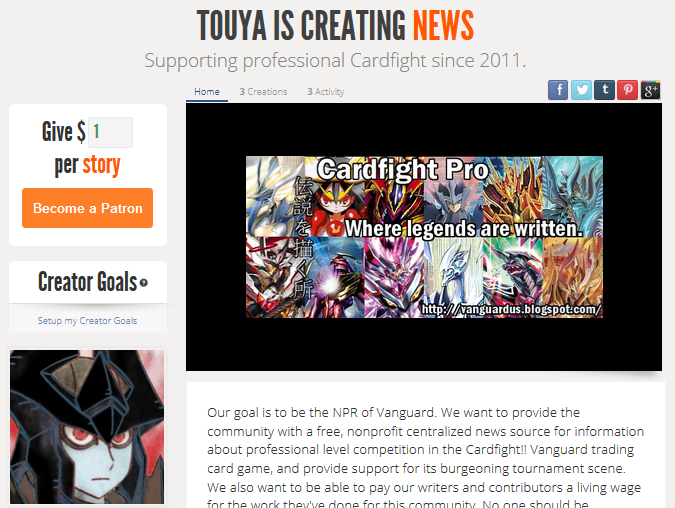
Over the past few months, we at Cardfight Pro have increasingly had to face a problem that we would be remiss to ignore. No one should ever be expected to work 48 hours a week and not be paid a living wage for their contributions, but this is exactly the dilemma we have to address. When we started out in 2011 our work was done for free, as a labor of love; but the bar is higher in 2015, and the hours necessary to create quality news are longer. Our goal is to be the NPR of Vanguard. We want to provide the community with a free, nonprofit centralized news source for information about professional level competition in the Cardfight!! Vanguard trading card game, and provide support for its burgeoning tournament scene. We also want to be able to pay our writers and contributors a living wage for the work they've done for this community. Working for the good of the community and paying our employees are not mutually exclusive decisions; as part of our solution, we've opened up our Patreon page to public donations. Cardfight Pro will be written for and supported by the public.

Patreon is an efficient system which allows patrons to donate whatever amount they feel the content is worth, or are able to pay. Patrons of Cardfight Pro can donate through a pledge, paying whatever amount they feel comfortable with on a monthly basis. We do not need a tremendous amount of money, nor should anyone feel compelled to donate large sums. If all of our readers donated just $4 a year, our chief editor would make minimum wage. (Note that a pledge can be made for one month only and then canceled later, to make the donation truly one-time.) As Cardfight!! Vanguard continues to grow and Cardfight Pro grows along with it, we will be able to hire more permanent staff, and realize our long-term goal; a print publication available on the magazine racks of retailers and bookstores across the United States. If our campaign is successful, readers will observe an immediate effect of their support--Cardfight Pro will move to a twice-daily schedule, updating in the mornings and evenings every day of the week. As an immediate reward, patrons who pledge $4 or more will be able to suggest articles to be written and published on Cardfight Pro, and all patrons will have the option to receive public acknowledgment (in the form of their name, their username or other preferred identification) at the end of news articles. Business owners that pledge $8 or more will also be able to have their business identified as a source of support, allowing them to advertise their brand on the site. Those who pledge $30 or more will be able to have a strategy or deck analysis article written at their request.

As part of our transparency policy, all funds donated through Patreon will be disclosed annually during our end-of-year reporting in December. Money paid to employees and contributors will be clearly labeled, as will work-related expenses for travel and equipment. At this time it is believed that upwards of 98% of the funds received will go to paying the employees. We have no desire to misuse the funding our supporters provide; Cardfight Pro must match the will of the community as nearly as is possible. Our services will always remain free to the public. No one will be excluded from content based on donating too little or not at all.

Although the bar can always be set higher, Cardfight!! Vanguard is by far one of the best balanced games of its era and we do not want to drop an opportunity to help develop the very special community it is host to. Your donations will enable us to travel nationwide to cover tournaments across the United States, and eventually internationally.

We are also now live on Twitter; follow us @vanguardus