Showing posts with label toronto. Show all posts

Wednesday, September 4, 2013

News: World Championship 2013 Canadian Regional Decklists

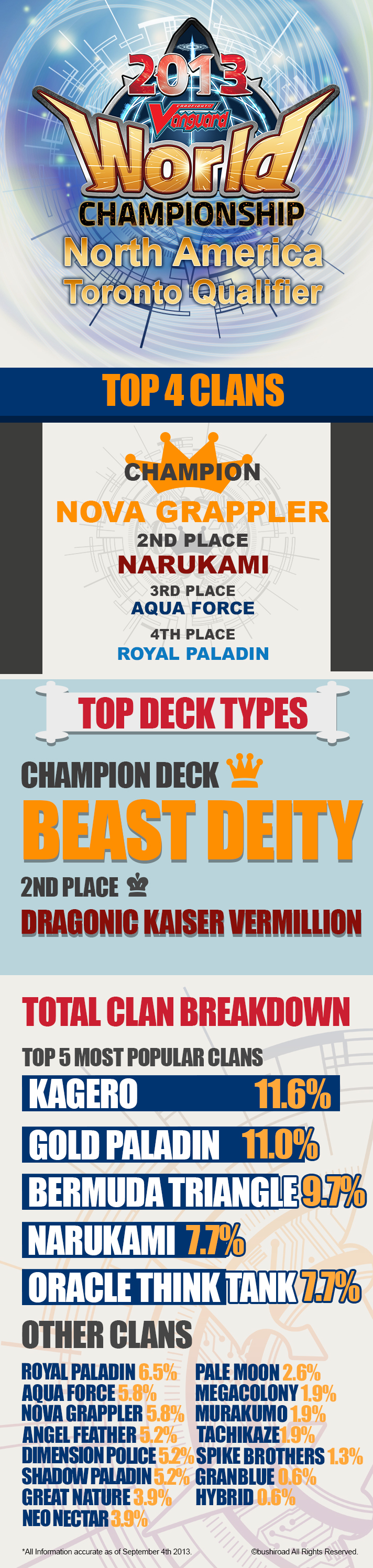
The official English Cardfight!! Vanguard portal has been updated with deck recipe spaces for every branch of this year's world championship, and with this update has come the decklists from the weekend's WCS2013 Toronto qualifier. The qualifier's results came as a surprise following a format that had been dominated largely by Dragonic Overlord the End, as regional champion Sebastian LeBon won the tournament using a Nova Grappler deck based around Illuminal Dragon, while runner-up Kevin Perron took his position with a Narukami deck built on Dragonic Kaiser Vermillion and his crossride "THE BLOOD."

Sebastian LeBon: Beast Deities 
Grade 0
x1 Beast Deity, White Tiger (FV)
x2 Shining Lady CT
x4 Ring Girl, Clara HT
x2 Three Minutes DT
x4 Red Lightning CT
x4 The Gong DT
Grade 1
x4 Tough Boy
x4 Twin Blader
x3 Beast Deity, Scarlet Bird
x4 Beast Deity, Blank Marsh
Grade 2
x2 King of Sword
x1 Hungry Dumpty
x4 Beast Deity, Black Tortoise
x4 Beast Deity, Golden Anglet
Grade 3
x4 Beast Deity, Azure Dragon
x3 Ultra Beast Deity, Illuminal Dragon


Note that while only the top 2 decklists from Toronto are being provided, the top 4 finishers from the regional have been invited to the North American finals. The decks not represented in the deck recipes are Robert Ewell's Tri-stinger Dragon and Kevin Luu's Majesty Lord Blaster deck.

One of the differentiating features of LeBon's Illuminal deck is the use of Scarlet Bird. Many Beast Deity builds avoid the card now due to its low 6000 base that doesn't play well with a format dominated by 13000 power defense, but LeBon's deck plays toward making offensive moves throughout the entire length of a match rather than just after limit break, and Scarlet Bird's skill gives him one more way to search out one of the pieces of his main strategy without any need for counterblast. Although units like Blank Marsh and White Tiger aren't well suited to the endgame of the crossride format due to no single unit being able to break 13000 unboosted, many cardfighters have difficulty dealing with the earlier offensive plays and this helps feed to an endgame where Illuminal stands one full column after the opponent has hit 5 damage, letting it use every line to attack the opponent previously and still leave one standing to pass triggers onto. Attacking early and hard is a very simple strategy, but trying to oppose it oftentimes means surrendering the lead in card advantage for the duration of an entire game, and making that compromise can be a very risky play.

Kevon Perron: M.I.A. 
Grade 0
x1 Spark Kid Dragoon (FV)
x4 Demonic Dragon Nymph, Seiobo HT
x2 Yellow Gem Carbuncle CT
x4 Malevolent Djinn CT
x3 Mischievous Girl, Kyon-she DT
x3 Spark Edge Dragokid CT
Grade 1
x4 Red River Dragoon
x4 Wyvern Guard, Guld
x3 Photon Bomber Wyvern
x3 Rising Phoenix
Grade 2
x2 Dragonic Deathscythe
x4 Thunderstorm Dragoon
x1 Demonic Dragon Berserker, Garuda
x4 Dusty Plasma Dragon
Grade 3
x4 Dragonic Kaiser Vermillion
x4 Dragonic Kaiser Vermillion "THE BLOOD"


Meanwhile Perron's Kaiser Vermillion stands out for its grade 2 lineup, focusing toward Thunderstorm and Dusty Plasma, both cards that assist in making those 18000 lines to negate crossride defense and in other cases make unboosted swings. Unlike contemporary DKV decks which frequently feature Deathscythe as a 4-card staple of the build, Perron chose to put Deathscythe on the backburner, entrusting field control to Vermillion. His treatment of Garuda is also an interesting choice. Many DKV decks run Garuda at 3 or 4 copies, but by focusing less on Deathscythe, Perron opened up his damage zone considerably so that he would not need a heavy focus on unflipping to use his Vermillions' skills multiple times. Of his grade 1 lineup, Rising Phoenix is arguably the most important supporting framework from the deck, since it can make up for Spark Kid Dragoon's skill failing or otherwise make use of the soul for a normal +1 that helps stretch out a difference in cards between Perron and his opponent when factoring in the -2~4 incurred to them by his limit breaks while providing improved consistency through raw draw power. Our hats are off to Mr. LeBon and Mr. Perron for a lively opening to this year's world tournament.

Bushiroad has also released a full breakdown of clan representation within the tournament. Kagerou and Gold Paladin were the most popular clans, followed by Bermuda Triangle, Narukami and Oracle Think Tank, with Royal Paladin as the sixth most played. These numbers are fairly normal, and can be taken to generally correspond to the six key units of the format DOTE, Platina Ezel, Labrador, "THE BLOOD," Tsukuyomi and Majesty Lord Blaster. Below is the full table of 19 clans reproduced in text, and numbered according to the order of Bushiroad's info graphic, which is based on how highly used each clan was. The only clan complete in the English format but not represented at Toronto are the Dark Irregulars, with every other available clan finding some representation.
  1. Kagerou 11.6%
  2. Gold Paladin 11.0%
  3. Bermuda Triangle 9.7%
  4. Narukami 7.7%
  5. Oracle Think Tank 7.7%
  6. Royal Paladin 6.5%
  7. Aqua Force 5.8%
  8. Nova Grappler 5.8%
  9. Angel Feather 5.2%
  10. Dimension Police 5.2%
  11. Shadow Paladin 5.2%
  12. Great Nature 3.9%
  13. Neo Nectar 3.9%
  14. Pale Moon 2.6%
  15. Megacolony 1.9%
  16. Murakumo 1.9%
  17. Tachikaze 1.9%
  18. Spike Brothers 1.3%
  19. Granblue 0.6%
  20. Hybrid 0.6% (represents a combination of clans)

Monday, September 2, 2013

News: Nova Grappler Places First in Toronto World Championship Qualifiers, Tri-stinger Dragon Turns Heads

Note: To help better organize the community and answer questions about WCS2013, there are now help threads on the Neo Ark Cradle forums and Cardgame!!Coalition.

The World Championship 2013 regional qualifiers have begun, with the first North American qualifier in Toronto having finished yesterday evening. Regional champion Sebastien LeBon fought his way to the top using a Nova Grappler deck, currently believed to be a Beast Deity build. The victory comes as a surprise to the world of pros, as Nova Grappler has never been a strong component of high level play, and even more surprising is that no Dragonic Overlord the End decks placed in the regional. LeBon may have brought some exciting innovations to how the Grapplers are played. Runner up Kevin Perron played a Narukami deck, rumored to be a Dragonic Kaiser Vermillion "THE BLOOD" build, third place fighter Robert Ewell used an Aqua Force deck based around Tri-Stinger Dragon, and fourth went to Kevin Luu with Majesty Lord Blaster. All four cardfighters have received invitations to the North American national finals in Pasadena, California.


The presence of Tri-stinger in the regional finals instead of Glory Maelstrom has also been a surprise. The deck has been relatively underground up to this point, but those well versed in Aqua Force can attest to its strength. The main strategy of Tri-stinger builds is to use the Dragon's counterblast 2 to power up a rearguard Basil or Benedict by +3000, so that they can swing for 13000 with their initial attack, and then either (in Basil's case) swap places with Coral Assault or have Benedict stand and swing for 13000+ power again with as little as a 5000 power boost. With Tri-stinger's limit break, he unflips the 2 counterblast that he paid when he attacks in the third or more battle of the turn, allowing him to make the maneuver all over again in the next turn. This quality of making four 13000+ power attacks per turn helps Tri-stinger to contend effectively with the crossride decks that have caused so many problems for Aqua Force since their debut, quickly eating up their 5000 power shields and forcing them to drop 10000 shield per each attack by way of not having anything else to guard with. Furthermore, Tri-stinger plays a very vicious game against other limit break decks, deliberately using Astraea to make a 14000 power vanguard line that constantly baits the opponent to guard in a way that they never reach their limit break until they have no resources left to guard with.

According to on-site informants, approximately 300 people attended the Toronto regional. Reigning world champion Brandon Smith was in attendance, and lasted until the final elimination round to make it into the top 16, but took two losses spread across the tournament's third and seventh rounds from gradelock, causing him to be eliminated. As Smith will still be competing for this year's championship title in subsequent tournaments, we will not be disclosing his deck type.

Alarmingly, in the aftermath of the Toronto regional some sellers have taken to selling the WCS2013 regional promo PR/0069EN Creeping Dark Goat at four times the price of any other contemporary promo card, going as high as $18.99 for a single copy, and almost twice the price of Circle Magus, a previous world championship promo released last year. Goat is a promo card whose English-language release was met with celebration earlier this year, as the card has been called Shadow Paladin's most competitive first vanguard, both in the English and Japanese formats. Critics of the high price have pointed out that there is no real market for the pricetag, as without the Revengers in the English format Shadow Paladin is generally ranked lower than Megacolony in competitive application, and only played by hardcore fans of the clan. Consumers are discouraged from buying overpriced Goats, as that price is unlikely to go down unless CDG becomes unsellable at these artificially inflated prices.

Monday, September 3, 2012

Spotlight: Brandon Smith

Fighter's Spotlight is an ongoing project concerned with tracking real-world professional cardfighters across the globe. 
Smith is at the bottom right. Opposite him is John Pedro, the Canadian runner-up for 2012. Original photo by Cardfight USA.
Brandon Smith
Birthdate: July 29, 1986
Titles Won: Canadian Regional Champion, North American National Champion (2012), World Champion (2012)
Current Status: World Champion (Former, 2012)
Deck Type: Gold Paladin (Spectral Duke Dragon)
Brandon Smith is the former international champion and one of two out of 120 fighters to have qualified in Toronto to participate in the 2012 North American national championship. Originally an Oracle Think Tank cardfighter from outside Canada that later converted to Royal Paladin, he made the leap to Gold Paladin following Barcgal's restriction and used his experience from local play to rocket into the throne of the North American continent. Following this, he became the leading fighter in the world and the first World Champion in history. Smith was also instrumental in the early spearheading of Cardfight in the United States, bringing the game into Collectible Investments in the very first month of its release.

In addition to his victories at Toronto, Los Angeles and Tokyo, Smith participated in the Chicago regional while Brandon Bastianelli used their deck, but was eliminated in the top eight and came in sixth. During the North American Stand Up Challenge Cup, Smith used a Majesty Lord Blaster deck, but abstained from participating past the regional level due to a scheduling conflict with the on-site gunslinger event that he was running at the championship finals.

Smith competed using a Great Nature build in the 2013 World Championships, making top 16 at the Toronto regional qualifier and going 12-1 at Chicago; his one loss became the tiebreaker that set him outside the cut to top 8 without the chance to participate further. Despite being denied the opportunity to defend his title, Smith remained positive and continued to encourage others to play Cardfight!! Vanguard. His tenure as world champion ended with the close of the WCS2013 on January 12, 2014, with the title formally passing over to European cardfighter Almeida Stewart.

Decks and Play Style
Smith's deck was co-developed between him and Bastianelli, with Bastianelli having developed the early build, later dropping it for the Royals while Smith fine-tuned it. As a result of their diligence, the finished deck would eventually top both the Canadian and Chicago regionals, with no modifications made between appearances.

Smith adheres to the Spectral Duke Dragon style of play, using an eight critical, four draw build to try to maximize his output critical, forcing the opponent to race him for damage and activate his limit break more easily. The extra critical triggers also help with Duke Dragon's self-standing skill, as it retains the effects of the triggers upon standing, mitigating the relative lack of threat that it poses upon losing twin drive. Smith chose to use Gwydion over Falcon Knight for his lone draw, most likely because Gwydion's 5000 power can still push Duke Dragon up to 16000 or Gigantech up to 17000.

Sleygal Dagger and Little Battler, Tron both work as alternative boosters to one another, Tron turning Duke Dragon into a 21000-power column while Dagger can achieve similar numbers by repeating her counterblast. Due to the popularly questioned integrity of the 2012 championship's double and single elimination format, the most widely agreed upon point about Smith's deck is that its main feature is the ride security. Unlike other cardfighters, Smith's use of the Vortimer ride chain gives him seven extra cards to parse through for his grade 2 and 3 ride, helping to ensure that he does not miss a ride or on his initial twin drive.

Smith's Spectral Duke also emphasizes Viviane more commonly than contemporary builds, compensating for the steep loss in advantage that Duke Dragon's powerful limit break confers. His deck is somewhat weakened by the absence of Tripp, as without the ability to unflip damage, any counterblast that Smith uses is permanently lost. This weakens his capacity to survive the latter parts of a match, since without any counterblast the deck's skills are cut off from use, but as it's inherently difficult to survive a well executed Dragon rush, it's rare for the deck to reach that point in the game.

Winter 2012 Regional Tournament, Canada
Card Pool: TD01-BT03, BT06-EB03, PR 0001-0029
Grade 0
x1 Black Dragon Whelp, Vortimer (FVG)
x4 Silent Punisher CT
x4 Elixir Sommelier HT
x4 Weapons Dealer, Gwydion DT
x4 Flame of Victory CT
Grade 1
x2 Sleygal Dagger
x4 Halo Shield, Mark
x1 Little Battler, Tron
x4 Scout of Darkness, Vortimer
x4 Knight of Elegant Skills, Gareth
Grade 2
x4 Knight of Superior Skills, Beaumains
x3 Player of the Holy Bow, Viviane
x4 Black Dragon Knight, Vortimer
Grade 3
x4 Spectral Duke Dragon
x3 Gigantech Destroyer

This decklist ultimately went unchanged for the national tournament, taking the North American title without modification.

Winter 2012 National Tournament, North America
Card Pool: TD01-BT03, BT06-BT07, PR 0001-0029
Grade 0
x1 Black Dragon Whelp, Vortimer (FVG)
x4 Silent Punisher CT
x4 Elixir Sommelier HT
x4 Weapons Dealer, Gwydion DT
x4 Flame of Victory CT
Grade 1
x2 Sleygal Dagger
x4 Halo Shield, Mark
x1 Little Battler, Tron
x4 Scout of Darkness, Vortimer
x4 Knight of Elegant Skills, Gareth
Grade 2
x4 Knight of Superior Skills, Beaumains
x3 Player of the Holy Bow, Viviane
x4 Black Dragon Knight, Vortimer
Grade 3
x4 Spectral Duke Dragon
x3 Gigantech Destroyer

Smith's decklist proved extraordinarily long-lived, once again going unmodified for the world title.

Winter 2012 International Tournament, Japan
Card Pool: TD01-BT03, BT06-BT07, PR 0001-0029
Grade 0
x1 Black Dragon Whelp, Vortimer (FVG)
x4 Silent Punisher CT
x4 Elixir Sommelier HT
x4 Weapons Dealer, Gwydion DT
x4 Flame of Victory CT
Grade 1
x2 Sleygal Dagger
x4 Halo Shield, Mark
x1 Little Battler, Tron
x4 Scout of Darkness, Vortimer
x4 Knight of Elegant Skills, Gareth
Grade 2
x4 Knight of Superior Skills, Beaumains
x3 Player of the Holy Bow, Viviane
x4 Black Dragon Knight, Vortimer
Grade 3
x4 Spectral Duke Dragon
x3 Gigantech Destroyer


Interviews
Smith and Bastianalli were both interviewed six minutes before the Chicago regional award ceremony, by an editor from Cardfight Pro (then operating under the "Game Set" brand.) The full text and an audio recording of the interview can be found here.

Additional Images
Smith is second from the left, holding the championship trophy. Original photo by Cardfight!! Vanguard. On the right is runner-up Henry Suharto, to the right of him fourth-place finalist Christopher Sok, and on the far left is third-place finalist Christopher Fernau.

Sunday, July 1, 2012

North American National Championship Qualifier Locations

Initially leaked in an Anime Expo 2012 announcement, revised dating and location information for the 2012 North America qualifiers has just been added to the Bushiroad website. With consultation from professional event planner and media manager Alyssa Fisher, here is our forecast for the events.

Marriott Toronto Airport Hotel, Toronto, Canada: September 1st. Most event spaces at this hotel only seat 12-16 people, so speculating on the event's locale is easier. The conference rooms have enough room to host the Canadian qualifier, but do not provide a single open space for the tournament to be overseen in. The Grand (840-1000 individuals) or Junior Ballrooms (180) are much more likely locations due to their open shape and high carrying capacity.

Wyndham Dallas Love Field Hotel, Dallas, Texas: September 8th. Less information is available for this location than most, but the First Class A&B rooms can accommodate 330-600 people in various configurations.

Update: This location has been changed to Hyatt Regency Dallas. This is probably due to Hyatt's higher carrying capacity, as virtually any event space in the hotel can hold 1,000 people. Marsalis Hall on the exhibition level is one possibility due to its enormous size, well suited to being stocked with arranged and cordoned-off tables to create competition space, but it may be too large for the estimated attendance. The Reunion Ballroom or Landmark sections on the lobby level are also probable, with many configurations that lend themselves well to the qualifier while maintaining a high seating count.

Gamesmart MX, Mexico City, Mexico: September 15th. Information on this facility is sparse, but notably the website mentions that the winner of the qualifier will receive plane tickets and accommodations to the championship site.

The Comcast Arena, (Listed as Seattle, Washington but actually in Everett, Washington): September 15th. The Edward D. Hansen Conference Center addition is almost confirmed as the site (it's specified on the CF-Vanguard website where otherwise you would only list "The Comcast Arena"), but any given event space inside of it can hold up to 800 people, so there's no specific location that can be said of at this time.

Chicago Marriott Schaumburg Hotel, Chicago, Illinois: September 22nd. The most likely place for the qualifier is the ballroom, which can seat up to 1000 people. The only other area within the hotel grounds of comparable size is the Grand Marquis Tent, which can seat up to 350 people, but as it is a tent it is most likely unsuitable for the qualifier's purposes.

New Jersey Convention & Exposition Center, (Listed as New York but actually inside of New Jersey): October 6th. Any of the four exhibit halls has a carrying capacity exceeding 1000. The conference center can probably be ruled out due to how the space is compartmentalized, but exhibit halls A through D still stand. Taking into account the junior and main ballrooms, the designated space is basically impossible to predict.

North Atlanta Trade Center, Atlanta, Georgia: October 13th. Appears to provide only a single space, so speculation is unnecessary.

Anaheim Convention Center, (Listed as Los Angeles, California but actually located in Anaheim, California): November 3rd. This is where the national championship will be held. The situation is essentially the same as with the NJCEC, being that there's no particular space that lends itself well to the situation. The first floor exhibit halls are likely, however. Note that this was a past Anime Expo location.

While even the most popular of card games often only see a turnout of around 500 to these types of tournaments, when accounting for spectators, as well as friends and family brought in by the participants, the total room needed by the event space doubles.