A recent tweet from Bushiroad CEO Kidani Takaaki has revealed that the third season of Cardfight!! Vanguard will be having Japanese rock band Psychic Lover perform the opening theme. This will be the first opening not performed by JAM Project, and the change in musical artists is speculated to be a result of the poor reception of OP03 "Limit Break" compared to the series' first two openings, and/or because of JAM Project currently being preoccupied by the upcoming release of their 51st single, "The Wings of Legend."
Although primarily known for their work done for live action Super Sentai shows, like JAM Project before them Psychic Lover is also associated with the Yu-Gi-Oh! franchise, through the fourth ending theme to Yu-Gi-Oh! GX "Precious Time, Glory Days" and to the Super Robot Wars line of video games through the music they did for 2005 mecha anime Gaiking: Legend of Daiku-Maryu.
Showing posts with label yu-gi-oh. Show all posts
Sunday, November 25, 2012
Thursday, September 20, 2012
News: Cardfight!! Vanguard 3DS
To much applause yesterday, subscribers to the video game magazine Famitsu were revealed an up-and-coming Spring 2013 3DS title, Cardfight!! Vanguard Ride to Victory. The game is being developed by FuRyu, previously known for the
Tsukumonogatari PSP visual novel-RPG hybrid and the 3DS/PSP dungeon
crawler Unchained Blades, and will be retailing for 5229 yen, about 66.82 USD. While information is scarce at this time and the game is allegedly only at 40% completion, it is currently known that it will recreate the experience of playing the tabletop game, but on a handheld console. If and how this will take advantage of the 3DS' glasses-free 3D is unknown at this time, but the announcement is drumming much excitement from fans. As Cardfight's publisher, Bushiroad Inc., has had its hands in the video game market since before they turned their eyes to producing the CFV franchise, many have been waiting for this announcement since the anime debuted in January of last year.
While there are many questions in the air as to how the title will be executed, already we do have some answers. The game is to feature its own original storyline, but still based on the anime series, with the protagonist seeking to challenge Japan's fictitious pro scene and fight for the national title. Aichi, Ren, Kai, Shin, Misaki and Kamui have all been confirmed through screenshots or scans to be making appearances, but their exact role at this time is uncertain. Players will be able to use points earned in the game's story mode and free play to buy cards from the in-game Card Capital to modify their decks.
The current phase "battle phase" and inside of it "attack step" is listed in katakana at the top left; current number of cards remaining in deck, number of cards in the hand, cards in soul, and available counterblast are at the top right alongside a fighter's portrait. This setup is mirrored for the bottom left. Note that despite the season 1-inspired plot, Aichi is wearing his Circuit-era outfit. This pattern is likewise true for the remaining cast. Assuming that this screenshot comes from the 3DS' top screen, the hand seems to be shown on the bottom.
Other confirmed details are that the in-game shop will sell booster packs directly patterned off of their real-world equivalents. Noticeably, none of the screenshots or magazine reveals so far have shown any cards from after TD07; due to the game being less than halfway complete, it may be speculated that cards from BT07-08 will be included in the final product, depending on its date of release. Additionally, magazine scans appear to reveal a new, original character not present in the existing continuities.
This character may be a protagonist to embody the player in the game, if Aichi himself is not the protagonist.
While these initial shots look promising, there are many predecessors in the genre already pinning the fledgling game's shadow. As early as 1997 MicroProse's Magic: the Gathering had recreated the earliest TCG in computer form, boasting free character customization, accurate recreation of gameplay and an expansive overworld to explore. Hudson Soft's 1998 Pokémon: Trading Card Game featured similar depth of innovation by converting the experience into a portable game accessible to a broader age range, taking advantage of the programmed environment to include cards that did not exist in the real world. In 1999 Konami completed this early triumvirate of VTCGs with the last entry of the "Big 3," Yu-Gi-Oh! Forbidden Memories, a PlayStation release frequently criticized for its inaccurate gameplay but lauded for its detailed graphical presentation--more akin to a visual novel than a VTCG as was established then--and for taking its own direction with an at-the-time incomplete storyline. Ride to Victory appears to follow a middle ground between the Memories and Pokémon patterns that were previously used in the Tag Force games, not sewing its plot from wholecloth but instead providing a different adaptation of a past storyline.
Aside from these early forerunners, Japan's domestic VTCG market is already flooded by purely virtual innovations based out of arcades that deal real trading cards for use with scan machines (Monster Battle Road, Mushiking et al.), and nearly as many handheld Yu-Gi-Oh! releases as Street Fighter II remakes. Despite the small amount of information presently available, there are already many expectations riding on Ride to Victory, and challenges that it must overcome in the highly competitive environments both domestically and abroad. Given how Bushiroad has handled similar challenges facing both its real TCG and the anime, the future is nonetheless looking bright for Victory.
In other news, a second Big Vanguard Fest event was announced for 2013. This event will take place on from 27 April to 28 April, in the same two-day style as the 2012 Fest.
While there are many questions in the air as to how the title will be executed, already we do have some answers. The game is to feature its own original storyline, but still based on the anime series, with the protagonist seeking to challenge Japan's fictitious pro scene and fight for the national title. Aichi, Ren, Kai, Shin, Misaki and Kamui have all been confirmed through screenshots or scans to be making appearances, but their exact role at this time is uncertain. Players will be able to use points earned in the game's story mode and free play to buy cards from the in-game Card Capital to modify their decks.
The current phase "battle phase" and inside of it "attack step" is listed in katakana at the top left; current number of cards remaining in deck, number of cards in the hand, cards in soul, and available counterblast are at the top right alongside a fighter's portrait. This setup is mirrored for the bottom left. Note that despite the season 1-inspired plot, Aichi is wearing his Circuit-era outfit. This pattern is likewise true for the remaining cast. Assuming that this screenshot comes from the 3DS' top screen, the hand seems to be shown on the bottom.
Other confirmed details are that the in-game shop will sell booster packs directly patterned off of their real-world equivalents. Noticeably, none of the screenshots or magazine reveals so far have shown any cards from after TD07; due to the game being less than halfway complete, it may be speculated that cards from BT07-08 will be included in the final product, depending on its date of release. Additionally, magazine scans appear to reveal a new, original character not present in the existing continuities.
This character may be a protagonist to embody the player in the game, if Aichi himself is not the protagonist.
While these initial shots look promising, there are many predecessors in the genre already pinning the fledgling game's shadow. As early as 1997 MicroProse's Magic: the Gathering had recreated the earliest TCG in computer form, boasting free character customization, accurate recreation of gameplay and an expansive overworld to explore. Hudson Soft's 1998 Pokémon: Trading Card Game featured similar depth of innovation by converting the experience into a portable game accessible to a broader age range, taking advantage of the programmed environment to include cards that did not exist in the real world. In 1999 Konami completed this early triumvirate of VTCGs with the last entry of the "Big 3," Yu-Gi-Oh! Forbidden Memories, a PlayStation release frequently criticized for its inaccurate gameplay but lauded for its detailed graphical presentation--more akin to a visual novel than a VTCG as was established then--and for taking its own direction with an at-the-time incomplete storyline. Ride to Victory appears to follow a middle ground between the Memories and Pokémon patterns that were previously used in the Tag Force games, not sewing its plot from wholecloth but instead providing a different adaptation of a past storyline.
Aside from these early forerunners, Japan's domestic VTCG market is already flooded by purely virtual innovations based out of arcades that deal real trading cards for use with scan machines (Monster Battle Road, Mushiking et al.), and nearly as many handheld Yu-Gi-Oh! releases as Street Fighter II remakes. Despite the small amount of information presently available, there are already many expectations riding on Ride to Victory, and challenges that it must overcome in the highly competitive environments both domestically and abroad. Given how Bushiroad has handled similar challenges facing both its real TCG and the anime, the future is nonetheless looking bright for Victory.
In other news, a second Big Vanguard Fest event was announced for 2013. This event will take place on from 27 April to 28 April, in the same two-day style as the 2012 Fest.
Thursday, March 8, 2012
Comparisons between Vanguard and Ito's earlier work
Spoiler warning: details for Cardfight!! Vanguard Season 1 and Yu-Gi-Oh! R Volumes 1-5 follow.
Although he certainly didn't get the same amount of recognition before the first volume of Cardfight!! Vanguard was published, the mysterious Ito Akira did not simply appear out of thin air and start pumping out this storyline. While we know almost nothing of his identity, brief indexes of his work are available throughout the net. Most prominently, he did all of the artwork for Yu-Gi-Oh! R with Takahashi Kazuki's writing and direction at the helm. Here's a summary of his work;
What this article is concerned with though, is the recurring themes and design choices common between R and Vanguard. Sharing both a writer and artist, it's natural that these manifest. For the intents of this article, it should be clear that I am in no way suggesting a lack of originality, or of Vanguard being a "rip-off" of Yu-Gi-Oh!; the two series are different beasts that follow different rules.
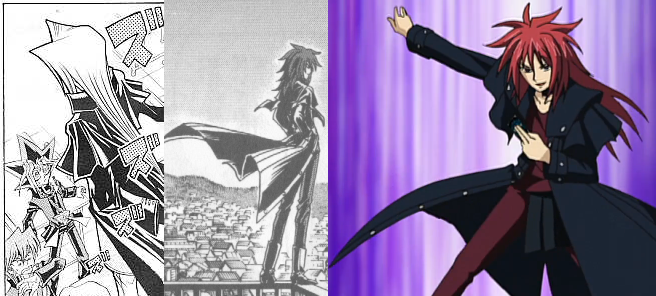
Consider first, the most natural of symmetries; the art. A number of characters in Vanguard can draw their origins back to R, and the most prominent of them all is the series' antagonist, Suzugamori Ren. His design is made to directly evoke the same presence of Tenma Yako, having similarly patterned hair and eye shape as well as the coat Yako was so fond of sporting;
The characters even make identical facial expressions.
As in R, in Vanguard people are not the ultimate source of evil.
Perfectly well-meaning ideals are made to be compromised by forces from
outside the characters' context.
In R, Tenma Yako's desire to resurrect Pegasus J. Crawford, is twisted by his means of doing so--the Wicked Gods--into a mindless lashing out at Pegasus' perceived murderer, Mutou Yugi.
This
has its own parallel in Vanguard; Suzugamori Ren's longing for the strength to support his friends is engineered by the power of
PSY Qualia into a lust for humiliating his opponents. Both characters have lost sight of their original goals, and are instead given to a desire to, in Ren's own words, "take everything."

And both of these characters have their foils, who stay by their former ideals but reconstruct them to adjust for reality. Unlike his twin, Tenma Gekko is not so vested in reviving Pegasus that he would sacrifice innocent lives to do so. Though he disagreed with Yako, Gekko still kept by his brother's side up until Yako's Project R.A. was brought underway. Similarly, Shinjou Tetsu initially continues to stand by his old friend Ren, becoming a Foo Fighter where Kai chose to run from Suzugamori's plot.
Just as Gekko eventually turns away from the Rebirth of Avatar altogether, and rebels against his brother believing that Pegasus' death has made them stronger, Shinjou Tetsu expresses a gradual shift in the aftermath of his match with Kamui. Where he should have felt triumphant over his victory, Kamui's comments on the meaning of a team prompts Tetsu to look up at Kai in the stands and seemingly reevaluate his position. Though Vanguard's first season has not yet finished airing, it is fair to say that this may be the extent of Tetsu's development towards Gekko's decision--because Gekko's role is actually split between two characters, Tetsu and Kai.
While Tetsu represents the Gekko that chose to stay with his brother, as well as the overall attitude of Richie Merced and Depre Scott, Kai Toshiki is the Gekko that opposed Yako. And for that, Ren resents him, as Yako did--though unlike with Merced in R, it's ultimately Ren himself who puts Kai on his knees.
Tetsu and Kai are composite characters. Where Tetsu represents Pegasus' four adopted children--Yako, Richie, Depre and the antagonist aspects of Gekko--Kai is a composite of Gekko's protagonist traits and Yugi himself. While Ren and Yako both have an ultimate goal, they are ceaselessly distracted from it by the source of their hatred and motivation. In addition to being the objects of the antagonists' loathing, both Yugi and Kai are drawn similarly by Ito;
Despite how the iris is depicted, Kai seems to have inherited Yugi's general eye and ear shape, as well as facial structure. Though Ito owns nothing of Yugi's uniform design, the style in which the uniforms are drawn is significantly similar--Ito himself has a very defined, angular way of drawing these clothes. This form is unique to himself.
And although the comparisons are frequent, where he serves the same function for Ren that Yugi did for Yako, Kai ultimately resembles Seto Kaiba in design alone. Kaiba's coldness towards others is because of an antagonistic personality and lack of respect for people, but Kai is a genuinely nice person whose childhood experiences have left him socially awkward. Ironically, a large portion of Kai's fan following can be derived from misinterpretation of his lack of social skills as self-confidence.
Compare as to how he also resembles the initial counterpart I introduced, Gekko. The absence of color throughout much of the Vanguard manga leads to decidedly similar artwork for each of them, both featuring predominantly dark, white-trimmed jackets over an interior white shirt and downturned collars. The buttons on Yako's double-breasted suit act as twin highlights beneath the shoulders to Kai's school uniform, which causes them to be shaded similarly under different light levels.
Aside from the artwork, both are close individuals to the primary antagonist who, having defected from his group, act to correct their past mistakes while remain secondary characters to the protagonist.
So if Ren is Yako, and Tetsu and Kai are together Gekko, then who is Bandit Keith Howard? Surprisingly enough, compare Suiko's actions with Howard's; she works in an advisory role to the antagonist, feeding him stimuli that compel him to clash with the protagonists. As Keith deceived Yako into believing that Yugi was Pegasus' murderer, Suiko was content with hooking Ren on the power of PSY Qualia, granting him Phantom Blaster Overlord to temper that strength and encourage his growth. The two avoid endangering themselves in straightforward battle, preferring to use others first, and then become confrontational only as their goal approaches.
Setting wise, Yu-Gi-Oh! R's Kaiba Corp tower bears a distinct resemblance to the Foo Fighter HQ; the Foo Fighters themselves are the series' equivalents to the card professors guild. As such, the HQ serves much the same purpose as Kaiba Corp, being the antagonists' home ground.
Volume 5 of R brings about a surprising turn of events which Vanguard eventually revisits; Yako uses the Fiend's Sanctuary magic card, which creates a monster with attack points equal to the opponents' remaining life points--in game terms, any one hit from such a monster would instantly win the game, though it would be either extremely weak or extremely strong depending on how much damage the opponent had already sustained. The monster the Sanctuary creates takes on the shape of the protagonist Mutou Yugi, and is used in the narrative as an allegory for Mutou's feelings towards the "Other Yugi" he became the host to at the very start of the series. This Other, an amnesiac ghost sealed within a memento from Mutou's grandfather, inhabits his body during duels, and so fights for him in times of need.
What Yako uses the Fiend's Sanctuary card to illustrate, is that Yugi can only resent his Other, who has stood in his place and gradually taken over his life by fighting his battles for him. Mutou Yugi is not himself the titular "King of Games"(Yu Gi Ou)--the nameless spirit he's become the host for has, and it is the spirit who has been living his life.
While Yugi himself takes control of his body once more to refute Yako's claim, believing firmly that his Other is his friend and that it is because of the Other Yugi that he grew as a person and met so many people, this point does not go unvisited by Cardfight!! Vanguard. As the series progresses, the protagonist Sendou Aichi learns to "hear" his cards' voices, an ability eventually identified as PSY Qualia. A completed state of PSY Qualia is marked by auras appearing in the wielder's eyes during periods of use, and is accompanied by ever-expanding arrogance on part of the wielder that bears marked similarity to the personality traits exemplified by the Other Yugi in Yu-Gi-Oh!'s earlier chapters. Every known bearer of PSY Qualia gained it by craving power to please their friends; ride 50 epitomizes this during Sendou's fight with Kai.
In an interview with Time the original creator of Yu-Gi-Oh!, Takahashi Kazuki, presented the Other Yugi as an allegory for transformation. Yugi's literal transformation into his Other that takes place once per chapter carries with it a message of becoming something else, a type of "transformation" that Takahashi felt was very prominent with children. This "transformation" or henshin has itself become inundated in Japanese culture, not just through Yu-Gi-Oh! but also through the Super Sentai television shows that the west would later bring over as Power Rangers, the masked heroes of Kamen Rider and the magical girl genre anime and manga like Sailor Moon or Puella Magi Madoka Magica. Takahashi would go on to reiterate his stance on transformation in a postscript statement;
But where Takahashi embraces transformation as a tool of growth, Ito refutes it. Rides 43-50 of Cardfight!! Vanguard are a vicious deconstruction of transformation, and the superpowers which pervade comparable anime. PSY Qualia is ultimately rejected, as it is no longer the player that is fighting but supernatural forces from outside their control--and so the player is no longer playing at all. Rather than transformation being a necessary, positive change, it is instead a denial of the self while blindly attempting to live up to the expectations of one's peers, thereby compelling them to "grow stronger." This is not growth at all, but a furthered dependency on others.
PSY Qualia is however only one half of the total stimuli that made Aichi's transformation a reality. The other half, the Shadow Paladin deck that Ren gave to Aichi, is not without its own R equivalent. Compare how the Wicked Gods line up with Phantom Blaster Dragon;
Ito consistently depicts the Wicked Gods as malevolent, shrouded monsters emerging from a human figure, an artistic decision which contrasts his narrative attitude that evil does not find its source in human forms. Phantom Blaster Dragon is similarly depicted as emerging from the humanoid Blaster Dark, whom in a previous panel was established as taking on Ren's appearance. In going with R's ending, it could be said that while evil does not originate from people, the fault still lies in human beings for taking the paths they march upon. Regardless of the influence of the Wicked Gods on Yako and PSY Qualia on Ren and later Aichi, these characters ultimately chose to lend their ears to these outside forces.
I have discussed the word "bunshin" and the difficulty in translating it before, and R is yet another example of this term coming into play. When Yako summons the third and final Wicked God in volume 5, he declares The Wicked Avatar(or as the original Japanese manga has it "THE DEVILS AVATAR") as his own "bunshin," what Vanguard and R both translate as avatar. While Takahashi had the stronger presence in R's overall writing, there is no doubt that Ito's time spent working on this project and his involvement in it would go on to influence his own concept of avatar in Vanguard, particularly Suzugamori Ren and Aichi's own "devil's avatar," Blaster Dark.
Reinforcing this comparison is how the Wicked Gods are portrayed becoming active in Yako's deck versus how the Shadow Paladins are active in Aichi's third deck.
Both depictions show the active force as shadowy tendrils emerging from the cards themselves, disturbing the color and clarity of image around them. Just as The Wicked Avatar seems to "jump" from his deck into Yako's hand after this scene takes place, Vanguard seems to have taken the idea of making one's avatar appear at will and converted it into a game mechanic, through card skills that add specific avatars to the hand. The general train of thought that Vanguard follows out of R is that of corrupting force which preys on emotional need, and eschewing dependency on the supernatural in favor of personal strength as a mortal human being.
So what can we conclude from these artistic parallels? As stated before, in both R and Vanguard people are not the ultimate source of evil. Evil takes place when an external force corrupts good intentions. Just as R concluded with Yako repenting for his actions, letting go of Pegasus and being grateful that he did not "take away [Yugi's] smile," Ren will likely realize the error of his ways. Previews for the second season, Asia Circuit, showcase Suzugamori as joining Team Q4 on their overseas trip, which would support this theory. The primary conflict in both series is fundamentally an emotional one, where unprepared young people must cope with the deaths of parents and the betrayal of friends. For season 1's conflict to be concluded satisfactorily, Ren and Kai need only apologize to one another.
Although he certainly didn't get the same amount of recognition before the first volume of Cardfight!! Vanguard was published, the mysterious Ito Akira did not simply appear out of thin air and start pumping out this storyline. While we know almost nothing of his identity, brief indexes of his work are available throughout the net. Most prominently, he did all of the artwork for Yu-Gi-Oh! R with Takahashi Kazuki's writing and direction at the helm. Here's a summary of his work;
- He was on the team for the original Yu-Gi-Oh! manga, though his exact role isn't specified.
- Ito did key animation for episode 9 of Mirai Nikki, as well as some side work for Samurai Champloo.
- Over the course of four years, he personally drew every panel of Yu-Gi-Oh! R, and is also said to have some hand in the story, even though Takahashi is listed as the main writer.
- Ito also assisted in the creation of Yu-Gi-Oh! GX.
What this article is concerned with though, is the recurring themes and design choices common between R and Vanguard. Sharing both a writer and artist, it's natural that these manifest. For the intents of this article, it should be clear that I am in no way suggesting a lack of originality, or of Vanguard being a "rip-off" of Yu-Gi-Oh!; the two series are different beasts that follow different rules.
Consider first, the most natural of symmetries; the art. A number of characters in Vanguard can draw their origins back to R, and the most prominent of them all is the series' antagonist, Suzugamori Ren. His design is made to directly evoke the same presence of Tenma Yako, having similarly patterned hair and eye shape as well as the coat Yako was so fond of sporting;
The characters even make identical facial expressions.
As in R, in Vanguard people are not the ultimate source of evil.
Perfectly well-meaning ideals are made to be compromised by forces from
outside the characters' context.In R, Tenma Yako's desire to resurrect Pegasus J. Crawford, is twisted by his means of doing so--the Wicked Gods--into a mindless lashing out at Pegasus' perceived murderer, Mutou Yugi.
This
has its own parallel in Vanguard; Suzugamori Ren's longing for the strength to support his friends is engineered by the power of
PSY Qualia into a lust for humiliating his opponents. Both characters have lost sight of their original goals, and are instead given to a desire to, in Ren's own words, "take everything."
And both of these characters have their foils, who stay by their former ideals but reconstruct them to adjust for reality. Unlike his twin, Tenma Gekko is not so vested in reviving Pegasus that he would sacrifice innocent lives to do so. Though he disagreed with Yako, Gekko still kept by his brother's side up until Yako's Project R.A. was brought underway. Similarly, Shinjou Tetsu initially continues to stand by his old friend Ren, becoming a Foo Fighter where Kai chose to run from Suzugamori's plot.
Just as Gekko eventually turns away from the Rebirth of Avatar altogether, and rebels against his brother believing that Pegasus' death has made them stronger, Shinjou Tetsu expresses a gradual shift in the aftermath of his match with Kamui. Where he should have felt triumphant over his victory, Kamui's comments on the meaning of a team prompts Tetsu to look up at Kai in the stands and seemingly reevaluate his position. Though Vanguard's first season has not yet finished airing, it is fair to say that this may be the extent of Tetsu's development towards Gekko's decision--because Gekko's role is actually split between two characters, Tetsu and Kai.
While Tetsu represents the Gekko that chose to stay with his brother, as well as the overall attitude of Richie Merced and Depre Scott, Kai Toshiki is the Gekko that opposed Yako. And for that, Ren resents him, as Yako did--though unlike with Merced in R, it's ultimately Ren himself who puts Kai on his knees.
Tetsu and Kai are composite characters. Where Tetsu represents Pegasus' four adopted children--Yako, Richie, Depre and the antagonist aspects of Gekko--Kai is a composite of Gekko's protagonist traits and Yugi himself. While Ren and Yako both have an ultimate goal, they are ceaselessly distracted from it by the source of their hatred and motivation. In addition to being the objects of the antagonists' loathing, both Yugi and Kai are drawn similarly by Ito;
Despite how the iris is depicted, Kai seems to have inherited Yugi's general eye and ear shape, as well as facial structure. Though Ito owns nothing of Yugi's uniform design, the style in which the uniforms are drawn is significantly similar--Ito himself has a very defined, angular way of drawing these clothes. This form is unique to himself.
And although the comparisons are frequent, where he serves the same function for Ren that Yugi did for Yako, Kai ultimately resembles Seto Kaiba in design alone. Kaiba's coldness towards others is because of an antagonistic personality and lack of respect for people, but Kai is a genuinely nice person whose childhood experiences have left him socially awkward. Ironically, a large portion of Kai's fan following can be derived from misinterpretation of his lack of social skills as self-confidence.
Compare as to how he also resembles the initial counterpart I introduced, Gekko. The absence of color throughout much of the Vanguard manga leads to decidedly similar artwork for each of them, both featuring predominantly dark, white-trimmed jackets over an interior white shirt and downturned collars. The buttons on Yako's double-breasted suit act as twin highlights beneath the shoulders to Kai's school uniform, which causes them to be shaded similarly under different light levels.
Aside from the artwork, both are close individuals to the primary antagonist who, having defected from his group, act to correct their past mistakes while remain secondary characters to the protagonist.
So if Ren is Yako, and Tetsu and Kai are together Gekko, then who is Bandit Keith Howard? Surprisingly enough, compare Suiko's actions with Howard's; she works in an advisory role to the antagonist, feeding him stimuli that compel him to clash with the protagonists. As Keith deceived Yako into believing that Yugi was Pegasus' murderer, Suiko was content with hooking Ren on the power of PSY Qualia, granting him Phantom Blaster Overlord to temper that strength and encourage his growth. The two avoid endangering themselves in straightforward battle, preferring to use others first, and then become confrontational only as their goal approaches.
Setting wise, Yu-Gi-Oh! R's Kaiba Corp tower bears a distinct resemblance to the Foo Fighter HQ; the Foo Fighters themselves are the series' equivalents to the card professors guild. As such, the HQ serves much the same purpose as Kaiba Corp, being the antagonists' home ground.
Volume 5 of R brings about a surprising turn of events which Vanguard eventually revisits; Yako uses the Fiend's Sanctuary magic card, which creates a monster with attack points equal to the opponents' remaining life points--in game terms, any one hit from such a monster would instantly win the game, though it would be either extremely weak or extremely strong depending on how much damage the opponent had already sustained. The monster the Sanctuary creates takes on the shape of the protagonist Mutou Yugi, and is used in the narrative as an allegory for Mutou's feelings towards the "Other Yugi" he became the host to at the very start of the series. This Other, an amnesiac ghost sealed within a memento from Mutou's grandfather, inhabits his body during duels, and so fights for him in times of need.
What Yako uses the Fiend's Sanctuary card to illustrate, is that Yugi can only resent his Other, who has stood in his place and gradually taken over his life by fighting his battles for him. Mutou Yugi is not himself the titular "King of Games"(Yu Gi Ou)--the nameless spirit he's become the host for has, and it is the spirit who has been living his life.
While Yugi himself takes control of his body once more to refute Yako's claim, believing firmly that his Other is his friend and that it is because of the Other Yugi that he grew as a person and met so many people, this point does not go unvisited by Cardfight!! Vanguard. As the series progresses, the protagonist Sendou Aichi learns to "hear" his cards' voices, an ability eventually identified as PSY Qualia. A completed state of PSY Qualia is marked by auras appearing in the wielder's eyes during periods of use, and is accompanied by ever-expanding arrogance on part of the wielder that bears marked similarity to the personality traits exemplified by the Other Yugi in Yu-Gi-Oh!'s earlier chapters. Every known bearer of PSY Qualia gained it by craving power to please their friends; ride 50 epitomizes this during Sendou's fight with Kai.
"Why? Why won't you understand?! I'm strong! I got strong!"
"I believe that everyone has an 'other self' inside them. It may be your
ideal self, someone who it's your goal to become. But when you're
pressured to be a certain way by the expectations of your parents or the
world, the burden may be too much to bear and you may lose sight of
yourself. In other words, your 'other self' is something you have to
create, not that people can force upon you. I think it's best to take it
easy and keep an eye on your 'other self,' and aim for that goal. But
don't stress out about reaching it right away."
But where Takahashi embraces transformation as a tool of growth, Ito refutes it. Rides 43-50 of Cardfight!! Vanguard are a vicious deconstruction of transformation, and the superpowers which pervade comparable anime. PSY Qualia is ultimately rejected, as it is no longer the player that is fighting but supernatural forces from outside their control--and so the player is no longer playing at all. Rather than transformation being a necessary, positive change, it is instead a denial of the self while blindly attempting to live up to the expectations of one's peers, thereby compelling them to "grow stronger." This is not growth at all, but a furthered dependency on others.
PSY Qualia is however only one half of the total stimuli that made Aichi's transformation a reality. The other half, the Shadow Paladin deck that Ren gave to Aichi, is not without its own R equivalent. Compare how the Wicked Gods line up with Phantom Blaster Dragon;
Ito consistently depicts the Wicked Gods as malevolent, shrouded monsters emerging from a human figure, an artistic decision which contrasts his narrative attitude that evil does not find its source in human forms. Phantom Blaster Dragon is similarly depicted as emerging from the humanoid Blaster Dark, whom in a previous panel was established as taking on Ren's appearance. In going with R's ending, it could be said that while evil does not originate from people, the fault still lies in human beings for taking the paths they march upon. Regardless of the influence of the Wicked Gods on Yako and PSY Qualia on Ren and later Aichi, these characters ultimately chose to lend their ears to these outside forces.
I have discussed the word "bunshin" and the difficulty in translating it before, and R is yet another example of this term coming into play. When Yako summons the third and final Wicked God in volume 5, he declares The Wicked Avatar(or as the original Japanese manga has it "THE DEVILS AVATAR") as his own "bunshin," what Vanguard and R both translate as avatar. While Takahashi had the stronger presence in R's overall writing, there is no doubt that Ito's time spent working on this project and his involvement in it would go on to influence his own concept of avatar in Vanguard, particularly Suzugamori Ren and Aichi's own "devil's avatar," Blaster Dark.
Reinforcing this comparison is how the Wicked Gods are portrayed becoming active in Yako's deck versus how the Shadow Paladins are active in Aichi's third deck.
Both depictions show the active force as shadowy tendrils emerging from the cards themselves, disturbing the color and clarity of image around them. Just as The Wicked Avatar seems to "jump" from his deck into Yako's hand after this scene takes place, Vanguard seems to have taken the idea of making one's avatar appear at will and converted it into a game mechanic, through card skills that add specific avatars to the hand. The general train of thought that Vanguard follows out of R is that of corrupting force which preys on emotional need, and eschewing dependency on the supernatural in favor of personal strength as a mortal human being.
So what can we conclude from these artistic parallels? As stated before, in both R and Vanguard people are not the ultimate source of evil. Evil takes place when an external force corrupts good intentions. Just as R concluded with Yako repenting for his actions, letting go of Pegasus and being grateful that he did not "take away [Yugi's] smile," Ren will likely realize the error of his ways. Previews for the second season, Asia Circuit, showcase Suzugamori as joining Team Q4 on their overseas trip, which would support this theory. The primary conflict in both series is fundamentally an emotional one, where unprepared young people must cope with the deaths of parents and the betrayal of friends. For season 1's conflict to be concluded satisfactorily, Ren and Kai need only apologize to one another.
Labels:
akira ito,
anime,
bushiroad,
cardfight vanguard,
ito akira,
manga,
tcg,
yu-gi-oh,
yu-gi-oh r
Subscribe to:
Posts (Atom)