
Fighter's Spotlight is an ongoing project concerned with tracking real-world professional cardfighters across the globe.
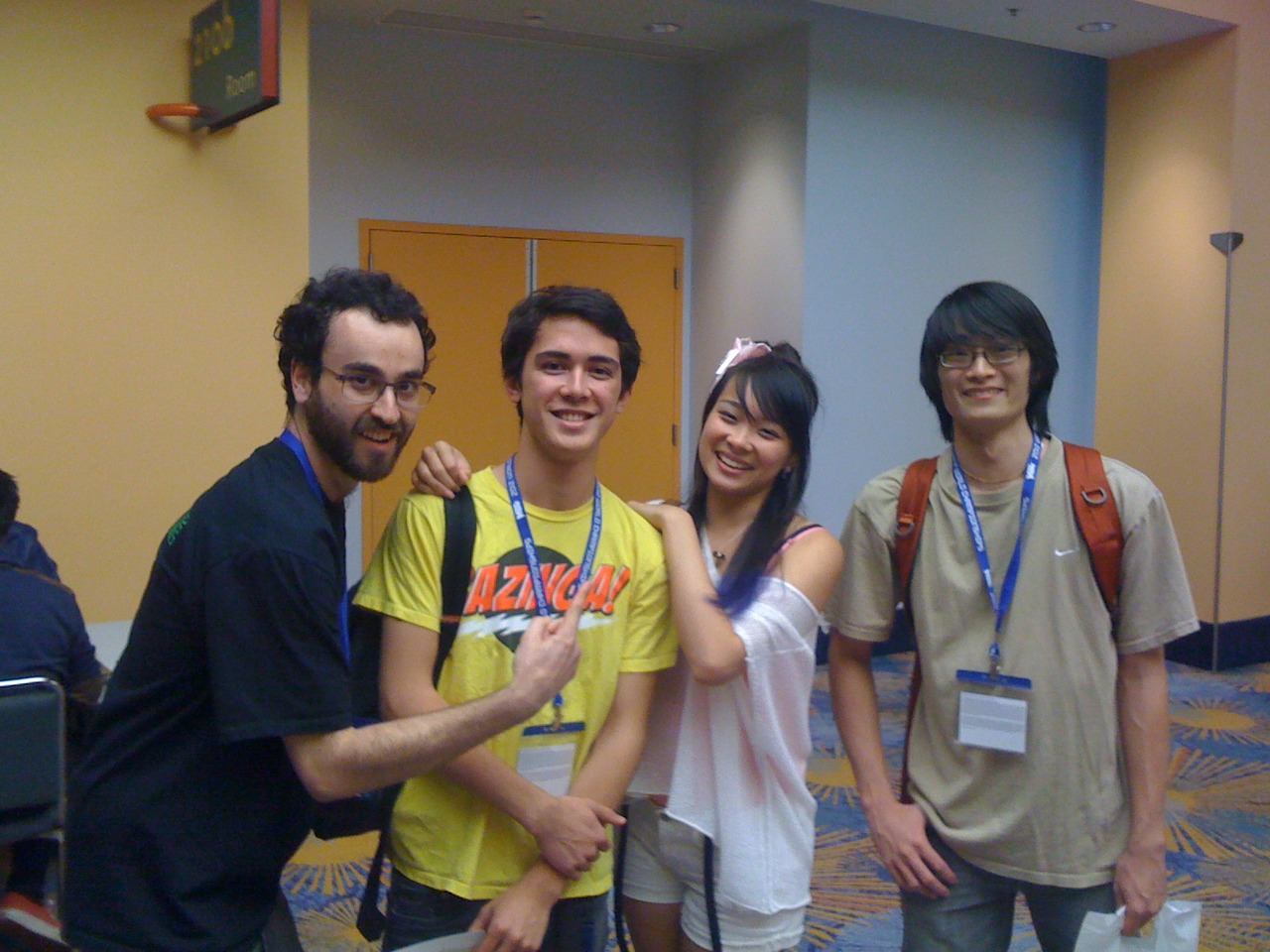 |
| Original photo provided by frugs, do not repost without the original photographer's express permission. |
Donald William Buckley
Age: 18Titles Won: Los Angeles Regional Champion
Current Status: Los Angeles Regional Champion (Reigning)
Deck Type: Granblue
Donald William "Will" Buckley is the reigning Los Angeles regional champion, and the final entrant in the 2012 North American national championship. A stand-out fighter among the participants, he is mainly remembered for being one of three North American regional champions in that year to not run some variation of Gold Paladin or Narukami, the dominant clans of his day. This claim to fame was considered unbelievable at the time, and as a result of it and his inexperience in the tournament scene, some accusations of cheating emerged from online critics. Unlike with the previous cases of Kanamaru Makoto and Thomas Cassidy however, none of these accusations were ever substantiated with evidence or testimony, and Buckley remains a powerful reminder of the influence of individual skill and often-underestimated outlier decks in the pro scene.
Buckley did not participate in the National Championship finals, and was instead substituted for by third-place fighter Austin Pham1.
Decks and Play Style
Buckley's Granblue deck draws from the limit break play style introduced for them in Breaker of Limits. The main concept of the deck is to use their most recent first vanguard Captain Nightkid, along with the older cards Chappie the Ghostie and Ruin Shade, to bring key cards into the drop zone for later use in conjunction with card skills. The deck's trigger base is almost entirely devoted to critical triggers; because of the deck's ability to instantly and unpreventably send any card to the drop zone with Chappie, draw support becomes less necessary as the main strategy revolves around that same zone, also where healed cards go during the drive or damage check of a heal trigger. Dancing Cutlass and Rough Seas Banshee also act as support against this lack of draw power, actually fueling one another by sending Banshee to the soul and then using her as fuel for Cutlass.
The deck's key drop zone cards are Ice Prison Necromancer, Cocytus and the Deadly series of cards--Nightmare, Spirit and Swordmaster. The two skills complement one another, as when one is not available due to its restrictions, the other is. Cocytus' skill is activated by riding Skeleton Demon World Knight and discarding a Granblue, then riding Cocytus from the drop zone, but this can only be done when the opponent has a grade 3 or greater vanguard and only at the beginning of the ride phase, meaning it can be only used on the turn after it is ridden. So while it does not steal out the first turn advantage from them, it can ensure security and provide a powerful unit to make comebacks with. At more opportune times, Buckley can turn to the Deadly cards instead.
Nightmare and Spirit appear from the drop zone to the rearguard by soulblasting 2 and retiring a grade 1 or greater Granblue rearguard. This again plays into the soul provided by Rough Seas Banshee, as with even one copy of her in the soul after Nightkid's skill, both units can be superior called. While they do not allow for direct card advantage, there is no way to remove them from the game since they can simply appear from the drop zone if retired, and the two cards together form a base 16000 line for combating both the popular Garmore and Spectral Duke Dragon decks of that tournament season. Furthermore, when Nightmare and Spirit are both on the field, they can be retired at no other cost to superior ride Deadly Swordmaster from the drop zone if Buckley has a grade 2 or greater vanguard, providing another way of fighting and directly taking the lead when Cocytus would otherwise be unavailable or inappropriate.
Since Swordmaster himself is a base 11000 unit, it takes greater resources to assail him, and his defense puts strain on other cardfighters. Meanwhile Cocytus provides +5000 power at limit break 4, breaking the 21000+ line easily with twelve of Buckley's fourteen grade 1s, and on-ride he can counterblast 2 to superior call a unit from the drop zone--also opening up a combo with Demon World Knight by calling the unit that Knight dropped to the field.
The deck's name is a carryover from Buckley's experience with the Yu-Gi-Oh! Trading Card Game, being named after the Infernities deck archetype; said archetype was a very dominant deck in 2010, thus the joke is that "Infernities topped" in Los Angeles. It was named alongside his friends, who similarly patterned their deck names after Yu-Gi-Oh! as "Wind-Ups" and "Madolches."
Summer 2012 Regional Tournament, Los Angeles: Infernity
Card Pool: TD01-BT03, BT06-BT07
Grade 0
x2 Chappie the Ghostie
x4 Knight Spirit CT
x4 Rough Seas Banshee CT
x1 Captain Nightkid (FVG)
x4 Ghoul Cannonball CT
x4 Doctor Rouge HT
Grade 1
x4 Gust Jinn
x2 Dancing Cutlass
x4 Samurai Spirit
x4 Deadly Nightmare
Grade 2
x4 Ruin Shade
x2 Skeleton Demon World Knight
x4 Deadly Spirit
Grade 3
x4 Ice Prison Necromancer, Cocytus
x3 Deadly Swordmaster
Citations and External Links
1. "[Press Release] Top Four Cardfight!! Vanguard North American Finalists Heading to Japan to Compete in World Championship 2012." Official Cardfight!! Vanguard USA. Bushiroad, 6 Nov. 2012. Web. 15 Nov. 2012. <http://www.facebook.com/notes/official-cardfight-vanguard-usa/press-release-top-four-cardfight-vanguard-north-american-finalists-heading-to-ja/363826427040389>.


