Tuesday, October 1, 2013

News: Platina Ezel Places First in Dallas Qualifier, Chaos Breaker Dragon Dominates Tsurumai Vanguard Championship

Over the weekend the World Championship 2013 Dallas qualifier concluded with first place cardfighter Hank Hwang bringing a Platina Ezel deck to the top 4. While most Platina decks right now opt to run 4-4 on both forms of Ezel to maximize their crossride potential, Hwang instead chose to run four copies of Great Silver Wolf Garmore and just one Incandescent Lion, making use of Kyrph's superior ride to access his Ezel tech when possible but otherwise allowing for a much more direct access to the deck while still carrying heavy endgame potential. 230 cardfighters participated in the Dallas qualifier, less than the 300+ numbers typical of other North American regionals but still ten more than in the preceding World Championship. Hwang is a veteran pro cardfighter who had previously placed twelfth in the Stand Up Challenge Cup national tournament earlier this year.

While Gold Paladin has had a strong presence in the top 4s of the ongoing WCS2013, Royal Paladin had a much stronger impact at Dallas than in previous regionals, taking half of the top 4 with Majesty Lord Blaster and a King of Knights build similar to what made such big waves in Japan's equivalent format in 2012. The Platina Ezel deck was forecasted to do well in the European championship because of Gold Paladin's established success in the previous year, particularly in the upcoming German qualifier, and in the developing French scene where the deck is humorously known as "Platilol." But in the European qualifiers that have taken place so far, alternative Gold Paladin builds have been more effective along with the usual suspects of The End and "THE BLOOD."
Hwang is on the far right. Original photo by Cardfight!! Vanguard USA.
The North American national championship has turned out with heavy favor to Gold Paladin, with Ezel decks appearing in the top 4 of every regional so far, while on a global scale Dragonic Kaiser Vermillion "THE BLOOD" has been comparatively successful in numbers. Where in Japan every national championship came out with Royal Paladin as the senior class national deck up until Pale Moon suddenly swept through the title match earlier this year, Gold Paladin and Narukami are instead the familiar tyrants to English-language play, and their success has the previous World Championship backing it. Dragonic Overlord the End remains the deck to beat when building for professional play, but it has many rivals and "THE BLOOD" is seeing heavy adoption as the new face of international competition. Part of this comes from "THE BLOOD"'s improved consistency by having effectively two copies of the same grade 3 with the benefits of crossride defense on one of them, being able to take out the opponent's field and hand simultaneously in one or two quick bursts, as well as the relative cheapness of the deck which makes it more accessible by comparison. Currently Narukami's Guld is priced at a fourth of Kagerou's Barri, $6 versus $18 because of Guld's BT09 reprint devaluing it significantly, with "THE BLOOD" at approximately half of DOTE's $30 pricetag. Narukami did not have many expectations riding on it prior to WCS2013, but its dual boss cards may together prove to be one of the most practical decks of the season.

In Japanese waters, Chaos Breaker Dragon has been drawing attention after attaining heavy proliferation at the Tsurumai VGCS. The tournament took place on September 15th and the results were published on the 16th, but flew under the radar in the English scene due to the close attention being paid to the ongoing World Championship qualifiers.

The tournament had 54 participants, an unusual low for a VGCS but nonetheless a much higher turnout than in local tournaments. The tournament format was four 20 minute rounds of Swiss draw followed by top 16 50 minute rounds, all in best of 3.

First place cardfighter Gungnir used a Raging Form Dragon deck, while second place fighter Houki used Chaos Breaker Dragon. Third place also went to a Raging Form cardfighter, and fourth to Chaos Breaker, while the remaining best 8 were all Chaos Breaker Dragon decks. This is a much higher level of adoption than was expected by the global community even accounting for the hype surrounding Chaos Beaker, with the card having gone for as high as 3000~4000 yen when entire booster boxes typically sell for 4700 yen. These prices were lampooned within Tsurumai's top 8, where Link Joker cardfighter white21 titled his deck "3500 yen." What should be kept in mind when considering these results is the much lower attendance, as Tsurumai saw only half of the regular turnout of most other Vanguard Championships. Following the Tsurumai VGCS results, Chaos Breaker's RRR single price has since stabilized at around 3000~3500 yen.

Another, less obvious factor in Chaos Breaker's success is the plurality of Japanese social circles. A standard practice within VGCS tournaments is to preregister those that will be participating, but prior to the tournament one of the preregistered participants, handle name "Haww" had to cancel because of his hospitalization. In a show of solidarity, his friends brought Link Joker decks to the tournament and named their decks in his honor. Second place fighter Houki dedicated his deck "For the Sake of Scattered haww", fifth place fighter Lot implored Haww to "lend me power!!" and sixth place fighter Akaishika ("Red Shika") wished that he would "Get well soon, Haww-san." Playing one deck because of another fighter is the norm in Japan, where clans unite cardfighters as part of a larger group. It's not uncommon to see one fighter explaining that he played a particular deck because of a Takeshi or Yamato that introduced them to it. Even so, not all of the Link Joker fighters were there on another's behalf. Fourth place finalist Shachihoko humorously named their deck "Forgive me, Amon" (「許してくれアモン」)  out of regret for dropping the Dark Irregulars clan in favor of Link Joker. Eighth place finalist Oosaki injected some comedy of his own into the tournament, calling his Chaos Breaker deck "Book of Moon."

Also of note is that one Dimension Police deck did make it into the top 16, using the newly released Dark Dimensional Robo, "Я" Daiyusha. This build played 3 copies of both Super Dimensional Robo and Dark Dimensional Robo, with 2 copies of the Daikaiser break ride rounding it out and Daimagnum as its first vanguard instead of Gouyusha; although it did make use of many new cards, Daiheart was not one of them, contrary to what one might expect of the varied grade 3 lineup.

While Raging Form Dragon has risen to being one of the dominant decks of the Japanese format alongside Dragonic Descendant and Luquier “Я,” Chaos Breaker Dragon is instead a highly anticipated card that many were expecting to do well but which still remained something of an enigma until now. Prior to his introduction, Link Joker struggled in professional play, placing highly but never quite high enough compared to its contemporaries, with Nebula Lord's recent victory at the Pitarui VGCS prior to Catastrophic Outbreak's release being their first instance of actually topping a large-scale tournament. Chaos Breaker has stirred a response by providing a hard counter to every Reverse deck in the format through his limit break, which retires rearguards when they Unlock, and his consistent ability to Lock one rearguard per turn with a single discard. The tournament finals were recorded and uploaded to YouTube, and can be viewed below.


By running him alongside Infinite Zero Dragon, Japanese Link Joker cardfighters have opened up the opportunity to start an ideal spread of 3 Locked rearguards and then maintain 2 Locks for two turns after their initial break ride, Locking units with Infinite Zero, Dusttail Unicorn and Chaos Breaker, keeping them Locked with Palladium, and retiring them when they Unlock with Chaos Breaker's soulblast while also drawing cards. Even if this golden setup is missed, Chaos Breaker alone opens up possibilities for consistent Lock options outside of break ride, where Nebula Lord Dragon was heavily reliant on Infinite Zero such that it could only maintain its massive field power bonus for a single turn. An interesting innovation of these new Chaos Breaker decks compared to Nebula Lord is that five of the six Link Joker deck from Tsurumai VGCS' top 8 ran three copies of Star-vader Mobius Breath Dragon, whose midgame on-hit Lock skill has been highly valued for both slowing down the opponent's plays and pressuring them to defend it. As a result the card has quickly become entrenched as one of Chaos Breaker's staples, despite having no real use in the rearguard. Tsurumai VGCS decklists are provided at the bottom of the article.

The VGCS tournaments are a series of unofficial tournaments organized by fans and cardshops. Unlike Bushiroad's larger official tournaments, most VGCS events are done using a best of 3, Swiss tournament model, with entry fees in the vicinity of 1000 yen per person that go toward grand prizes like booster boxes, Nintendo 3DS handhelds and other merchandise. Turnout is typically 70-80 persons, but some events see 100 or more participants, all of whom compete using pseudonyms and internet handles rather than their real names as in official events.

First Place
Deck Name: Revenger/「撃退者」
Handle Name: Gungnir/ぐんぐにーる
Grade 0
x1 Creeping Dark Goat (FV)
x1 Frontline Revenger, Claudas
x4 Grim Revenger CT
x4 Revenger, Air Raid Dragon CT
x1 Death Feather Eagle CT
x4 Healing Revenger HT
x3 Freezing Revenger DT
Grade 1
x4 Morale Revenger, Dorin
x4 Dark Revenger, Mac Lir
x3 Transience Revenger, Masquerade
x2 Revenger, Dark Bond Trumpeter
Grade 2
x4 Blaster Dark Revenger
x4 Dark Cloak Revenger, Tartu
x3 Nullity Revenger, Masquerade
Grade 3
x4 Revenger, Raging Form Dragon
x4 Illusion Revenger, Mordred Phantom

Second Place
Deck Name: For the Sake of Scattered haww/散っていったhawwのために
Handle Name: Houki/ほうき
Grade 0
x1 Star-vader, Dusttail Unicorn (FVG)
x4 Star-vader, Meteoliger CT
x3 Star-vader, Weiss Soldat CT
x4 Star-vader, Nebula Captor DT
x1 Star-vader, Scouting Felis DT
x4 Star-vader, Stellar Garage HT
Grade 1
x4 Prison Gate Star-vader, Palladium
x4 Barrier Star-vader, Promethium
x3 Demonic Bullet Star-vader, Neon
x3 Opener of the Black Door
Grade 2
x4 Unrivaled Star-vader, Radon
x4 Star-vader, Colony Maker
x3 Star-vader, Mobius Breath Dragon
Grade 3
x4 Star-vader, Infinite Zero Dragon
x4 Star-vader, Chaos Breaker Dragon

Tuesday, September 24, 2013

News: Ezel and Gancelot to Return in VG-BT14: Brilliant Strike

Early posters and web previews from Doctor O's twitter shocked the global Cardfight community today with the first look at the contents of the fourteenth main booster set, VG-BT14: Brilliant Strike (光輝迅雷 lit. Blazing Thunderclap.) The set's slogan is 「黒き呪縛を截ち切れ!金色の騎士たち!!」 "Cut through the black Lock! Golden knights!!" and its cover card is a currently-unknown new form of Ezel, Aichi's key grade 3 from the Asia Circuit arc. According to Doctor O, the set will provide strong support for the Gold Paladin, Royal Paladin, Genesis, Kagerou, Murakumo, Neo Nectar and Narukami clans. BT14 will be released in Japan on December 12th, 2013. The special conference for BT13 to be held live on September 26th through NicoNico Douga will reveal additional information regarding this latest booster set in addition to showing off cards from the recently released Catastrophic Outbreak.

The new incarnation of Ezel mixes his Red Lion and Platina armors, and is shown prominently cutting through the black rings used by the Link Joker clan to create their Lock spell. Popular speculation is that this Ezel will either be a new Gold Paladin grade 3 for Aichi, or that Ezel will return to his in-universe home army as a Royal Paladin for the Jewel Knights. This is fueled by Ezel's unique relationship to Kourin, who uses the card as the basis of her Gold Paladin deck in the manga, and who originally owned the card in the anime.

Alongside Ezel has been featured a crossbreak ride for Solitary Liberator Gancelot, and a crossbreak ride for "Sacred Regalia of Wisdom, Angelica," the cover card of VG-TD13: Successor of the Sacred Regalia, Misaki's Genesis trial deck. The crossbreak will be "Fair Goddess, Minerva" and will be illustrated by celebrated artist Tanaka Takayuki alias "Tony Taka," who has previously done work for Sega's fantasy RPG Shining franchise.

Reactions to the set's unveiling are mixed. Internationally many cardfighters were left with the impression that Ezel's storyline within the card lore was finished, and that Alfred, Garmore and now Gancelot would have taken the reigns for Aichi's key grade 3s. There have also been expectations within the community that Blaster Blade and Blaster Dark would be the key units to repel the invading force of Link Joker due to their ongoing storyline in the card lore, and Ezel's sudden appearance seems jarring to some in light of that. In Japan however, Ezel's appearance has not been as surprising, in part because of some wordplay that has been lost in the translation of BT14. Both Brilliant Strike and Ezel's previous form Blazing Lion Platina Ezel are written with the kanji 光輝 , so that in Japanese their names are Kouki Jinrai and Kouki no Shishi Platina Ezel. Ezel's appearance was thus foreshadowed by this allusion, and he is the title card of the set as Alfred was in BT10, and as Blockade Inferno was for BT11. The decision to translate 光輝 as "Brilliant" instead of "Blazing" caused this to be lost in translation.

It has been noted that despite some indications to the contrary, this does not appear to be the final set of the third season Link Joker, as the season's titular clan is not listed for BT14. It would be very uncharacteristic for a final set to not include the current antagonists, which implies that BT15 or later will be the last set of the current storyline, in keeping with Bushiroad CEO Kidani Takaaki's previous statement that Link Joker is planned to air for over a year. Finally, Doctor O stated on Twitter this evening that Megacolony would be supported in BT15, bringing with them the winning entry of the original unit card design contest "Unbeatable Mutant Abectrozeus" from last May.

Sunday, September 22, 2013

News: Glory Maelstrom Fighter Places First in World Championship 2013 Chicago Regional Qualifier, Greece and Belgium Dominated by Dragons and Paladins

Last weekend the Chicago regional qualifier came to a surprising conclusion, with Eric Hernandez taking the regional title using his aggressive Glory Maelstrom deck, and Daniel Janas' Dragonic Kaiser Vermillion "THE BLOOD" coming in second. "THE BLOOD" has been no stranger to professional play throughout this tournament season, appearing in three of the four other world qualifiers to have taken place so far, but Maelstrom is a deck with relatively low representation in English play. This was out of an attendance of 332 persons, approximately 50 more than in the previous year. In other parts of the globe the qualifier results have been similarly varied. Belgium's qualifier for the European championship saw 81 persons in attendance, and ended with Almeida Stewart's Dragonic Overlord the End in first and Soudant Dominique's "THE BLOOD" in second, both familiar stories to western players. In Greece the qualifier had a turnout of 65 cardfighters, with Avis Samaras' Garmore-Ezel Gold Paladin deck in first and Illias Joannis' Spectral Duke Dragon in second.

Following his shot at the Toronto title, reigning world champion Brandon Smith attended the Chicago regional, bringing previous regional champion Brandon Bastianelli with him, and we were able to meet the two of them in the preregistration line. In contrast to the stable format of the Challenge Cup, which saw the majority of professional cardfighters adopting DOTE and other popular decks, the 2013 World Championship has proved unpredictable with diverse top 8s from each regional and a very diminished presence of Kagerou and Royal Paladin across the world. Smith and Bastianelli were no exception to this trend, with the world champion having drawn much attention in recent weeks for running a Great Nature deck.

"I'm running the deck I promised to last year." Bastianelli was proud to bring Great Daiyusha to Chicago. He had been preparing for this day since BT04's release last December, and while he explained that Great Daiyusha did not really suit his preferred control-based play style, it was a card that he was dedicated to out of a strong bond. "It's one of those units that I don't really like what it does with its skill, but love as a card."

When Smith was asked about his thoughts on The End in this tournament, in light of the deckbuild having dominated competitive play for the last seven months, he explained that he was no longer as concerned with it. "I'm not really worried about DOTE. I think my Majesty beatstick's better." He laughed. Smith had a thorough history with the Majesty Lord deck during the Challenge Cup, but found its sacrificial play style awkward and eventually moved on to exploring other options prior to Worlds. "Our goal today is 0 DOTEs in the top 8!"

He almost got his wish. The top 8 of the tournament had only a single The End deck present, with the top 4 coming down to Glory Maelstrom, "THE BLOOD" and two Gold Paladin decks. There was an overwhelming sense of evolution running through the tournament that day. Like Soul Saver Dragon before it, The End has become a cliché in pro play, its strategies have been memorized and the build is now known inside and out by anyone trying to contend for the world title. And so the game is changing.

Smith made it through all eight elimination rounds 7-1 that day, which put him in the top 12, but he was cut from the top 8 without a chance to participate in the tournament finals because of his tiebreakers. By contrast Bastianelli was eliminated 0-2, regretting the results but admitting that he had not done his best in maintaing focus. Where their paths will go in the rest of this season is unknown, but Bastianelli has his mind set on the future, toward BT12: Binding Force of the Black Rings and the coming of Link Joker for 2014.

Currently the favorite for the North American national championship title is Toronto regional champion Sebastien LeBon, a Nova Grappler cardfighter known for his Illuminal Dragon deck. On-site viewers at other regionals have contested the relative skill of the finalists, with LeBon's strongest contenders at this time being Johnathan Luu and Daniel Sirois from Atlanta, and Robert Ewell from LeBon's own top 4 back in Toronto. With six regionals still remaining in North America, and the Hawaii and Washington qualifiers to finish this weekend, the question of who will be representing the continent in the World Championship is still open.

Monday, September 9, 2013

News: Dragonic Overlord the End and "THE BLOOD" Storm Atlanta World Championship Qualifier

The second regional qualifier in the World Championship 2013 tournament series has concluded, with first place going to Johnathan Luu and his Dragonic Overlord the End deck. Second place was taken by Daniel Sirois using Dragonic Kaiser Vermillion "THE BLOOD," with third also going to a "THE BLOOD" cardfighter Christopher Hairston, and fourth to Christian Okezie with Blazing Lion Platina Ezel. In stark contrast to the Toronto results from the previous weekend, Atlanta's top 4 is more in line with what was expected from the 2013 tournament season. Outside of the top 4, Oracle Think Tank was reportedly a popular choice, with different cardfighters bringing Tsukuyomi, CoCo and Goddess Amaterasu through the elimination rounds.

Johnathan Luu's decklist has been leaked onto the internet through an interview conducted by YouTube channel Team Limit Break. The full decklist has been reproduced in text below.

Johnathan Luu
Grade 0

x1 Lizard Soldier, Conroe (FV)
x4 Dragon Monk, Genjo HT
x3 Gatling Claw Dragon DT
x3 Dragon Dancer, Monica DT
x2 Embodiment of Armor, Tahr CT
x4 Blu-ray Dracokid CT
Grade 1
x4 Wyvern Guard, Barri
x4 Embodiment of Armor, Bahr
x2 Demonic Dragon Mage, Kimnara
x3 Dragon Monk, Gojo
x1 Flame of Hope, Aermo
Grade 2
x4 Burning Horn Dragon
x1 Bellicosity Dragon
x2 Berserk Dragon
x1 Cross Shot, Garp
x4 Dragon Knight, Nehalem
Grade 3
x4 Dragonic Overlord The End
x3 Dragonic Overlord

Although running stand triggers in DOTE decks has proven popular since the rise of Kaden Kawakami as the presiding North American national champion, Luu preferred critical triggers for a stronger early game to throw the opponent to higher damage faster, and to avoid having dead drive checks when fighting with just his center lane. Luu was mindful of the current state of competitive play, building his deck with Majesty Lord Blaster matchups in mind and preferring base 10000 grade 2 rides to deny the majority of Wingal Brave combos.

It should be noted when considering these results is that runner up Daniel Sirois was pressed for time. Conflicting reports from eyewitnesses at Atlanta state that Sirois was either disqualified during the finals for incurring too many penalties or deliberately incurred enough penalties to get disqualified so that he could leave the tournament in a timely manner.

The next tournament in the World Championship will be the first European qualifier in Brussels on September 14, followed by the third North American qualifier in Chicago on the 15th.

Wednesday, September 4, 2013

News: World Championship 2013 Canadian Regional Decklists

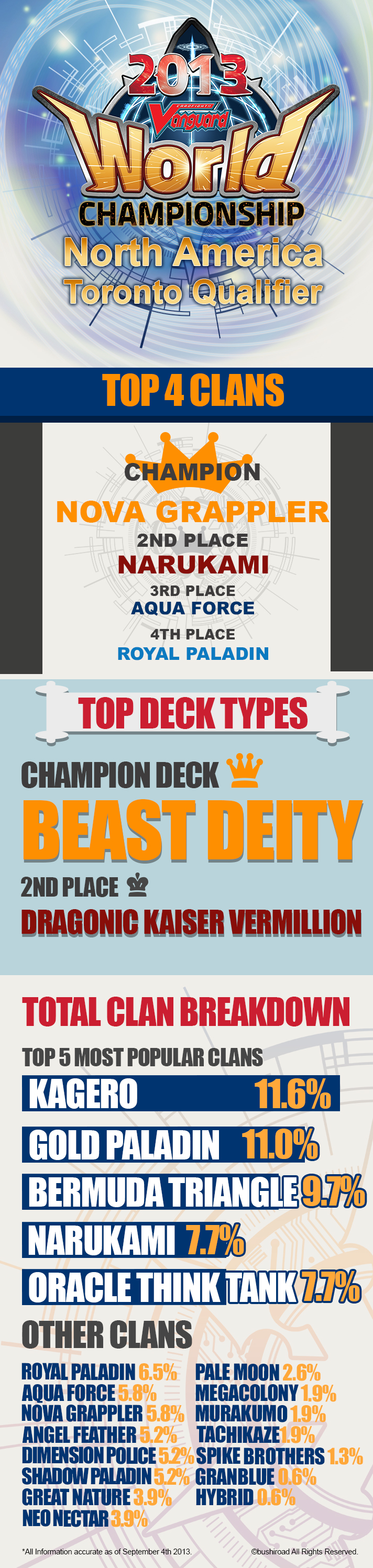
The official English Cardfight!! Vanguard portal has been updated with deck recipe spaces for every branch of this year's world championship, and with this update has come the decklists from the weekend's WCS2013 Toronto qualifier. The qualifier's results came as a surprise following a format that had been dominated largely by Dragonic Overlord the End, as regional champion Sebastian LeBon won the tournament using a Nova Grappler deck based around Illuminal Dragon, while runner-up Kevin Perron took his position with a Narukami deck built on Dragonic Kaiser Vermillion and his crossride "THE BLOOD."

Sebastian LeBon: Beast Deities 
Grade 0
x1 Beast Deity, White Tiger (FV)
x2 Shining Lady CT
x4 Ring Girl, Clara HT
x2 Three Minutes DT
x4 Red Lightning CT
x4 The Gong DT
Grade 1
x4 Tough Boy
x4 Twin Blader
x3 Beast Deity, Scarlet Bird
x4 Beast Deity, Blank Marsh
Grade 2
x2 King of Sword
x1 Hungry Dumpty
x4 Beast Deity, Black Tortoise
x4 Beast Deity, Golden Anglet
Grade 3
x4 Beast Deity, Azure Dragon
x3 Ultra Beast Deity, Illuminal Dragon


Note that while only the top 2 decklists from Toronto are being provided, the top 4 finishers from the regional have been invited to the North American finals. The decks not represented in the deck recipes are Robert Ewell's Tri-stinger Dragon and Kevin Luu's Majesty Lord Blaster deck.

One of the differentiating features of LeBon's Illuminal deck is the use of Scarlet Bird. Many Beast Deity builds avoid the card now due to its low 6000 base that doesn't play well with a format dominated by 13000 power defense, but LeBon's deck plays toward making offensive moves throughout the entire length of a match rather than just after limit break, and Scarlet Bird's skill gives him one more way to search out one of the pieces of his main strategy without any need for counterblast. Although units like Blank Marsh and White Tiger aren't well suited to the endgame of the crossride format due to no single unit being able to break 13000 unboosted, many cardfighters have difficulty dealing with the earlier offensive plays and this helps feed to an endgame where Illuminal stands one full column after the opponent has hit 5 damage, letting it use every line to attack the opponent previously and still leave one standing to pass triggers onto. Attacking early and hard is a very simple strategy, but trying to oppose it oftentimes means surrendering the lead in card advantage for the duration of an entire game, and making that compromise can be a very risky play.

Kevon Perron: M.I.A. 
Grade 0
x1 Spark Kid Dragoon (FV)
x4 Demonic Dragon Nymph, Seiobo HT
x2 Yellow Gem Carbuncle CT
x4 Malevolent Djinn CT
x3 Mischievous Girl, Kyon-she DT
x3 Spark Edge Dragokid CT
Grade 1
x4 Red River Dragoon
x4 Wyvern Guard, Guld
x3 Photon Bomber Wyvern
x3 Rising Phoenix
Grade 2
x2 Dragonic Deathscythe
x4 Thunderstorm Dragoon
x1 Demonic Dragon Berserker, Garuda
x4 Dusty Plasma Dragon
Grade 3
x4 Dragonic Kaiser Vermillion
x4 Dragonic Kaiser Vermillion "THE BLOOD"


Meanwhile Perron's Kaiser Vermillion stands out for its grade 2 lineup, focusing toward Thunderstorm and Dusty Plasma, both cards that assist in making those 18000 lines to negate crossride defense and in other cases make unboosted swings. Unlike contemporary DKV decks which frequently feature Deathscythe as a 4-card staple of the build, Perron chose to put Deathscythe on the backburner, entrusting field control to Vermillion. His treatment of Garuda is also an interesting choice. Many DKV decks run Garuda at 3 or 4 copies, but by focusing less on Deathscythe, Perron opened up his damage zone considerably so that he would not need a heavy focus on unflipping to use his Vermillions' skills multiple times. Of his grade 1 lineup, Rising Phoenix is arguably the most important supporting framework from the deck, since it can make up for Spark Kid Dragoon's skill failing or otherwise make use of the soul for a normal +1 that helps stretch out a difference in cards between Perron and his opponent when factoring in the -2~4 incurred to them by his limit breaks while providing improved consistency through raw draw power. Our hats are off to Mr. LeBon and Mr. Perron for a lively opening to this year's world tournament.

Bushiroad has also released a full breakdown of clan representation within the tournament. Kagerou and Gold Paladin were the most popular clans, followed by Bermuda Triangle, Narukami and Oracle Think Tank, with Royal Paladin as the sixth most played. These numbers are fairly normal, and can be taken to generally correspond to the six key units of the format DOTE, Platina Ezel, Labrador, "THE BLOOD," Tsukuyomi and Majesty Lord Blaster. Below is the full table of 19 clans reproduced in text, and numbered according to the order of Bushiroad's info graphic, which is based on how highly used each clan was. The only clan complete in the English format but not represented at Toronto are the Dark Irregulars, with every other available clan finding some representation.
  1. Kagerou 11.6%
  2. Gold Paladin 11.0%
  3. Bermuda Triangle 9.7%
  4. Narukami 7.7%
  5. Oracle Think Tank 7.7%
  6. Royal Paladin 6.5%
  7. Aqua Force 5.8%
  8. Nova Grappler 5.8%
  9. Angel Feather 5.2%
  10. Dimension Police 5.2%
  11. Shadow Paladin 5.2%
  12. Great Nature 3.9%
  13. Neo Nectar 3.9%
  14. Pale Moon 2.6%
  15. Megacolony 1.9%
  16. Murakumo 1.9%
  17. Tachikaze 1.9%
  18. Spike Brothers 1.3%
  19. Granblue 0.6%
  20. Hybrid 0.6% (represents a combination of clans)

Monday, September 2, 2013

News: Nova Grappler Places First in Toronto World Championship Qualifiers, Tri-stinger Dragon Turns Heads

Note: To help better organize the community and answer questions about WCS2013, there are now help threads on the Neo Ark Cradle forums and Cardgame!!Coalition.

The World Championship 2013 regional qualifiers have begun, with the first North American qualifier in Toronto having finished yesterday evening. Regional champion Sebastien LeBon fought his way to the top using a Nova Grappler deck, currently believed to be a Beast Deity build. The victory comes as a surprise to the world of pros, as Nova Grappler has never been a strong component of high level play, and even more surprising is that no Dragonic Overlord the End decks placed in the regional. LeBon may have brought some exciting innovations to how the Grapplers are played. Runner up Kevin Perron played a Narukami deck, rumored to be a Dragonic Kaiser Vermillion "THE BLOOD" build, third place fighter Robert Ewell used an Aqua Force deck based around Tri-Stinger Dragon, and fourth went to Kevin Luu with Majesty Lord Blaster. All four cardfighters have received invitations to the North American national finals in Pasadena, California.


The presence of Tri-stinger in the regional finals instead of Glory Maelstrom has also been a surprise. The deck has been relatively underground up to this point, but those well versed in Aqua Force can attest to its strength. The main strategy of Tri-stinger builds is to use the Dragon's counterblast 2 to power up a rearguard Basil or Benedict by +3000, so that they can swing for 13000 with their initial attack, and then either (in Basil's case) swap places with Coral Assault or have Benedict stand and swing for 13000+ power again with as little as a 5000 power boost. With Tri-stinger's limit break, he unflips the 2 counterblast that he paid when he attacks in the third or more battle of the turn, allowing him to make the maneuver all over again in the next turn. This quality of making four 13000+ power attacks per turn helps Tri-stinger to contend effectively with the crossride decks that have caused so many problems for Aqua Force since their debut, quickly eating up their 5000 power shields and forcing them to drop 10000 shield per each attack by way of not having anything else to guard with. Furthermore, Tri-stinger plays a very vicious game against other limit break decks, deliberately using Astraea to make a 14000 power vanguard line that constantly baits the opponent to guard in a way that they never reach their limit break until they have no resources left to guard with.

According to on-site informants, approximately 300 people attended the Toronto regional. Reigning world champion Brandon Smith was in attendance, and lasted until the final elimination round to make it into the top 16, but took two losses spread across the tournament's third and seventh rounds from gradelock, causing him to be eliminated. As Smith will still be competing for this year's championship title in subsequent tournaments, we will not be disclosing his deck type.

Alarmingly, in the aftermath of the Toronto regional some sellers have taken to selling the WCS2013 regional promo PR/0069EN Creeping Dark Goat at four times the price of any other contemporary promo card, going as high as $18.99 for a single copy, and almost twice the price of Circle Magus, a previous world championship promo released last year. Goat is a promo card whose English-language release was met with celebration earlier this year, as the card has been called Shadow Paladin's most competitive first vanguard, both in the English and Japanese formats. Critics of the high price have pointed out that there is no real market for the pricetag, as without the Revengers in the English format Shadow Paladin is generally ranked lower than Megacolony in competitive application, and only played by hardcore fans of the clan. Consumers are discouraged from buying overpriced Goats, as that price is unlikely to go down unless CDG becomes unsellable at these artificially inflated prices.

Saturday, August 31, 2013

News: Chaos Breaker Dragon's Skills Leaked

Following a long train of hype surrounding Link Joker's new boss card, Star-vader Chaos Breaker Dragon, his skill has been leaked through images of Monthly Bushiroad magazine. As Kai Toshiki's new key card, Chaos Breaker integrates Link Joker's Lock skills along with the retire aspects of his previous clans Kagerou and Narukami. The new unit's skill allows it to retire a rearguard when it is Unlocked and draw a card by eroding at Chaos Breaker's soul, preventing opponents from escaping Lock altogether.

Star-vader, Chaos Breaker Dragon
Grade 3/11000 Power/No Shield/Link Joker - Cyber Dragon/
AUTO (V) [Limit Break 4]: [Soulblast 1 cards with "Star-vader" in their name] During the opponent's end phase, when an opponent's card Unlocks, retire that card and draw 1 card.
ACT (V): [Counterblast (1) "Star-vader" and discard 1 card with "Star-vader" in its name from your hand] Choose one of your opponent's rearguards and Lock it. This ability cannot be used for the rest of the turn.


Chaos Breaker is expected to carry a heavy impact on professional play, as prior to his debut Link Joker has been very reliant on the Infinite Zero Dragon break ride to achieve consistent field control, and his ability to retire Unlocked units is very destructive to the currently Reverse-centric Japanese competitive scene. At present there are two types of Reverse units that have shown themselves to be best all-around units in tournament play and preliminary testing. The first type are cards like Luquier “Я” and Cocytus “Я” that give +1 card advantage per counterblast spent, but are based on limiting that advantage to the manipulation of specific zones and rearguard skills. They get their mileage out of Lock by capitalizing on the fact that Locked cards open at the end of their owner's turn. Being able to retire the cards that the opponent's Reverse card Locked changes this, negating the +1 that Luquier and Cocytus “Я” achieve and instead giving it to Chaos Breaker.

The second type are cards like Vowing Saber “Я” and “Я” Daiyusha, which Breaker has an even better matchup against. This is because these units are reliant on Lock 2 skills to achieve overwhelming power. Normally, Vowing Saber uses his Lock 2 to retire 2 of the opponent's rearguards, which works out to a -2 to the opponent with only counterblast cost once the Locks open. “Я” Daiyusha doesn't directly take away the opponent's card advantage, but by decreasing the opposing vanguard's power he functionally forces the opponent to drop one more card per attack to defend successfully so that they incur a -3 each turn. Chaos Breaker breaks the formula because now Vowing Saber takes a -2 equal to the opponent's -2, and Chaos gets to draw 2 cards to replace the rearguards that Saber retired, while Daiyusha's impact on the game is similarly mitigated to a -2 for Daiyusha vs net -1 to Breaker. Using Reverse card skills no longer becomes sustainable because more resources are lost through using them than are gained. The use of those skills is likely to drive Chaos Breaker's cardfighter to limit break in the first place, enabling his counterplay. Furthermore, Vowing Saber and “Я” Daiyusha normally choose their vanguard booster as the primary sacrifice for their Lock 2 skills, because Saber gets +10000 power to go for 21-23000 unboosted and Daiyusha's Tyrannus Gravity has a functionally similar effect. Chaos Breaker's retire skill takes away those vanguard boosters, so that in either case Reverse cardfighters need to use their limit breaks just to attack at normal strength rather than to power up. This narrows down their resources even further when Breaker limit breaks again, perpetuating a vicious cycle that makes Chaos Breaker Dragon into a hard counter to Reverse cards.

Bushiroad has gone all out in making Reverse cards some of the best choices to build a deck around within their own clans, which suggests that Chaos Breaker will be a format-defining unit not just during the release of Catastrophic Outbreak, but also through future booster sets.